
Credit reporting errors can tank your financial future, yet most people don’t know they have legal remedies available. Banks and debt collectors count on consumers staying silent about inaccurate information on their credit reports.
A California credit repair attorney can fight back on your behalf and recover damages you’re legally entitled to. We at Bontrager Law help clients access stronger remedies that go far beyond simply disputing errors.
How Credit Reporting Errors Destroy Your Financial Life
Credit reporting errors are far more common than most people realize. The Federal Trade Commission found that roughly one in five consumers has an error on at least one of their three credit reports. These aren’t minor typos-they’re serious inaccuracies that lenders, landlords, and employers see when evaluating you.

A late payment that wasn’t yours, a debt you already paid off, or an account opened in your name during identity theft can tank your credit score by 100 points or more. The damage spreads fast: a lower score means higher interest rates on mortgages and auto loans, rejected rental applications, and even lost job opportunities because employers check credit history.
Your Legal Rights Under Federal Law
The Fair Credit Reporting Act, enacted in 1970, gives you the right to dispute these errors and hold credit bureaus accountable when they fail to investigate properly. Under federal law, you can obtain free copies of your credit reports from Equifax, Experian, and TransUnion once every 12 months through AnnualCreditReport.com. Through 2026, you can check each report once a week for free to catch errors early. When you spot an inaccuracy, you have the right to dispute it with both the credit bureau and the business that reported the information-and the dispute process itself costs nothing.
What Happens When Credit Bureaus Ignore Your Dispute
The credit bureau has up to 30 days to investigate your dispute, but many don’t take this seriously. They may close your case prematurely, claim the dispute is frivolous, or simply reinvestigate without removing the error. The business that reported the inaccurate information must also investigate, and if they confirm it’s wrong, they must notify all three bureaus to correct the file. In practice, this rarely happens smoothly. Debt collectors and creditors often ignore dispute requests or fail to verify information properly before reporting it.
You can dispute by mail using the addresses for Equifax at P.O. Box 740256, Atlanta; Experian at P.O. Box 4500, Allen, TX; and TransUnion at P.O. Box 2000, Chester, PA. Include your full name and address, each disputed item with reasons, copies of supporting documents, and a copy of your report with errors circled. Send it via certified mail with return receipt so you have proof. If the investigation doesn’t resolve the error, you can add a statement of dispute to your file, though sending notices to past recipients may carry a fee.
Why DIY Disputes Often Fail
Most consumers don’t realize that credit bureaus and furnishers face minimal consequences for ignoring their disputes. Sending dispute letters yourself rarely works because these companies treat consumer disputes as routine and deprioritize them. They know most people won’t follow up legally. This is where the Fair Credit Reporting Act becomes your weapon-it allows you to recover statutory damages of up to $1,000 per violation, plus actual damages for real financial harm like higher interest rates or lost job opportunities, plus attorney fees. A California credit repair attorney can file a lawsuit that forces these companies to take your dispute seriously, investigate thoroughly, and correct errors or face court judgment and damages. When credit bureaus and debt collectors violate your rights, you gain access to legal remedies that go far beyond what you can accomplish on your own.
Why Courts Take Your Side Against Credit Bureaus
How Debt Collectors Exploit Consumer Inaction
Debt collectors and credit bureaus operate with the assumption that consumers won’t fight back legally. When you send a dispute letter on your own, these companies treat it as routine paperwork. They may acknowledge receipt, claim the item is accurate without real investigation, or simply ignore you entirely. The Federal Trade Commission has documented countless cases where furnishers fail to investigate disputes properly, yet face no meaningful penalty because the consumer has no legal leverage. A debt collector working for a large bank knows that most people lack the resources to pursue legal action, so they deprioritize your complaint and move on to the next account.
What Changes When an Attorney Enters the Case
This calculation shifts instantly when a California credit repair attorney files a lawsuit. Courts take violations of the Fair Credit Reporting Act and Fair Debt Collection Practices Act seriously, and furnishers know that litigation costs them far more than settling legitimate disputes. Under the FCRA, you can recover statutory damages of up to $1,000 per violation, and the Fair Debt Collection Practices Act allows similar recovery.
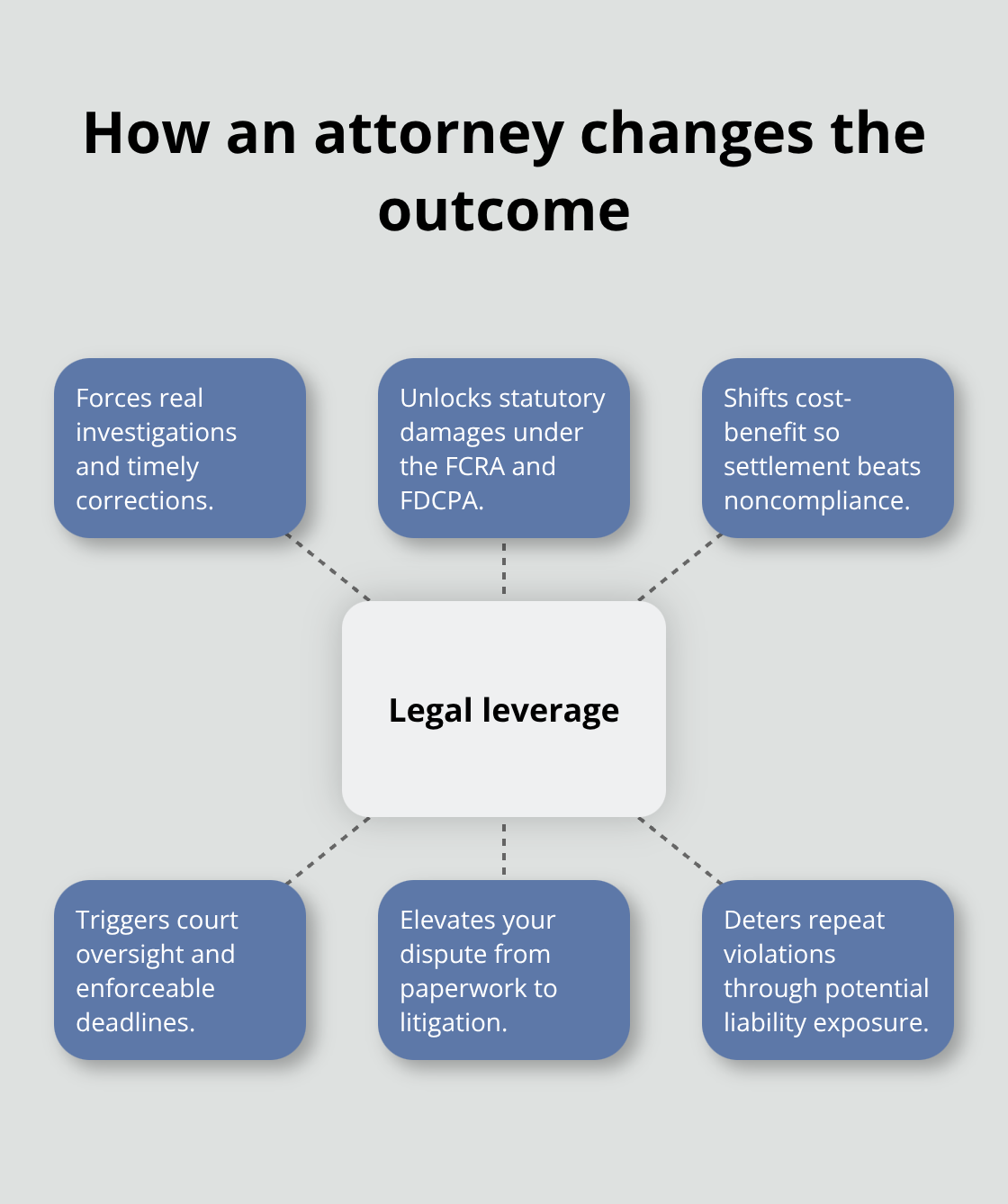
If a debt collector violates the FDCPA through threats, false statements, or harassment, you gain a direct path to compensation. Banks and creditors maintain entire legal departments to defend against these claims, but they only deploy those resources when they face actual lawsuits. Your individual dispute letter, no matter how detailed, does not trigger the same response.
An attorney shifts the power dynamic by making it clear that violations will result in court action and financial consequences. When an attorney files a complaint on your behalf, the furnisher or debt collector must respond to the court rather than ignore a consumer. The investigation becomes thorough because failure to investigate now exposes them to liability. Many credit bureau errors get corrected within weeks of receiving a demand letter from an attorney, not because the error suddenly became obvious, but because the cost-benefit calculation flipped.
Identifying Patterns of Intentional Misconduct
An attorney can identify patterns of violations that individual consumers cannot see. If a debt collector has systematically failed to investigate disputes or reported false information across multiple accounts, that pattern becomes evidence of intentional wrongdoing rather than a one-off mistake. This distinction matters because it can multiply your damages and demonstrate that the violation was deliberate. Courts award attorney fees in FCRA and FDCPA cases, which means you recover your legal costs when you win.
Accessing Discovery and Internal Evidence
You gain access to discovery, allowing your attorney to obtain internal communications showing how the credit bureau or debt collector handles disputes and what they knew about the inaccuracy. These documents often reveal negligence or intentional misconduct that would never surface in a DIY dispute process. Without legal representation, you remain at the mercy of companies that profit from inaccurate information staying on your report. This is precisely why the next step-understanding what damages you can actually recover-matters so much to your financial recovery.
What a Credit Repair Attorney Can Recover for You
Statutory Damages Under the FCRA and FDCPA
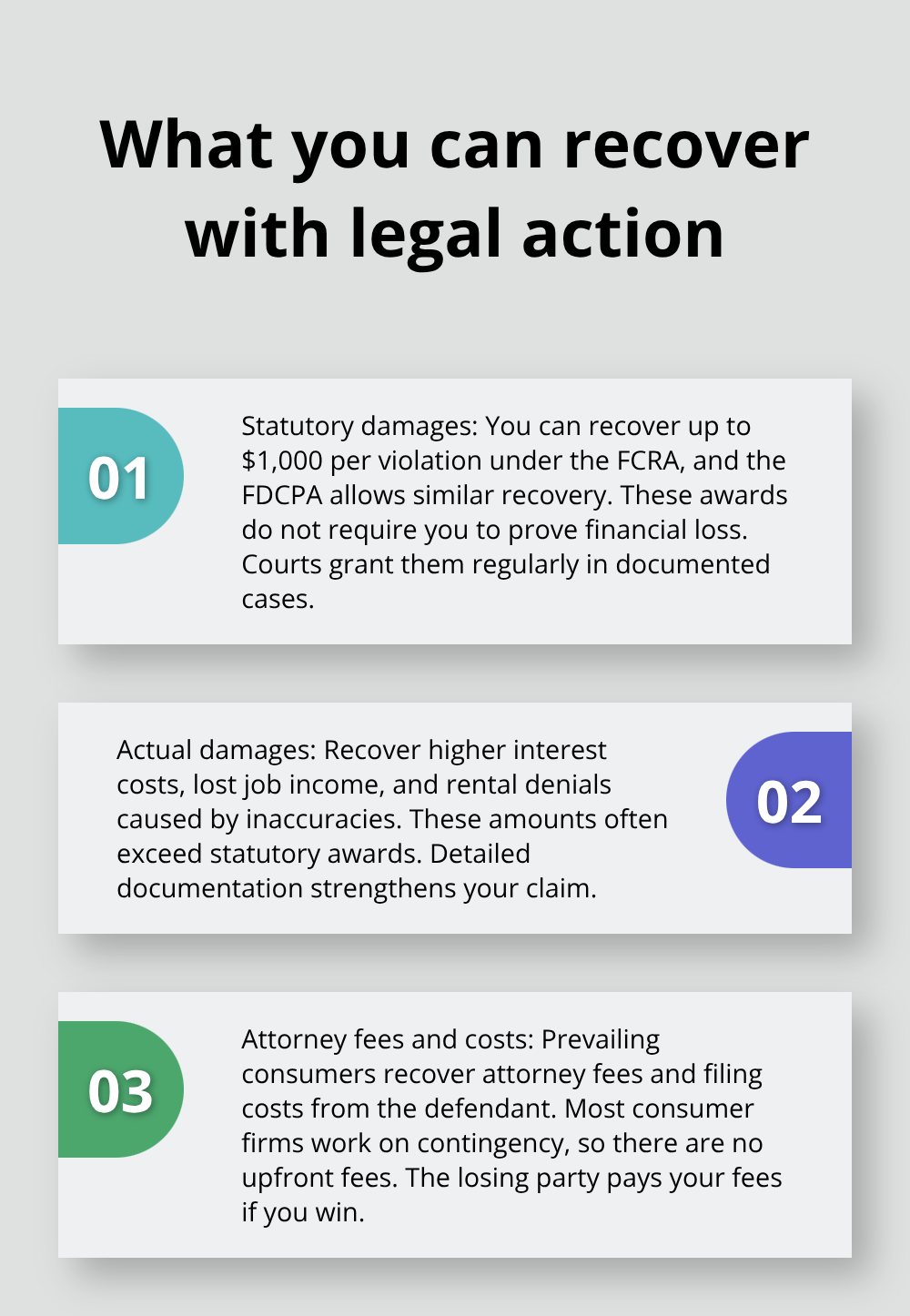
The Fair Credit Reporting Act allows you to recover statutory damages of up to $1,000 per violation, meaning each inaccurate item on your report or each failure by a credit bureau to investigate your dispute properly translates into potential compensation. If a debt collector violates the Fair Debt Collection Practices Act through false statements, threats, or harassment, you gain the right to recover damages as well. These aren’t theoretical numbers-courts award them regularly. In one case documented by the Federal Trade Commission, a consumer recovered $4,500 in statutory damages from a credit bureau that failed to investigate a dispute within the required 30-day window. The key distinction is that you don’t need to prove you lost money from the reporting error to recover statutory damages. The violation itself constitutes the harm.
Actual Damages for Real Financial Harm
Actual damages matter significantly and often exceed statutory awards. If an inaccurate credit report caused you to pay a higher interest rate on a mortgage, lose a job opportunity, or face denial of a rental application, you can recover those real financial losses on top of statutory damages. A higher interest rate of just 1 percent on a $300,000 mortgage costs you roughly $3,000 per year over the life of the loan. A denied job opportunity might represent tens of thousands in lost income. These actual damages frequently surpass the statutory damages significantly, which is why documenting the financial impact of the reporting error matters. Courts recognize that inaccurate credit information inflicts tangible financial harm that extends far beyond the violation itself.
Attorney Fees and Court Costs
Attorney fees and court costs shift the entire economics of fighting back. Under both the FCRA and FDCPA, the prevailing party-that’s you, if you win-recovers attorney fees from the defendant. This means you don’t pay out of pocket for legal representation in most cases. Consumer protection firms handle these cases on a contingency basis, meaning you pay nothing unless recovery occurs. The credit bureau or debt collector pays your attorney fees as part of the judgment. This removes the financial barrier that keeps most people from pursuing legal action. Court costs in California typically range from $300 to $500 for filing fees, but again, the defendant covers these costs when you prevail.
The Fair Credit Reporting Act was written specifically to make it economically viable for individuals to sue-the fee-shifting provision exists because Congress recognized that without it, companies would ignore consumer rights with impunity.
Final Thoughts
Credit reporting errors will not fix themselves, and waiting only compounds the damage to your financial life. You now understand that disputing errors on your own rarely works because credit bureaus and debt collectors treat consumer complaints as routine paperwork with minimal consequences for ignoring them. The Fair Credit Reporting Act exists specifically to give you legal remedies that go far beyond the DIY dispute process, but accessing those remedies requires you to take action.
A California credit repair attorney transforms your situation by shifting the power dynamic immediately. When an attorney files a lawsuit, furnishers and credit bureaus must respond to the court rather than ignore your letters, and they investigate thoroughly because violations now carry real financial consequences. You recover statutory damages of up to $1,000 per violation, actual damages for real financial harm like higher interest rates or lost job opportunities, and attorney fees paid by the defendant-meaning you fight back without paying out of pocket.
We at Bontrager Law represent individuals across California in disputes over credit reporting errors, identity theft, and unlawful debt collection against banks, collectors, and large corporations. Contact Bontrager Law for a free case review to evaluate your credit reporting violations, understand what damages you can recover, and learn your path forward. Don’t let inaccurate information on your credit report continue destroying your financial opportunities.