
The FCRA method of verification is one of the most useful and least used tools a California consumer has after a credit report dispute comes back “verified.” When a credit bureau tells you an item you challenged is accurate, the federal Fair Credit Reporting Act gives you the right to ask how the bureau reached that conclusion and who it contacted. That description can reveal whether the reinvestigation was a real review of your evidence or a quick confirmation that changed nothing.
At Bontrager Law, we represent individuals across California in disputes over inaccurate credit reporting so you can move forward with a clearer file and a practical plan. This guide explains what the method of verification actually is under federal and California law, how to request it and use the answer, and the mistakes that commonly leave inaccurate information sitting on a credit report after a dispute.
What the FCRA Method of Verification Actually Is
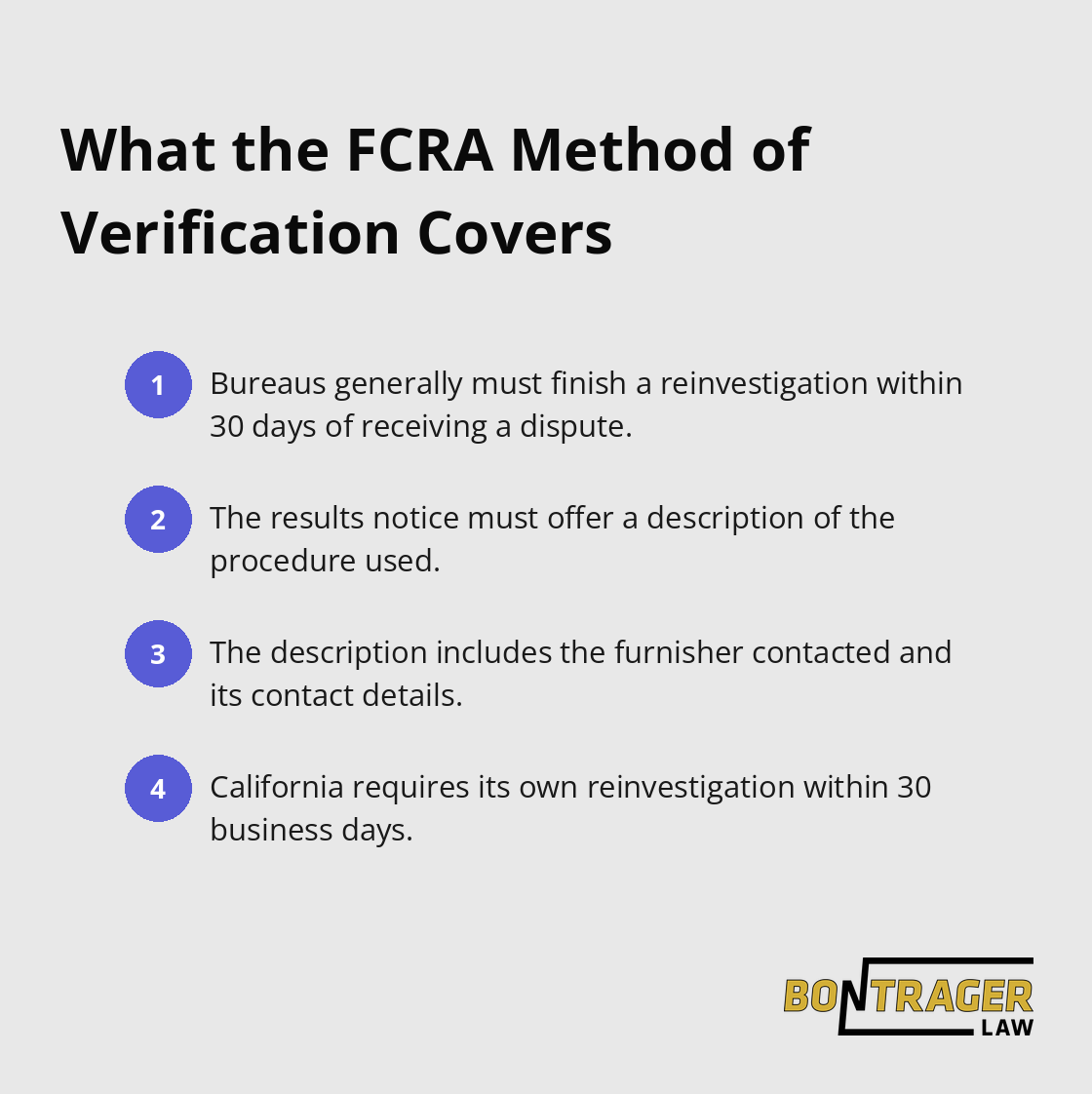
The phrase “method of verification” does not appear as a heading in the statute, but the right behind it is written directly into 15 U.S.C. section 1681i, the FCRA’s reinvestigation section. When you dispute the completeness or accuracy of an item in your file and notify the consumer reporting agency, the agency must conduct a reasonable reinvestigation and record the current status of the information, or delete it, before the end of the 30-day period that begins when the agency receives your dispute. That period may be extended by up to 15 additional days if you send relevant information during the first 30 days. Once the reinvestigation is complete, the law requires the agency to tell you about the procedure it used.
The Results Notice Must Tell You About the Procedure
Under section 1681i(a)(6), a consumer reporting agency must give you written notice of the results of a reinvestigation no later than 5 business days after it is completed. As part of that notice, the agency must include a statement that the reinvestigation is completed, a consumer report based on your file as revised, and a notice that, if you request it, the agency will provide a description of the procedure used to determine the accuracy and completeness of the information. That description must include the business name and address of any furnisher of information contacted and the furnisher’s telephone number, if reasonably available. The results notice must also tell you about your right to add a statement to your file and your right to request notifications to recent report recipients.
The Fifteen-Day Window for the Description
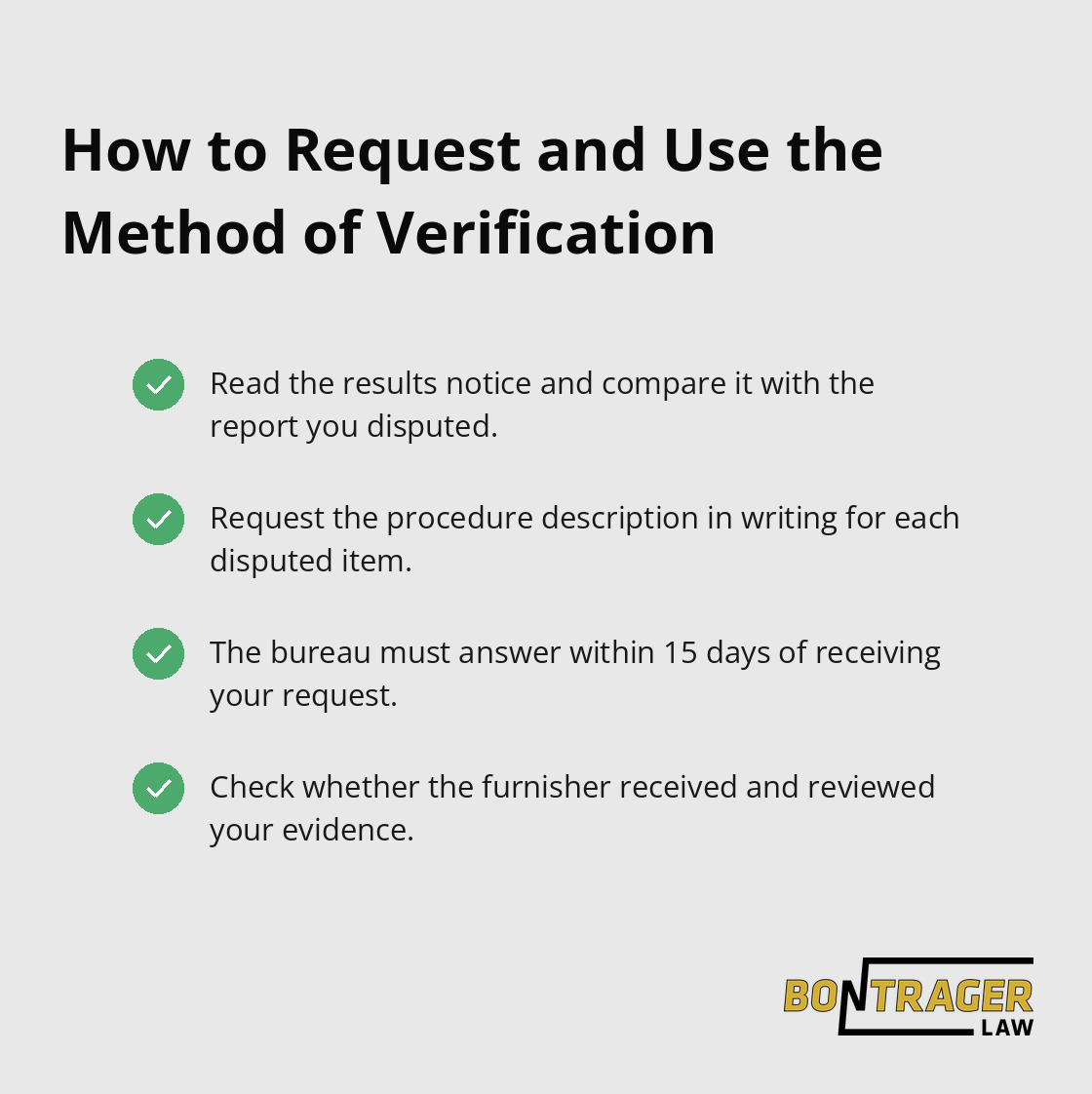
Section 1681i(a)(7) sets a firm timeline for the answer. A consumer reporting agency must provide the description of the reinvestigation procedure no later than 15 days after receiving your request. That short deadline matters because the description often tells you whether the bureau simply forwarded your dispute to the creditor and accepted the reply, or whether it actually considered the documents you supplied. Keeping a dated copy of your request makes it easy to show when the clock started.
California’s Parallel Rule in Civil Code Section 1785.16
California’s Consumer Credit Reporting Agencies Act contains its own version of these protections. Civil Code section 1785.16(a) requires a consumer credit reporting agency to reinvestigate and record the current status of disputed information before the end of the 30-business-day period that begins when it receives notice of the dispute. Under section 1785.16(d), the results notice must include a description of any changes made, a description of changes you sought that were not made with an explanation why, and a notice that, if you request it, the agency will describe the procedure used, including the name, business address, and telephone number of any furnisher contacted. The agency must provide that description no later than 15 days after receiving your request.
How to Request and Use the Method of Verification
A method of verification request works best when it is part of an organized dispute record rather than a one-line letter sent in frustration. The goal is to learn exactly what happened during the reinvestigation so you can decide whether to dispute again, add a statement, or take further action. California consumers who keep every notice, envelope, and response in one place are in a much stronger position at this stage.
Read the Results Notice Carefully
Start with the results notice itself. Compare the revised report the bureau sent with the report you disputed, and note any item that was marked verified, updated, or deleted. Under California Civil Code section 1785.16(d), the notice should also describe changes made and changes you sought that were not made, along with an explanation. If the explanation is missing or does not match the item you disputed, that gap is worth documenting before you send your request for the procedure description.
Send a Written Request That Identifies Each Item
Your request should identify each disputed account or entry and ask for the description of the procedure used to determine its accuracy and completeness, including the furnisher contacted. Sending it in writing, by a method that creates a delivery record, gives you proof of the date the agency received it, which starts the 15-day response window under 15 U.S.C. section 1681i(a)(7) and California Civil Code section 1785.16(d). If you disputed several items, ask about each one specifically so the response cannot gloss over any of them.
Compare the Description With What the Furnisher Was Told
The FCRA builds the furnisher into the reinvestigation. Under section 1681i(a)(2), the agency must notify the person who provided the disputed information within 5 business days of receiving your dispute and include all relevant information it received from you. Under 15 U.S.C. section 1681s-2(b), a furnisher that receives that notice must conduct an investigation, review all relevant information the agency provided, report the results to the agency, and, if the information is inaccurate or incomplete, report those results to the nationwide consumer reporting agencies it furnished. When the method of verification shows that your supporting documents never reached the furnisher, or that the furnisher simply confirmed the same data, you have a clearer picture of where the process broke down.
What Commonly Derails a Method of Verification Request
Many consumers stop after the first dispute result, even when the response raises more questions than it answers. Others send disputes that are too vague to investigate. Avoiding the mistakes below keeps your options open and builds the record you may need later.
Treating “Verified” as the End of the Road
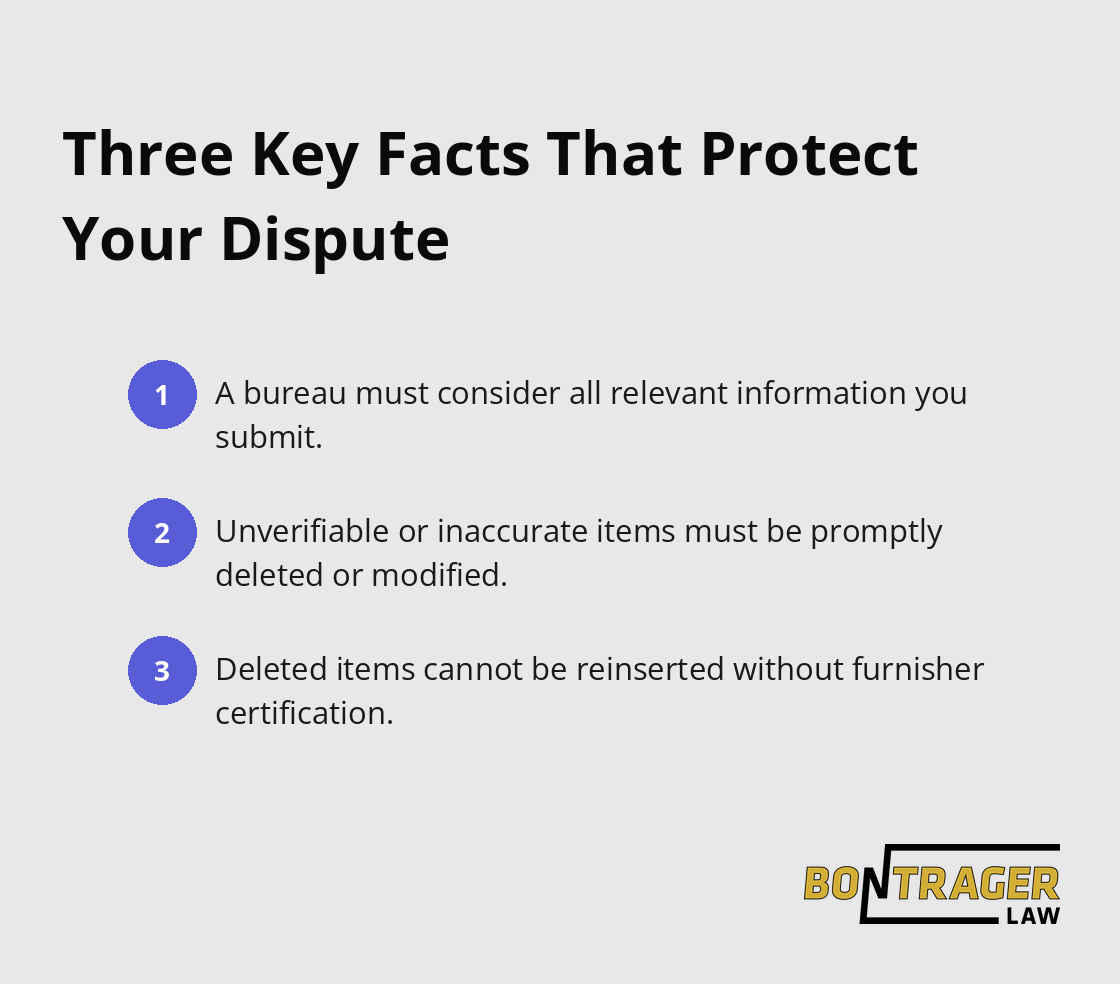
A verified result is not the same as an accurate one. Section 1681i(a)(4) requires the agency to review and consider all relevant information you submitted, and section 1681i(a)(5) requires it to promptly delete or modify an item that is found to be inaccurate or incomplete or that cannot be verified. Requesting the method of verification is how you test whether those duties were actually carried out. If the description shows the bureau never considered your evidence, a renewed dispute that points to that gap is often the logical next step.
Sending a Vague Dispute the Bureau Can Call Frivolous
Under section 1681i(a)(3), an agency may terminate a reinvestigation if it reasonably determines that a dispute is frivolous or irrelevant, including when the consumer fails to provide enough information to investigate. If it does, it must notify you within 5 business days, state its reasons, and identify the information it needs. California adds an important protection in Civil Code section 1785.16(e): the presence of information in your file that contradicts your position does not, by itself, make a dispute frivolous or irrelevant. Specific disputes with account details and supporting documents are much harder to dismiss.
Missing a Deleted Item That Quietly Comes Back
Winning a dispute does not always end the problem. Under section 1681i(a)(5)(B), information deleted after a reinvestigation may not be reinserted unless the furnisher certifies that it is complete and accurate, and the agency must notify you in writing of any reinsertion no later than 5 business days afterward. That notice must include a statement that the information was reinserted, the business name and address of the furnisher involved, its telephone number if reasonably available, and a notice of your right to add a statement disputing the information. Section 1681i(a)(5)(C) also requires the agency to maintain reasonable procedures to prevent deleted information from reappearing. Checking your reports again a few months after a successful dispute helps you catch a reinsertion early.
Forgetting the Statement of Dispute and Notification Rights
If the reinvestigation does not resolve the dispute, section 1681i(b) allows you to file a brief statement setting out the nature of the dispute, and section 1681i(c) requires later reports containing the item to note that you dispute it, unless there are reasonable grounds to believe the statement is frivolous or irrelevant. Section 1681i(d) also allows you to ask the agency to send notice of a deletion or your statement to anyone you designate who received a report for employment purposes within the prior two years, or for any other purpose within the prior six months. California’s section 1785.16(h) extends the non-employment look-back to 12 months. These rights are easy to overlook, but they can matter when a landlord, lender, or employer has already seen the error.
Final Thoughts
The FCRA method of verification gives California consumers a way to look behind a “verified” dispute result. Federal law in 15 U.S.C. section 1681i requires the bureau to describe its reinvestigation procedure within 15 days of your request, section 1681s-2(b) sets out what the furnisher must do after notice of a dispute, and California Civil Code section 1785.16 adds parallel state protections.
Using these rules well means keeping a complete dispute record, asking specific questions about each item, and comparing the answer with the evidence you submitted. That approach turns a frustrating dispute result into useful information about what to do next.
If a credit bureau verified information you believe is wrong and you need help understanding your options, contact Bontrager Law to speak with our team. We will review your dispute history, explain how the FCRA and California credit reporting rules may apply, and help you take a practical next step.