
A mixed credit file in California can make you look responsible for debts you never opened, collections you never received, and late payments that belong to someone else entirely. It usually happens quietly. A credit bureau’s matching system decides that another person’s records belong in your file, often because you share a similar name, a family relationship, an old address, or a Social Security number that differs by a digit or two. The result can be a denied loan, a rejected rental application, or a credit score that suddenly makes no sense.
At Bontrager Law, we represent individuals across California in disputes over inaccurate credit reporting so you can move forward with a file that reflects your own history. This guide explains what a mixed file actually is, how to dispute one under federal and California law, and the mistakes that allow another person’s information to keep coming back.
What a Mixed Credit File Actually Is
A mixed file occurs when a consumer reporting agency combines information about two or more different people into one consumer’s file. Unlike identity theft, nobody has necessarily used your information to open an account. Instead, the bureau’s own process has attached someone else’s accounts, inquiries, addresses, or public records to you. Because the information is genuine for the other person, it can look completely legitimate to a lender reviewing your report, which is exactly why mixed files are so damaging and so frustrating to fix.
Federal law addresses this problem directly. Under 15 U.S.C. section 1681e(b), whenever a consumer reporting agency prepares a consumer report, it must follow reasonable procedures to assure maximum possible accuracy of the information concerning the individual about whom the report relates. California’s Consumer Credit Reporting Agencies Act contains the same accuracy standard in Civil Code section 1785.14(b). Information that belongs to a different person is not accurate information about you, no matter how accurate it may be about them.
How Files Get Mixed Together
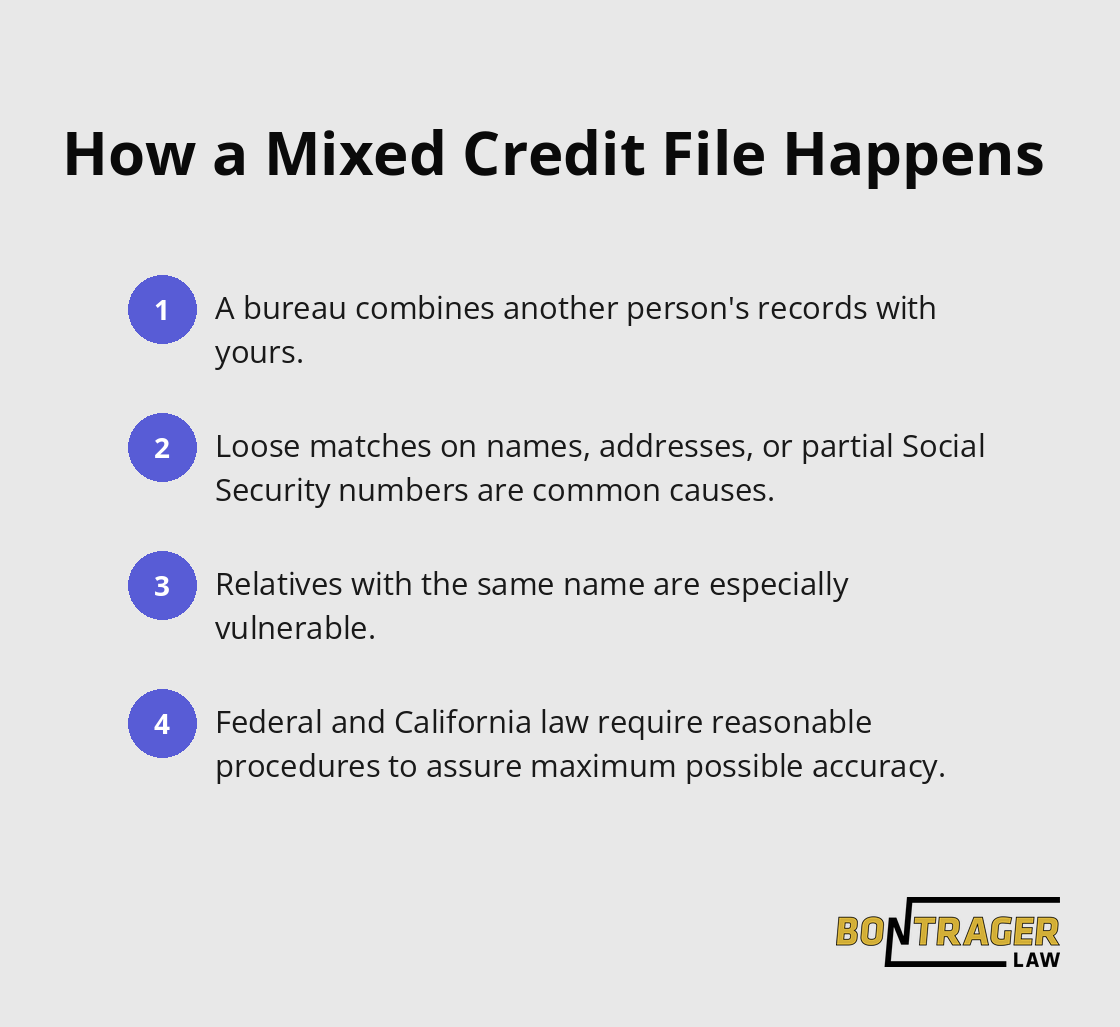
Mixed files usually trace back to how bureaus match incoming data to existing files. When a creditor reports an account, the bureau has to decide which consumer the account belongs to, and a loose match on a name, partial Social Security number, or address can send the account to the wrong person. Family members with the same name, such as a parent and child who share a name and once shared a home, are especially vulnerable. People with common surnames and people who have moved often can also find their records blended with a stranger’s.
Warning Signs in Your Report
The clues are often subtle at first. You may notice addresses where you never lived, employers you never worked for, name variations you have never used, or hard inquiries from lenders you never contacted. Accounts you do not recognize, especially collections or charge-offs, are another red flag. Federal law under 15 U.S.C. section 1681g requires a consumer reporting agency, upon request, to clearly and accurately disclose all information in the consumer’s file at the time of the request, so reviewing each bureau’s report closely is the first step.
Why California’s Identification Rules Matter
California law adds a useful protection when a file needs to be untangled. Civil Code section 1785.14(b) requires the bureau’s reasonable accuracy procedures to include permanent retention of the identifying data it used to identify the individual consumer, and it makes that retained data available for use in a reinvestigation or a restoration of a file. In a mixed file case, that identifying information can help show exactly where the bureau went wrong and which records belong to someone else.
How to Dispute a Mixed File Under Federal and California Law
Disputing a mixed file requires more than clicking a box that says an account is not yours. Because the bureau believes the information is accurate, your dispute needs to explain clearly that the information belongs to a different person and give the bureau what it needs to separate the records. A careful, documented approach also builds the record you may need if the bureau fails to fix the problem.
Building a Clear Written Dispute
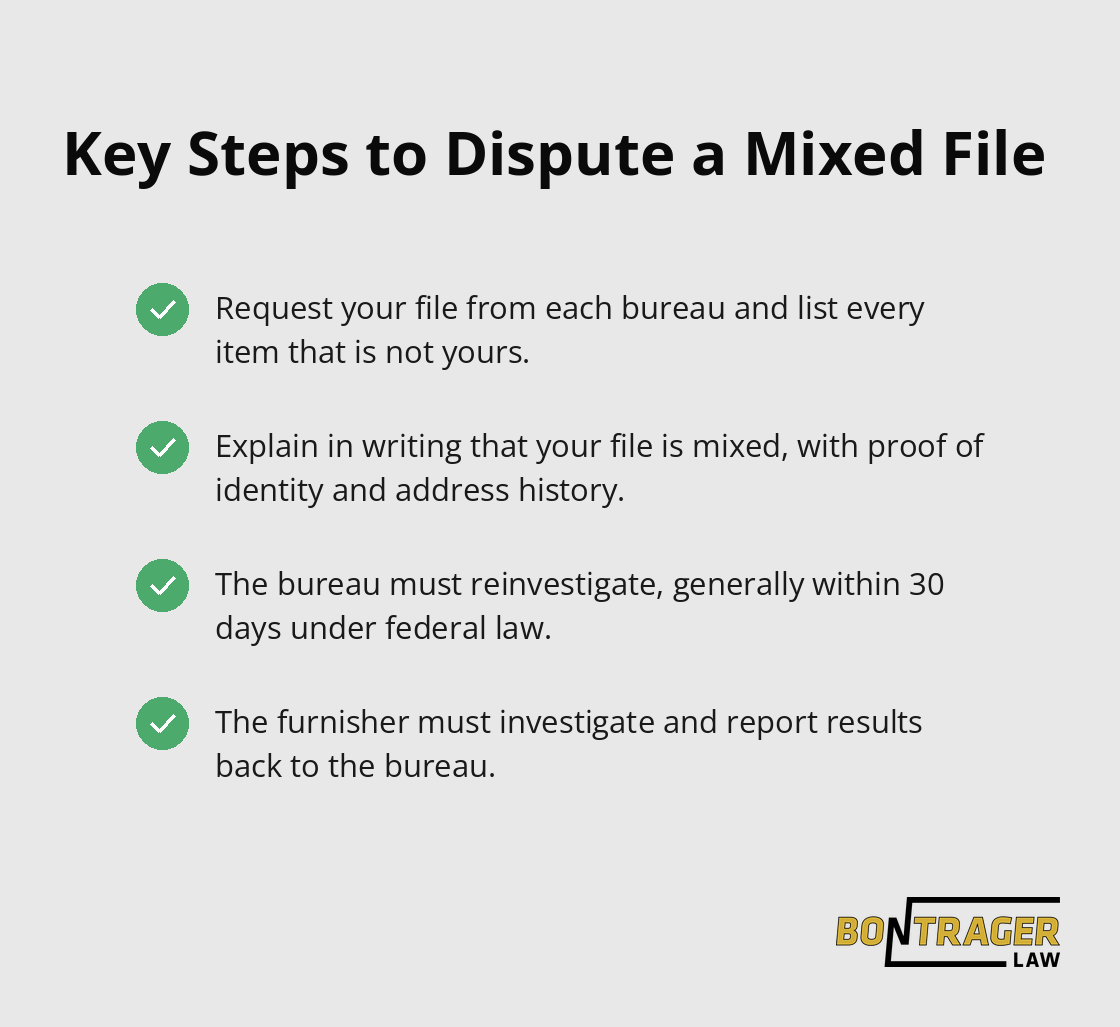
Start by listing every item that does not belong to you, including accounts, inquiries, addresses, names, and employers. Explain that you believe your file has been mixed with another person’s, and include copies of identification and proof of your own address history so the bureau can compare. Keep copies of everything you send along with proof of mailing. California Civil Code section 1785.16(b) requires the bureau to review and consider all relevant information you submit with your dispute, so a complete package matters.
What the Bureau Must Do After Your Dispute
Under 15 U.S.C. section 1681i(a)(1), when you dispute the completeness or accuracy of an item, the consumer reporting agency must conduct a reasonable reinvestigation before the end of the 30-day period beginning on the date it receives your dispute. That period can be extended by up to 15 additional days if you provide relevant information during the initial 30 days. Within five business days of receiving your dispute, the bureau must notify the company that furnished the information. If an item is found to be inaccurate or incomplete, or cannot be verified, the bureau must promptly delete or modify it. California’s Civil Code section 1785.16 sets its own reinvestigation timeline measured in business days and also requires the bureau to correct or delete information found to be inaccurate.
The Furnisher’s Role in the Investigation
The creditor or collector that reported the account has duties too. Under 15 U.S.C. section 1681s-2(b), after receiving notice of a dispute from a consumer reporting agency, the furnisher must conduct an investigation, review all relevant information the agency provided, and report the results back to the agency. When the furnisher’s records show a different date of birth, address, or Social Security number than yours, that mismatch is strong evidence that the account was never yours. Once the reinvestigation is complete, the bureau must send you written notice of the results within five business days under section 1681i(a)(6).
Mistakes That Keep a Mixed File From Being Fixed
Mixed files have a way of coming back. Information is removed, then reappears months later when a creditor reports again or when the bureau’s matching system pulls the two files together once more. Understanding the most common missteps makes it easier to get a lasting fix rather than a temporary one.
Disputing Items One at a Time
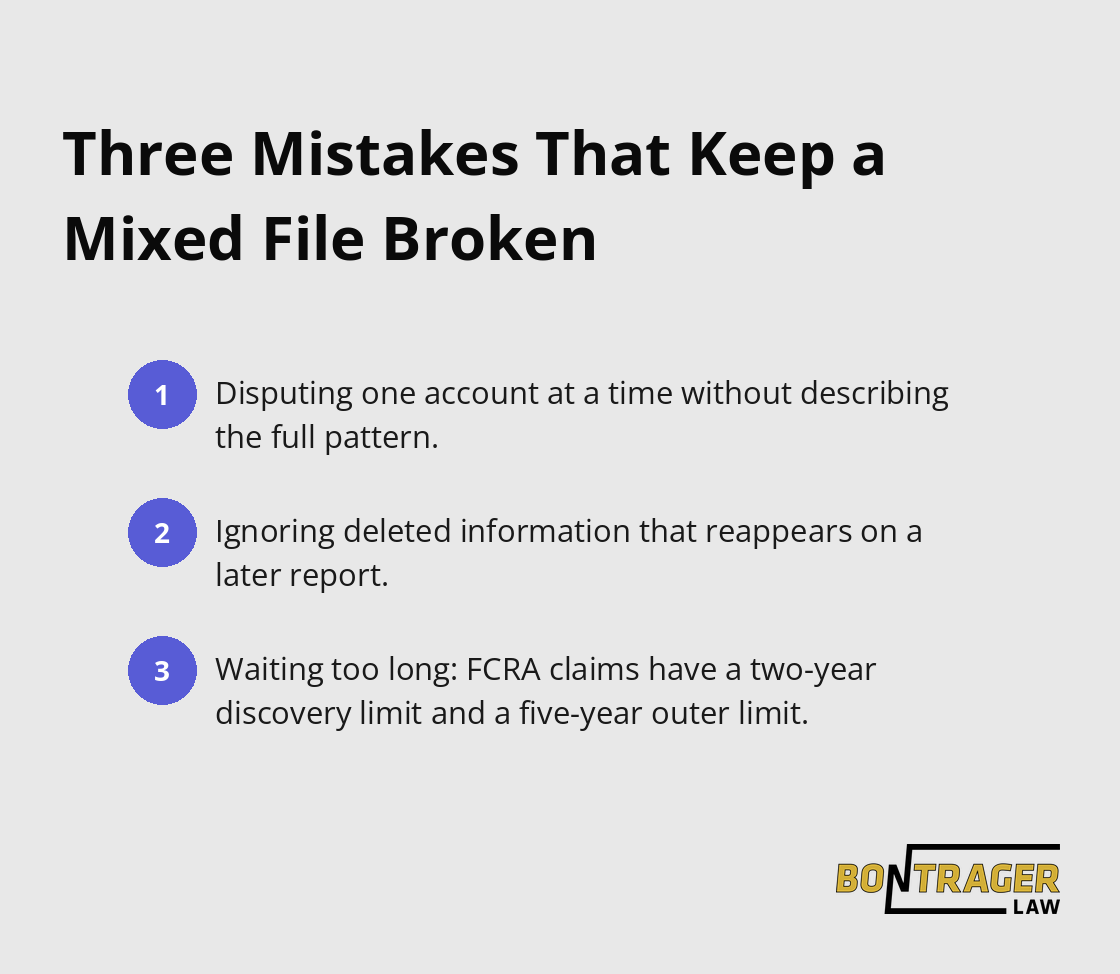
When people dispute a single unfamiliar account without explaining that their file is mixed, the bureau may treat it as an isolated error. It may verify the account with the furnisher, who confirms that the debt is real, without ever addressing whether it belongs to you. Describing the full pattern, including the wrong addresses, names, and identifiers, gives the bureau a much better chance of seeing the problem for what it is and separating the files.
Ignoring Reinserted Information
Deleted information is not supposed to quietly return. Federal law under 15 U.S.C. section 1681i(a)(5)(B) provides that deleted information may not be reinserted unless the furnisher certifies that it is complete and accurate, and the bureau must notify you of any reinsertion. California Civil Code section 1785.16(c) contains a similar rule, and section 1785.16(i) requires bureaus to maintain reasonable procedures to prevent deleted information from reappearing. If another person’s account shows up again after you won a dispute, keep that new report. It may be important evidence.
Waiting Too Long to Act
The Fair Credit Reporting Act allows consumers to bring claims when a bureau or furnisher fails to follow the law. Under 15 U.S.C. sections 1681n and 1681o, a person who willfully or negligently fails to comply can be liable to the consumer for damages. Those claims have deadlines. Under section 1681p, an action must be brought by the earlier of two years after you discover the violation or five years after the violation occurs. Waiting while a mixed file damages your credit can shorten the window you have to hold the responsible companies accountable.
Final Thoughts
A mixed credit file in California is not your fault, but fixing it often falls on you. Federal and state law require bureaus to follow reasonable procedures to report accurate information about the right person, to reinvestigate disputes, and to keep deleted information from coming back. A clear, documented dispute that explains the full pattern is the best way to separate your file from someone else’s.
If you have already disputed and the wrong information keeps returning, it may be time to look at your options more closely. You may also find it helpful to read about the FCRA method of verification and what to ask after a bureau responds to your dispute.
If another person’s debts are showing up on your credit report, contact Bontrager Law to speak with our team about your mixed file. We’ll review your reports, explain your rights under federal and California law, and help you take the next step toward a credit file that reflects your own history.