
A California FCRA lawsuit is often the last step for consumers who have disputed a credit report error, waited for a correction, and watched the same inaccurate account keep damaging their file. Many people do not realize that the Fair Credit Reporting Act and California’s own credit reporting statute give consumers the right to bring a claim in court, or that those rights come with firm deadlines. Waiting too long, skipping key dispute steps, or naming the wrong company can end a strong case before it begins. Understanding how these claims work gives you real control over the next move instead of leaving the outcome to the credit bureaus.
At Bontrager Law, we help consumers across California hold credit bureaus and the companies that furnish information accountable under the Fair Credit Reporting Act so you can move forward with confidence. This guide explains how an FCRA lawsuit actually works, the deadlines that control when you can file, and the mistakes that most often derail a claim.
How a California FCRA Lawsuit Actually Works
The Fair Credit Reporting Act is a federal law, but California consumers can also rely on the state’s Consumer Credit Reporting Agencies Act, found in the Civil Code starting at Section 1785.1. The two laws overlap in many areas, and a single credit reporting problem can give rise to claims under both. Knowing which rules apply, and to which company, shapes the entire case.
Federal Claims for Negligent and Willful Violations
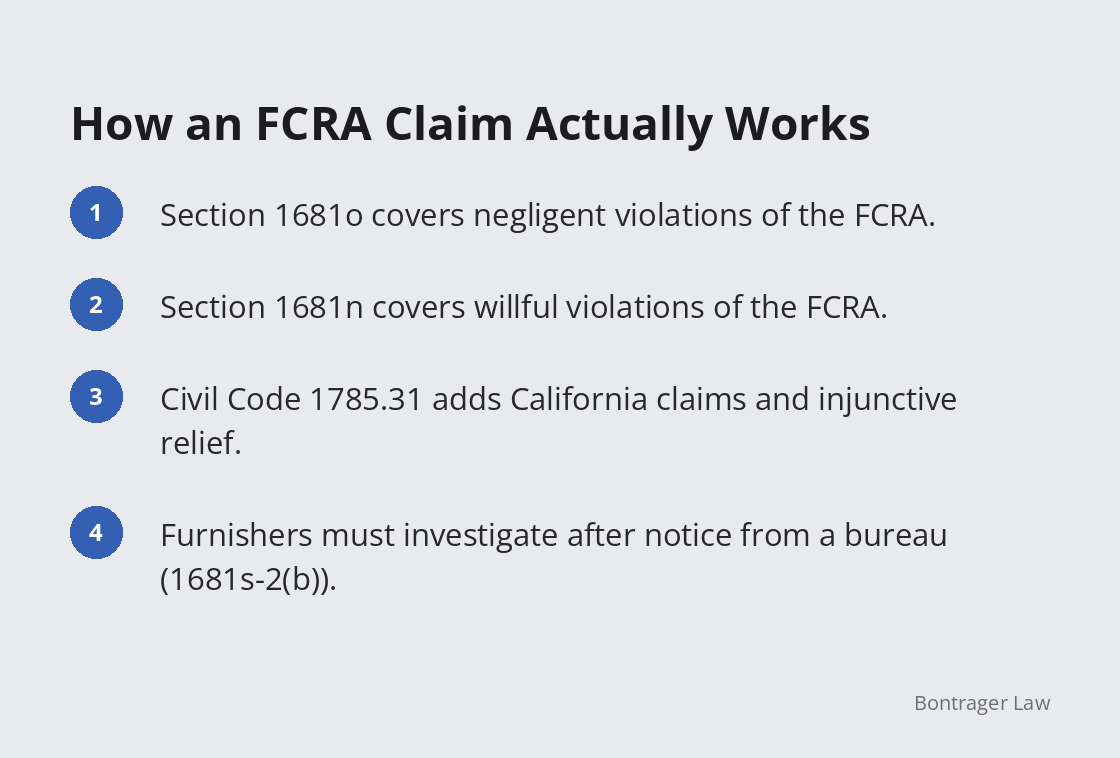
The FCRA creates two main paths for a consumer to hold a company responsible. Under 15 U.S.C. Section 1681o, any person who is negligent in failing to comply with a requirement of the Act with respect to a consumer is liable to that consumer for the actual damages caused by the failure. Under Section 1681n, any person who willfully fails to comply is liable to the consumer as well, and the statute makes additional remedies available when the violation is willful. Whether a violation was negligent or willful often becomes a central question in the case, so the facts showing how a company handled your dispute matter a great deal.
In real cases, the harm connected to a credit reporting violation can take many forms. Consumers describe being turned down for a mortgage, an auto loan, a rental, or a job, spending months writing letters and making calls, and dealing with the stress of watching an account they never opened or already resolved stay on their file. Documenting that harm as it happens, rather than trying to reconstruct it later, helps show the connection between the company’s conduct and the problems you experienced.
California’s Own Credit Reporting Law
California Civil Code Section 1785.31 allows any consumer who suffers damages as a result of a violation of the Consumer Credit Reporting Agencies Act to bring an action in a court of appropriate jurisdiction against the person responsible. Like the federal law, the California statute distinguishes between negligent and willful violations. Section 1785.31(b) also makes injunctive relief available to any consumer aggrieved by a violation or threatened violation, whether or not the consumer seeks any other remedy, which can matter when your main goal is to stop an error from being reported again.
Who Can Be Named in the Case
Credit bureaus are the most common defendants. Section 1681e(b) requires a consumer reporting agency to follow reasonable procedures to assure maximum possible accuracy of the information in a consumer report, and Section 1681i requires a reasonable reinvestigation when you dispute an item. Furnishers, such as banks, lenders, and collectors, can also be responsible, but the route matters. Under Section 1681s-2(b), a furnisher must investigate after receiving notice of your dispute from a credit bureau. Section 1681s-2(c), however, provides that the federal private liability provisions do not apply to violations of the furnisher accuracy duties in Section 1681s-2(a), which are enforced by government agencies and officials instead.
FCRA Lawsuit Deadlines in California
Every credit reporting claim has a clock. Missing the deadline can bar a claim no matter how clear the error, so identifying the right dates early is one of the most important steps in any case.
The Federal Two-Year and Five-Year Limits
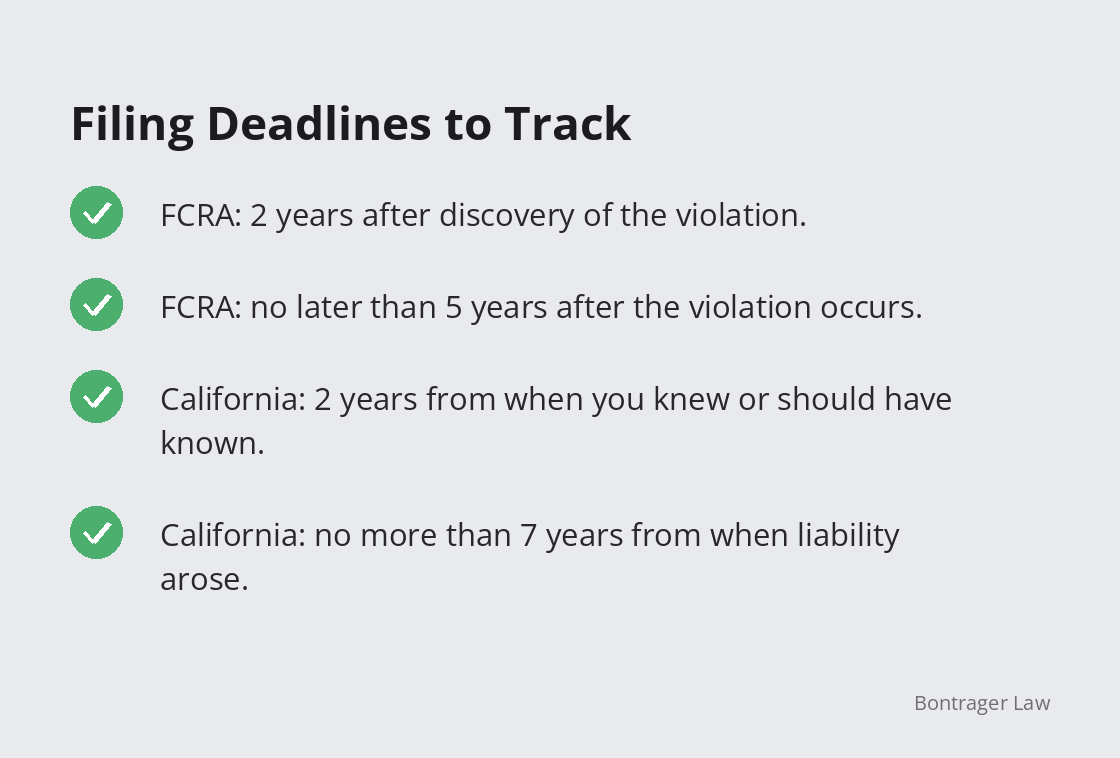
Under 15 U.S.C. Section 1681p, an action to enforce liability under the FCRA must be brought not later than the earlier of two years after the date the plaintiff discovers the violation, or five years after the date on which the violation occurs. The discovery rule can help consumers who did not learn about an error right away, but the five-year outer limit applies regardless of when you found the problem. Because each new inaccurate report or mishandled dispute can raise its own questions about timing, it is wise to note the date you first saw the error and the dates of every dispute and response.
California’s Two-Year and Seven-Year Limits
California Civil Code Section 1785.33 sets a separate deadline for claims under the state law. An action may be brought within two years from the date the plaintiff knew of, or should have known of, the violation, but not more than seven years from the earliest date on which liability could have arisen. The statute adds an exception: when a defendant has materially and willfully misrepresented information that the law requires it to disclose to the consumer, and that information is material to establishing liability, the action may be brought within two years after the consumer discovers the misrepresentation.
Where the Case Can Be Filed
Section 1681p also addresses the forum. An FCRA claim may be brought in any appropriate United States district court or in any other court of competent jurisdiction. California’s statute similarly allows an action in any appropriate court of competent jurisdiction. In practice, the choice between federal and state court depends on the claims involved, the defendants, and strategic considerations that an attorney can review with you before anything is filed.
Timing also affects strategy. If you are still in the middle of a dispute, it may make sense to complete the process and see how the bureau and furnisher respond before deciding whether to file. If the deadline is approaching, however, waiting for one more round of letters can be risky. An attorney can map out the relevant dates under both the federal and California statutes and help you decide whether to continue disputing, send a demand, or file a claim to protect your rights before the window closes.
What Derails an FCRA Lawsuit Before It Starts
Many credit reporting claims are weakened long before a complaint is filed. The most common problems involve skipped steps, missing records, and assumptions about which legal theories apply.
Skipping the Credit Bureau Dispute
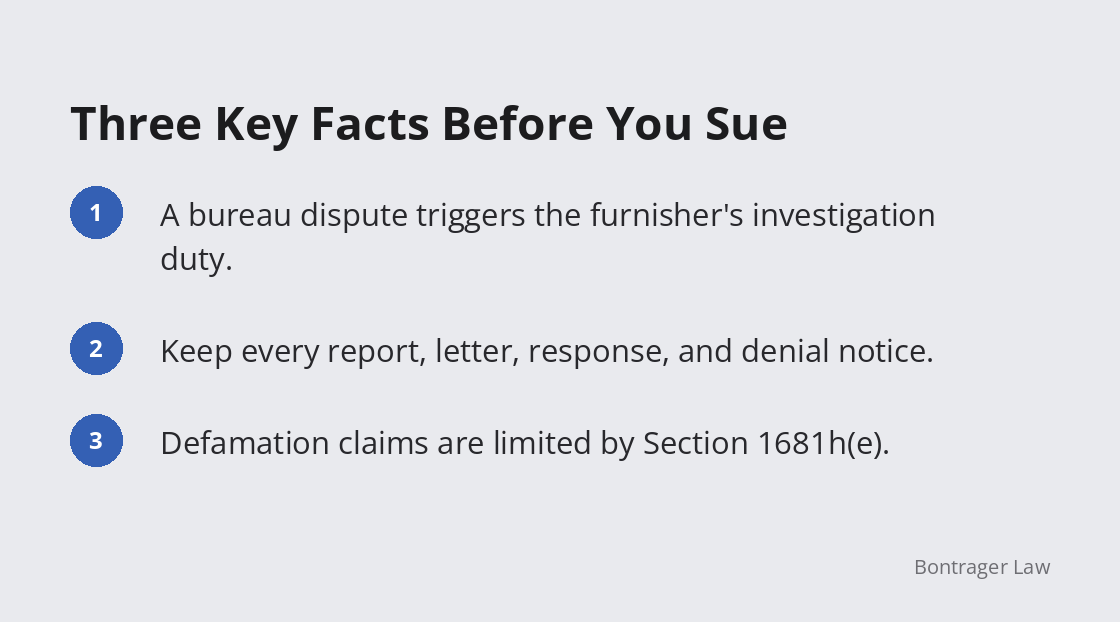
Disputing directly with the credit bureau is often what opens the door to a claim. Under Section 1681i(a)(1), when you dispute the completeness or accuracy of an item, the bureau must conduct a reasonable reinvestigation before the end of the 30-day period beginning on the date it receives your notice, and that period may be extended by up to 15 additional days in some situations when you send relevant information during the 30 days. Section 1681i(a)(2) then requires the bureau to notify the furnisher within five business days, and that notice is what triggers the furnisher’s investigation duties under Section 1681s-2(b). A direct dispute with a creditor in California can still be useful, but it does not replace the bureau dispute when you are preserving federal claims against a furnisher.
Losing the Paper Trail
Courts decide FCRA cases on evidence. Keep copies of every credit report showing the error, each dispute letter and the documents you enclosed, proof of mailing or online submission, and every response from the bureaus and furnishers. Record any credit denials, adverse action notices, or other harm connected to the inaccurate information. After a dispute comes back verified, asking how the information was checked can strengthen your record, and our guide to the FCRA method of verification in California explains that request.
Relying on the Wrong Legal Theory
Some consumers assume they can simply sue for defamation over a false credit entry. Section 1681h(e) limits that approach: except as provided in Sections 1681n and 1681o, consumers generally may not bring defamation, invasion of privacy, or negligence actions over certain reported information, except as to false information furnished with malice or willful intent to injure the consumer. That is why most credit reporting cases are built on the specific duties in the FCRA and the California statute. Combined with the filing deadlines, this makes an early case review especially valuable.
Final Thoughts
A California FCRA lawsuit can hold credit bureaus and furnishers responsible when disputes fail and errors remain on your report. The federal law allows claims for negligent and willful violations, California’s statute adds its own remedies including injunctive relief, and both laws impose deadlines that start running from discovery of the violation and cap the overall window.
The strongest cases usually share the same foundation: a documented dispute with the credit bureau, a clear record of each response, and prompt action well within the limitation periods.
If a credit reporting error is still on your file after you have disputed it, contact Bontrager Law to speak with our consumer protection team. We will review your reports and dispute history, explain your rights under the Fair Credit Reporting Act and California law, and help you decide on the right next step with confidence.