
A credit denial in California can feel confusing and personal, especially when the letter you receive is short and the reasons seem vague. Whether you applied for a car loan, a credit card, or a line of credit, federal law gives you specific rights when a lender turns you down based on information in your credit report. Those rights start with an adverse action notice, and that notice can be the key that unlocks what really went wrong. If the denial was caused by an error on your report, understanding the notice gives you a clear path to fix it.
We at Bontrager Law represent consumers across California who have been harmed by inaccurate credit reporting, so you can move forward with confidence. This guide walks you through what an adverse action notice actually is, what it must contain under the Fair Credit Reporting Act and the Equal Credit Opportunity Act, and the mistakes people make after a denial that can keep a reporting error alive.
What an Adverse Action Notice Actually Is
An adverse action notice is the message a creditor or other user of your credit information must give you when it makes a decision against you based in whole or in part on your consumer report. The Fair Credit Reporting Act, found at 15 U.S.C. 1681 and following sections, sets out these duties in Section 1681m. The Equal Credit Opportunity Act adds its own notice requirements for credit applications in 15 U.S.C. 1691(d), with detailed rules in Regulation B at 12 CFR 1002.9. Together, these laws are designed to make sure you are never left guessing why your application was refused or whose information was used to make the decision.
What Counts as Adverse Action
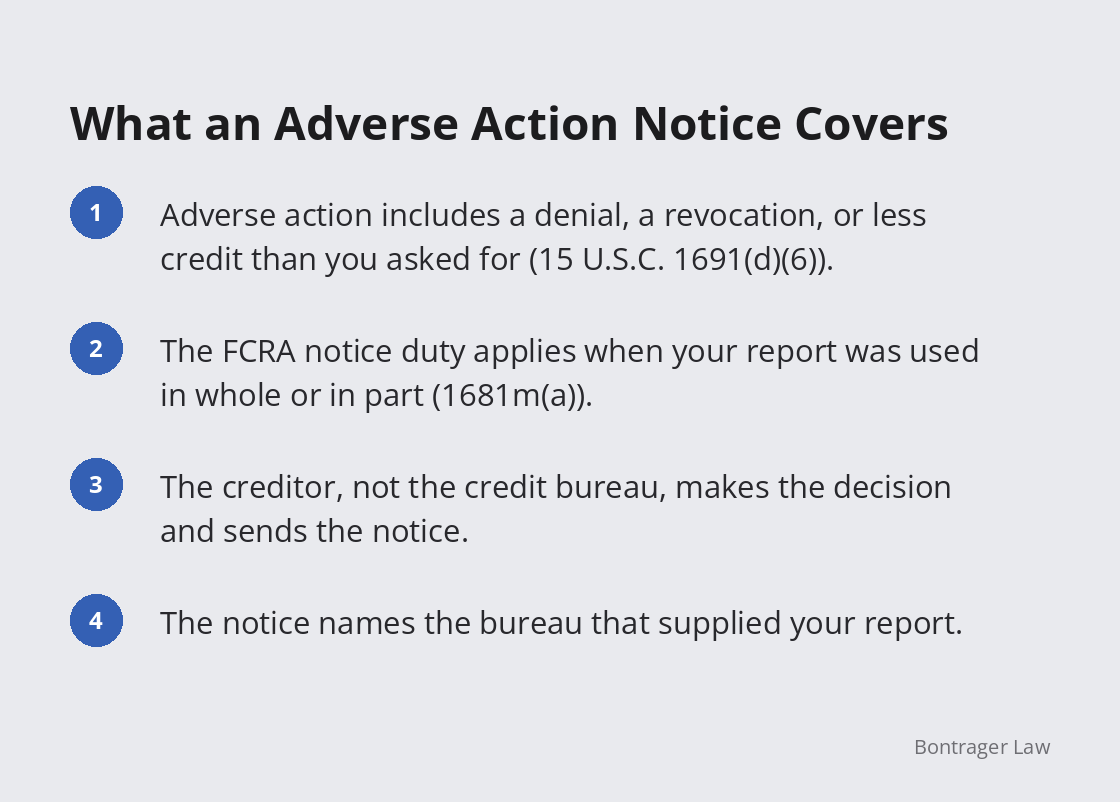
The term covers more than a flat denial. Under the Equal Credit Opportunity Act, adverse action means a denial or revocation of credit, a change in the terms of an existing credit arrangement, or a refusal to grant credit in substantially the amount or on substantially the terms requested. The Fair Credit Reporting Act adopts that definition in 15 U.S.C. 1681a(k) and extends the concept to other settings, such as certain insurance decisions, employment decisions, and decisions made in connection with an application or transaction you initiated that are adverse to your interests. So if a lender approves you only for a much smaller amount than you requested, or closes an existing account, you may still be entitled to a notice.
When the Credit Report Is the Reason
Section 1681m applies when the adverse action is based in whole or in part on information contained in a consumer report. That phrase matters. Your report does not have to be the only reason for the decision. If a single collection account, a late payment that never happened, or an account that belongs to someone else contributed to the denial, the lender’s duties under Section 1681m are triggered.
Who Must Send the Notice
The duty falls on the person or company that takes the adverse action, not on the credit bureau. In a typical credit application, that means the bank, credit union, auto lender, or card issuer that reviewed your file. The notice must identify the consumer reporting agency that furnished the report, and it must include a statement that the agency did not make the decision and cannot tell you the specific reasons for it. That statement is a reminder that the bureau’s role is to supply information, while the creditor is responsible for the decision itself.
How to Use Your Adverse Action Rights
Receiving a denial notice is the start of a process, not the end of one. The information required in the notice gives you the tools to see your report, request the creditor’s reasons, and dispute any errors with the credit bureau. Taking these steps promptly can protect your rights and shorten the time it takes to correct an inaccurate file.
Read Every Required Disclosure
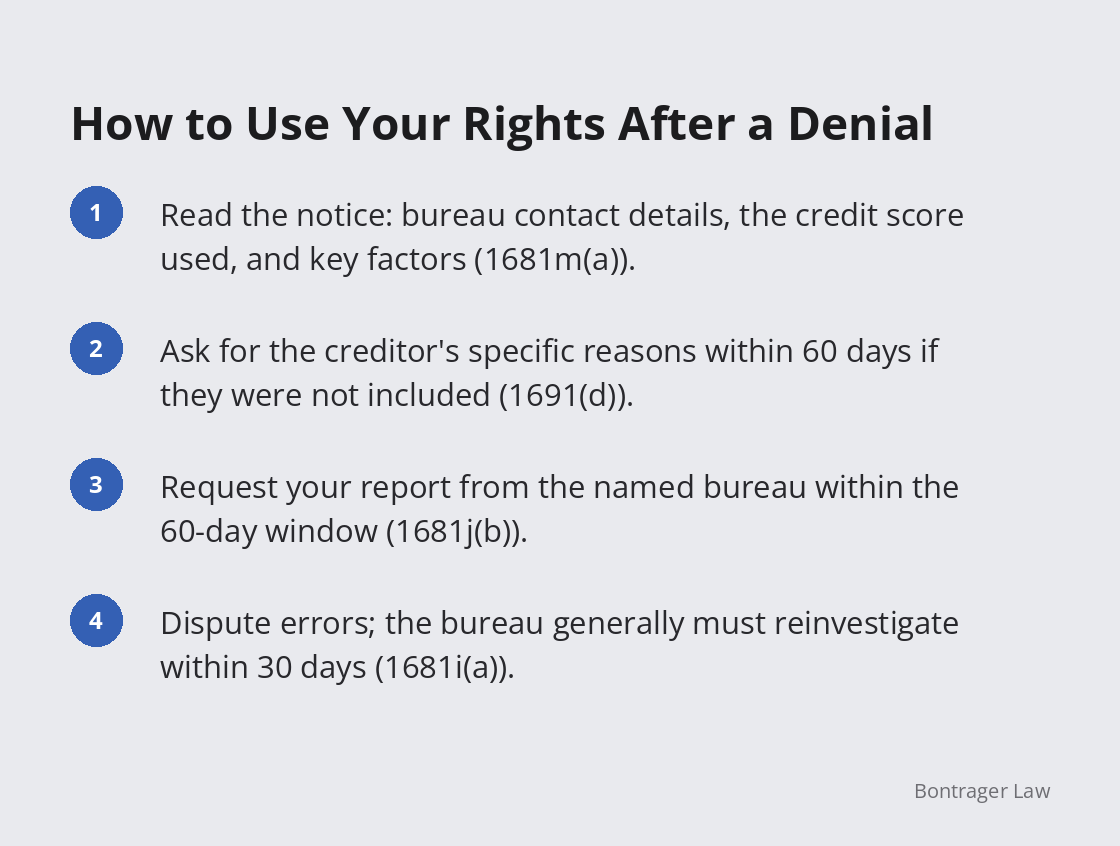
Under 15 U.S.C. 1681m(a), a person taking adverse action based on a consumer report must provide notice of the adverse action and must disclose the name, address, and telephone number of the consumer reporting agency that furnished the report. When a credit score was used, the user must also disclose the numerical credit score it relied on, along with related information described in Section 1681g(f), which can include the key factors that adversely affected the score. Finally, the notice must tell you about your right to obtain a copy of your report from that agency, including the 60-day period for requesting it, and your right to dispute the accuracy or completeness of information in the report.
Request the Creditor’s Specific Reasons
The Equal Credit Opportunity Act gives credit applicants a separate right to a statement of reasons. Under 15 U.S.C. 1691(d), a creditor must notify you of its action within thirty days after receiving a completed application, and each applicant against whom adverse action is taken is entitled to a statement of reasons. A creditor can satisfy this by providing the reasons in writing as a matter of course, or by telling you in writing that you have the right to a statement of reasons if you request it within sixty days of the notification. Regulation B, at 12 CFR 1002.9(b)(2), says the reasons must be specific and that statements based only on the creditor’s internal standards or policies, or on a failure to achieve a qualifying score, are insufficient. Specific reasons can point you directly to the item on your report that needs attention.
Get Your Report Within the 60-Day Window
The notice must mention a 60-day period for obtaining your report, and Section 1681j(b) ties that window to your receipt of the adverse action notice. Requesting your report from the agency named in the notice soon after you receive it lets you see the same information the lender reviewed. Compare every account, balance, payment history entry, inquiry, and personal identifier against your own records. Look for accounts you never opened, debts discharged in bankruptcy that are still shown as owed, duplicate collection accounts, and late payments that do not match your statements.
Dispute Errors With the Credit Bureau
If you find inaccurate or incomplete information, the Fair Credit Reporting Act gives you the right to dispute it directly with the consumer reporting agency. Under 15 U.S.C. 1681i(a)(1)(A), the agency must conduct a reasonable reinvestigation to determine whether the disputed information is inaccurate, record the current status of the information, or delete it, before the end of the 30-day period beginning on the date it receives your dispute. That period may be extended by up to 15 additional days in some cases when you provide relevant information during the initial 30 days. Keep copies of your dispute, the documents you send, and proof of delivery, because these records become important if the error is not corrected.
Common Mistakes After a Credit Denial
Many people lose valuable time after a denial because they do not realize how much information the notice provides or how quickly some of the windows close. Avoiding the following mistakes can make a real difference in how fast an inaccurate file gets corrected.
Throwing Away the Notice
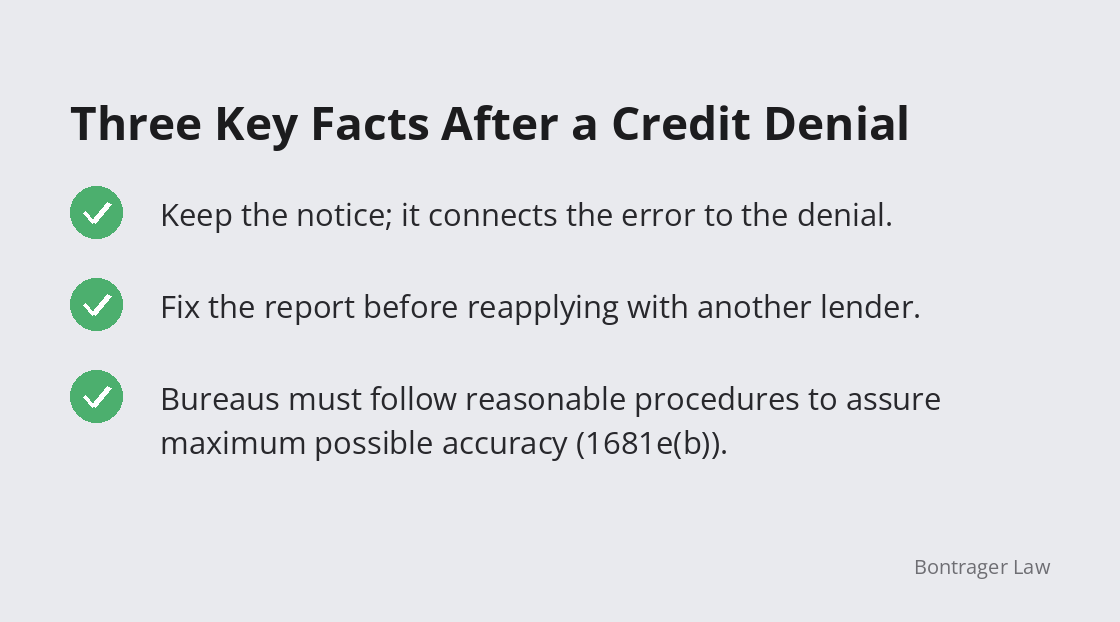
The adverse action notice is evidence. It identifies the bureau that supplied the report, the score the lender used, and often the key factors behind that score. If you later need to show that an inaccurate item contributed to a denial, the notice and the creditor’s statement of reasons can help connect the error to the harm it caused. Store the notice with your application paperwork, your credit report, and your dispute records so the full timeline is easy to reconstruct.
Reapplying Before the File Is Corrected
When a denial is caused by an error, applying again with another lender before the error is fixed often produces the same result. Each new application may also add another inquiry to your file. It is usually more productive to obtain your report, identify the problem, and complete the dispute process first. Once the reinvestigation is finished and the bureau sends you the results, you can decide whether to reapply with a more accurate report.
Assuming the Bureau Made the Decision
Because the notice must state that the consumer reporting agency did not make the decision, some consumers conclude that the bureau has no role in the problem. That is not quite right. The bureau did not decide to deny you, but if it reported inaccurate information, it may have obligations under the Fair Credit Reporting Act to correct the file and to follow reasonable procedures to assure accuracy. Likewise, if a creditor fails to provide the required notices, that failure can be an issue worth reviewing. Sorting out which company is responsible for which problem is one of the first things a consumer protection attorney will look at.
Final Thoughts
A credit denial in California is frustrating, but the adverse action notice that comes with it is one of the most useful documents you will receive. Federal law requires the creditor to tell you which bureau supplied the report, the credit score it used, your right to obtain your report and dispute errors, and, for credit applications, the specific reasons for the decision. Using those rights quickly can turn a confusing rejection into a clear plan for correcting your file.
If an error on your report caused the denial, you do not have to sort it out alone. Keeping organized records of your notice, your report, and your disputes puts you in a much stronger position if the bureau or the furnisher fails to fix the problem.
If you were denied credit because of inaccurate information on your credit report, contact Bontrager Law to speak with our team about your options. We will review your notice and credit report, explain your rights under the Fair Credit Reporting Act, and help you take the next step toward an accurate file.