
Background check errors in California can do far more damage than a few uncomfortable conversations. A report that mixes you up with someone who has a similar name, lists a criminal case that was dismissed, or shows outdated public records can quietly end a job opportunity before you ever learn what went wrong. The federal Fair Credit Reporting Act (FCRA) gives job applicants and employees specific rights when an employer uses a background report, and understanding those rights gives you real control when a report gets your history wrong.
At Bontrager Law, we help consumers across California hold background screening companies and the businesses that rely on them to their obligations under the FCRA so you can move forward with confidence. This guide explains how employment background checks actually work under federal law, the steps an employer must take before and after denying you a job, and the mistakes that most often weaken a claim over an inaccurate report.
How Employment Background Checks Actually Work Under the FCRA
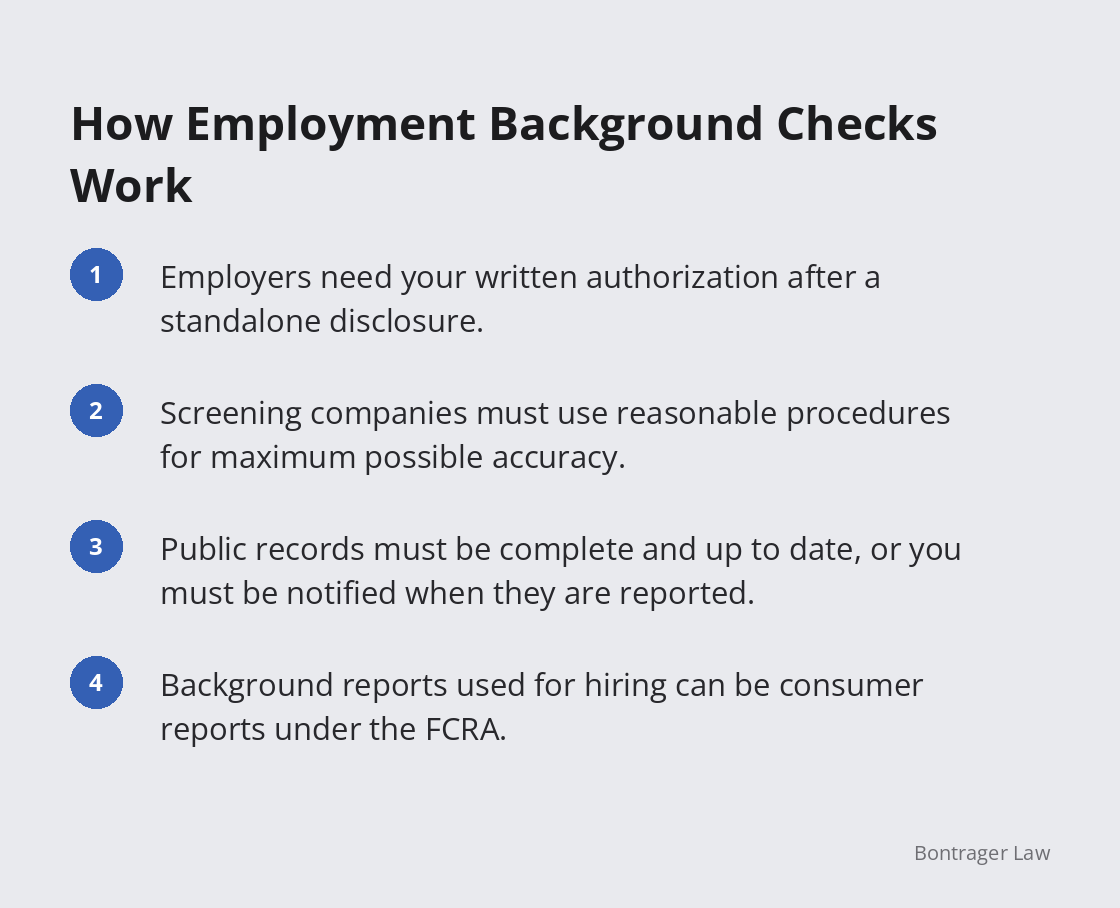
Many people think of the FCRA only in connection with credit reports, but the law also covers many background reports prepared for employment purposes. When a screening company assembles information about you and sells it to an employer, that report can be a consumer report subject to the FCRA, and the company can be a consumer reporting agency with duties to you.
Your Written Authorization Comes First
Under 15 U.S.C. 1681b(b)(2), an employer generally may not obtain a consumer report for employment purposes unless it first gives you a clear and conspicuous written disclosure, in a document that consists solely of the disclosure, that a consumer report may be obtained for employment purposes. You must also authorize the report in writing, and the statute allows that authorization to appear on the same disclosure document. The standalone disclosure requirement exists so the notice is not buried inside a long application or a stack of onboarding forms.
The Accuracy Duty of Screening Companies
Under 15 U.S.C. 1681e(b), whenever a consumer reporting agency prepares a consumer report, it must follow reasonable procedures to assure maximum possible accuracy of the information concerning the individual about whom the report relates. This duty is central to many background check cases. Matching records by name alone, ignoring a middle name or date of birth, or failing to check the outcome of a court case can all raise questions about whether the company followed reasonable procedures.
Special Rules for Public Record Information
Background reports often include public records such as criminal cases, civil suits, and judgments. Under 15 U.S.C. 1681k(a), a consumer reporting agency that reports public record information for employment purposes that is likely to have an adverse effect on your ability to obtain employment must do one of two things. It must either notify you, at the time the information is reported to the employer, that public record information is being reported, along with the name and address of the person receiving it, or it must maintain strict procedures designed to ensure that the information is complete and up to date. The statute treats items such as arrests, convictions, and suits as up to date if the current public record status of the item at the time of the report is reported. A dismissed case reported as if it were still open is the kind of issue the complete and up to date requirement is meant to address. Asking the screening company which option it followed, and what records it checked, can reveal whether this duty was met.
What Employers Must Do Before and After Denying You a Job
The FCRA does more than regulate the screening company. It also places duties on employers who rely on a background report to make a hiring, promotion, or retention decision. These steps give you a chance to spot an error before it becomes final and to correct it afterward.
The Pre-Adverse Action Notice
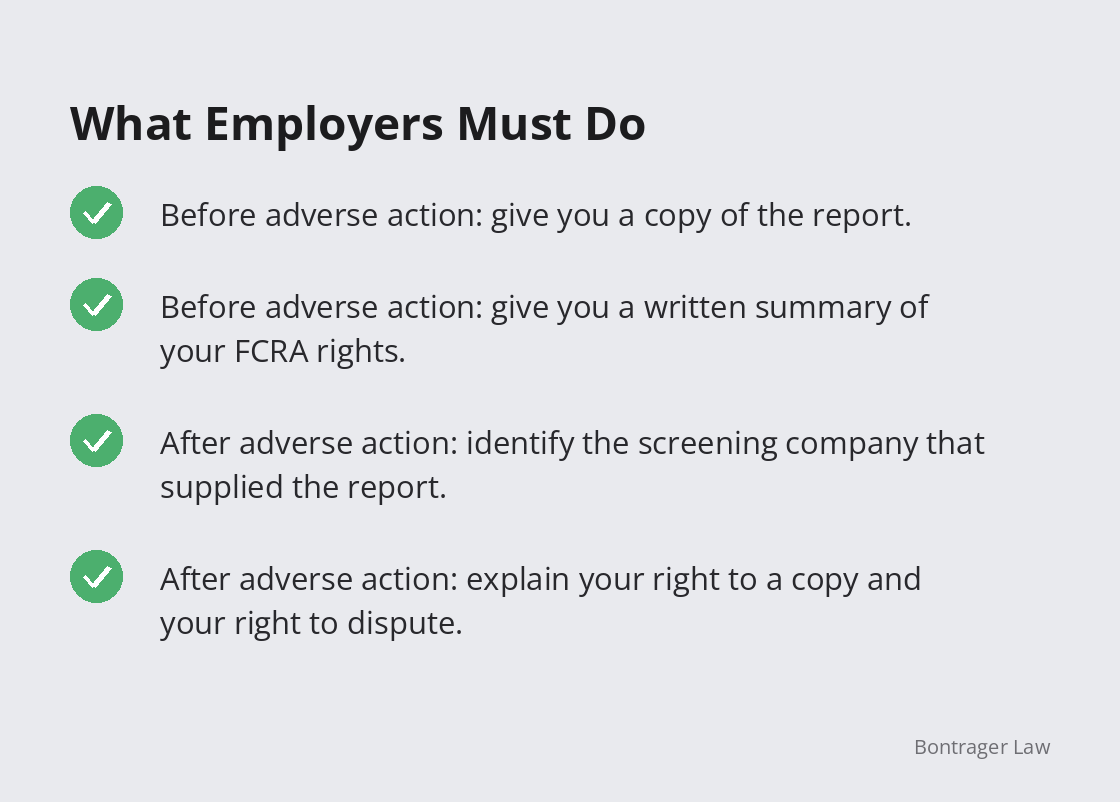
Under 15 U.S.C. 1681b(b)(3)(A), before taking any adverse action based in whole or in part on a consumer report used for employment purposes, the employer generally must provide you with a copy of the report and a written description of your rights under the FCRA. This step matters because it gives you the opportunity to review what the employer saw and to raise errors before the decision is made. The statute contains a separate procedure for certain applications made by mail, telephone, computer, or similar means, so the exact steps can depend on how you applied and the type of position.
The Adverse Action Notice
If an employer takes adverse action based in whole or in part on information in a consumer report, 15 U.S.C. 1681m(a) requires notice to you. That notice must include the name, address, and telephone number of the consumer reporting agency that furnished the report, and a statement that the agency did not make the decision and is unable to provide the specific reasons for it. The employer must also tell you about your right to obtain a copy of the report from that agency within the 60-day period described in the statute, and your right to dispute the accuracy or completeness of information in the report with the agency.
Your Right to Dispute With the Screening Company
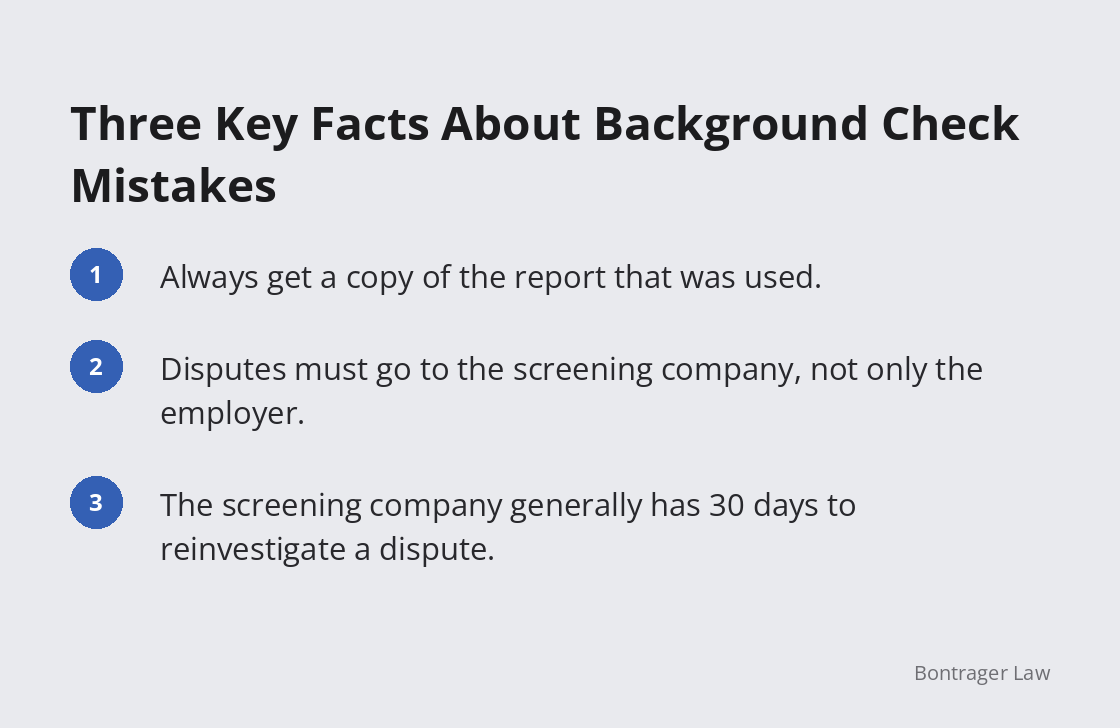
Under 15 U.S.C. 1681i(a)(1)(A), if you dispute the completeness or accuracy of an item in your file and notify the consumer reporting agency, the agency must conduct a reasonable reinvestigation and record the current status of the disputed information, or delete it, before the end of the 30-day period that begins when it receives your dispute. The statute allows that period to be extended by up to 15 additional days in some circumstances when you provide relevant information during the initial period. Under 15 U.S.C. 1681i(a)(5)(A), if the information is found to be inaccurate or incomplete or cannot be verified, the agency must promptly delete or modify it and notify the source of the information.
Why California Applicants Should Act Quickly
Hiring decisions often move fast, and the window between a pre-adverse action notice and a final decision can be short in practice. California job seekers who review the report as soon as they receive it, identify specific errors, and send a dispute promptly give themselves the best chance of correcting the record before an opportunity is lost for good.
Mistakes That Weaken a Background Check Error Claim
Background check problems are frustrating, and it is natural to want to move on to the next application. But the steps you take in the first days after learning about an error often determine whether the problem gets fixed and whether you can hold anyone accountable.
Not Asking for a Copy of the Report
Some applicants accept a rejection without ever seeing the report that caused it. The FCRA requires employers to provide a copy before taking adverse action in most situations and to identify the screening company afterward. Without the report, you cannot identify the exact error, the company that made it, or the records it relied on. Always request and keep a copy of every report and every notice you receive.
Disputing Only With the Employer
Telling the employer about the error is important, but the reinvestigation duty under 15 U.S.C. 1681i runs to the consumer reporting agency. A complaint made only to the hiring manager does not start that process. Send a written dispute directly to the screening company named in your notice, explain each error specifically, and include supporting documents such as court records showing a dismissal or proof of your identity.
Failing to Keep a Paper Trail
Claims involving background check errors depend heavily on documentation. Keep copies of the disclosure and authorization forms you signed, the pre-adverse action and adverse action notices, your dispute letters, proof of mailing or submission, and the agency’s response. Write down the dates of each conversation with the employer. This record helps show what the employer and the screening company knew, when they knew it, and how they responded. For a broader look at how FCRA claims work, see our page on the Fair Credit Reporting Act.
Final Thoughts
Background check errors in California can derail a career opportunity, but federal law gives you tools to respond. Employers generally must get your written authorization through a standalone disclosure, give you a copy of the report and a summary of your rights before taking adverse action, and send an adverse action notice afterward. Screening companies must follow reasonable procedures to assure maximum possible accuracy and must reinvestigate disputed information.
If an inaccurate report has led to a lost job or promotion, the most effective response is to get the report, dispute every error in writing with the screening company, and keep a detailed record of every notice and communication. Those steps protect your ability to correct the record and to pursue a claim if the law was not followed.
If you believe a background check error affected your employment, contact Bontrager Law to speak with our team. We’ll review your report and notices, explain your rights under the FCRA, and help you take the next step with confidence.