
Your employer is withholding your wages illegally, and you have more power than you think. California law sets strict limits on what companies can take from your paycheck, and violations happen more often than most workers realize.
At Bontrager Law, we help California workers fight back against unlawful wage garnishment and recover what they’re owed. This guide walks you through your legal options and shows you exactly how to stop the withholding.
What California Law Actually Allows Employers to Take
The 20 Percent Rule and How Employers Break It
California sets hard limits on wage garnishment that many employers simply ignore. Under California Civil Procedure Code Section 706.050, employers can garnish no more than 20 percent of your disposable earnings, or 40 percent above 48 times the state minimum wage-whichever is smaller. Disposable earnings means what you take home after mandatory deductions like taxes and Social Security. Many employers fail to understand this calculation or deliberately exceed it. If your employer takes more than 20 percent, that constitutes unlawful withholding.
Special Debts That Bypass Standard Protections
Some debts bypass these protections entirely. Child support withholding can reach 50 percent of disposable earnings if you support another family, or 60 percent if you don’t, plus an additional 5 percent if payments fall more than 12 weeks behind. Federal student loan defaults allow garnishment up to 15 percent of disposable pay. Federal tax levies don’t require a court judgment and use a different calculation based on standard deductions divided by 52 weeks.
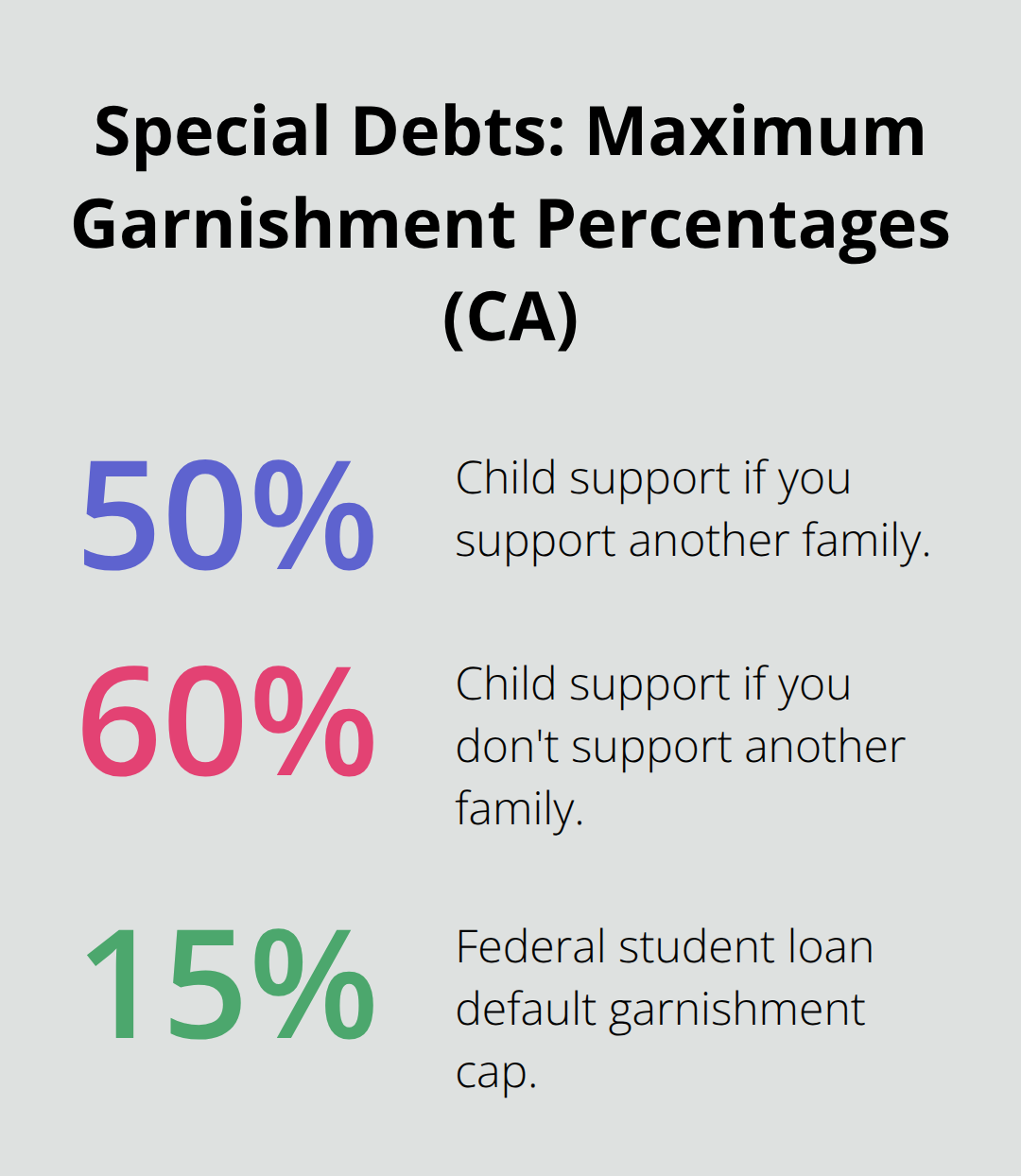
These distinctions matter because your defense strategy changes depending on the debt type.
What Counts as Unlawful Withholding
The real protection comes from knowing what counts as unlawful. California law shields certain earnings entirely. AB 2837, effective in 2025, added stricter enforcement rules requiring creditors to verify your current address and limiting how often garnishments can be renewed. If a creditor garnishes your account without proper legal procedures-like serving you with an Earnings Withholding Order form WG-002 or failing to identify the correct levying officer-that action violates the law. Retaliation also counts: your employer cannot fire you for a single wage garnishment under federal law.
Acting Fast Protects Your Paycheck
If you face multiple garnishments or your employer retaliates after you complain, document everything immediately. The fastest path to stopping unlawful withholding involves filing a Claim of Exemption with the sheriff within days of receiving the order, but only if the garnishment makes it impossible to pay basic family needs. Act fast because you only recover wages from the filing date forward, not retroactively. Understanding these violations sets the stage for your next move: knowing exactly which legal options apply to your situation.
How to Challenge Unlawful Garnishment in California
Three Paths to Stop Wage Violations
When your employer violates wage garnishment laws, you have three distinct paths forward, and the right choice depends on what happened and how quickly you need relief. The Labor Commissioner route works best for wage theft and retaliation claims. A damages lawsuit targets employers who knowingly exceed legal limits.
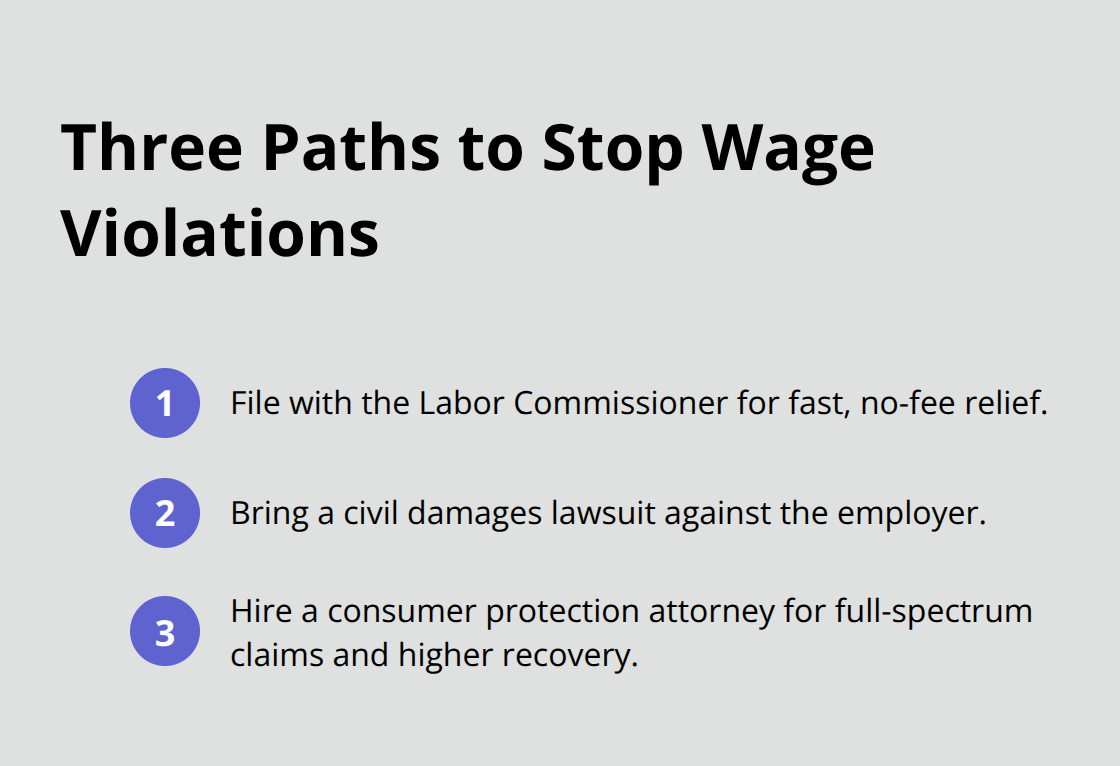
A consumer protection attorney handles the full spectrum of violations and often recovers more money because they understand which violations carry statutory penalties. Act within 30 days of discovering the violation because evidence degrades and witnesses become harder to locate.
The Labor Commissioner Route for Fast Relief
Most wage garnishment violations fall into one of two categories: procedural failures where the employer didn’t follow proper legal steps, or calculation errors where they took more than California law permits. The Labor Commissioner investigates for free and requires no attorney, making it the fastest initial step for retaliation or wage theft. The Labor Commissioner can order your employer to stop the garnishment immediately and pay penalties ranging from $50 to $500 per violation under California Labor Code Section 1197.1. If retaliation occurred, you can add claims for lost wages and emotional distress damages. The Labor Commissioner must issue a decision within 120 days in most cases, giving you relief far faster than a civil lawsuit.
Civil Court for Maximum Financial Recovery
A damages claim against your employer directly through civil court makes sense when the unlawful garnishment caused measurable financial harm. California courts allow you to recover actual damages (the money wrongfully taken), penalties of up to $500 per violation, and attorney fees if you win. If your employer garnished 25 percent of your paycheck when the law capped it at 20 percent, that five percent difference compounds across months and represents real money you can recover. Document every paycheck showing the incorrect deduction amount and calculate the total overage. Many employers settle these claims rather than defend them in court, especially when the violation is clear and well-documented.
Choosing Between Speed and Maximum Recovery
The key difference between a Labor Commissioner claim and a civil lawsuit is that civil court can award more money for intentional violations, while the Labor Commissioner provides faster relief for retaliation and basic wage theft. Choose the Labor Commissioner path if you need the garnishment stopped immediately and your employer retaliated against you. Choose civil court if you want maximum financial recovery and can wait longer for resolution. A consumer protection attorney accelerates recovery because they know exactly which violations carry statutory penalties and which require proving intent.
What Happens Next in Your Case
Once you select your path, the specific violations your employer committed determine your next steps and potential recovery amount. Understanding whether your case involves procedural failures, calculation errors, or retaliation shapes your strategy and timeline for resolution.
Common Wage Garnishment Violations Employers Make
Procedural Failures That Make Garnishment Illegal
Employers violate California wage garnishment rules in three distinct ways, and understanding which violation applies to your situation determines your recovery strategy. The most common violation happens when employers fail the basic procedural requirements that California law demands. An employer must receive a valid Earnings Withholding Order form WG-002 from the court or a creditor’s representative before taking any action.
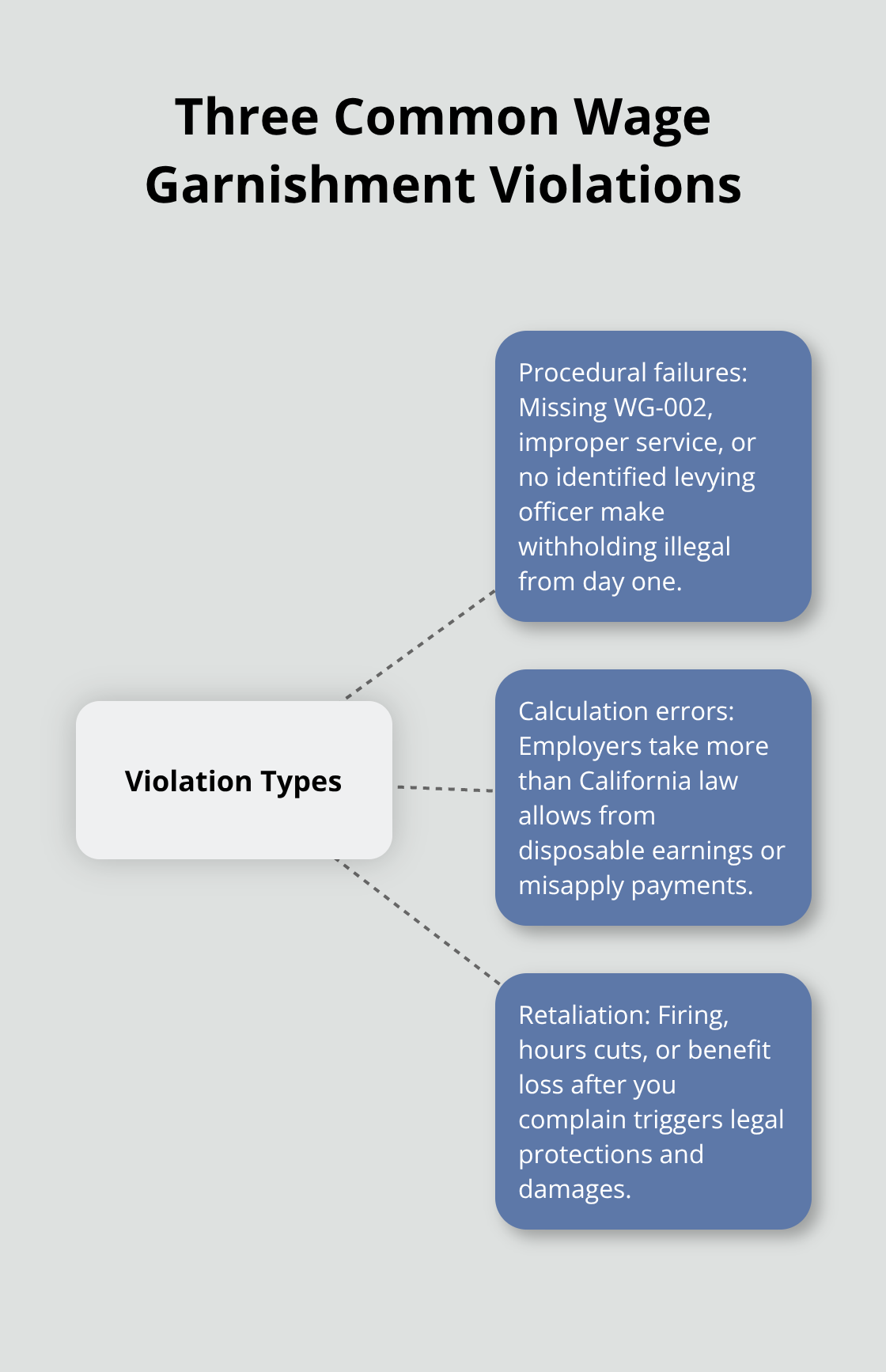
If your employer started garnishing your wages without this order, or without properly identifying the levying officer (usually the sheriff), the withholding is illegal from day one. Wage stubs often reveal procedural failures-deductions appear before any legal documentation arrives. Document your first paycheck showing the garnishment and cross-reference it with when you actually received notice of the order. This gap proves procedural failure and strengthens your claim significantly.
Calculation Errors That Exceed Legal Limits
The second violation involves the math itself. California Civil Procedure Code Section 706.050 caps garnishment at 25 percent of disposable earnings, calculated after mandatory deductions. Yet employers frequently make mistakes administering the garnishment, failing to apply payments correctly or withholding amounts that exceed what the law allows. If your employer garnished $400 from a $2,000 paycheck without calculating disposable earnings correctly, they violated the law. Calculate your actual disposable earnings for each pay period by subtracting federal income tax withholding, Social Security tax, and Medicare tax from your gross pay. Then determine the legal maximum: 25 percent of that disposable figure. When the actual amount taken exceeds this calculation, you have a clear violation with measurable damages.
Retaliation for Reporting Violations
The third violation occurs when your employer retaliates after you question the garnishment or file a complaint with the Labor Commissioner. Federal law under 15 U.S.C. Section 1674 prohibits firing you for a single wage garnishment. California Labor Code Section 1102.5 extends protection further, shielding workers who report wage violations to government agencies. If your employer terminated you, reduced your hours, or withheld benefits within 30 days of your complaint about garnishment, that constitutes retaliation and opens multiple damage claims. Retaliation cases carry statutory penalties of $50 to $500 per violation, plus actual damages for lost wages and emotional distress.
Final Thoughts
Unlawful wage garnishment stops when you take action, and we at Bontrager Law have spent nearly 20 years helping California workers recover what employers illegally took from their paychecks. Your first step is straightforward: collect every paycheck stub showing the garnishment, any written notice from your employer about the withholding, and records of when you received the Earnings Withholding Order. Calculate the exact amount your employer took versus what California law permitted, and if retaliation occurred, document the timeline between your complaint and any adverse employment action.
We handle the complexity from there through our free case review process, which examines your specific situation and identifies which violations apply to you. We determine whether the Labor Commissioner route offers faster relief, whether civil court will recover more money, or whether both paths make sense for your circumstances. We’ve recovered millions for California workers facing unlawful wage withholding, and we know exactly which violations carry the strongest penalties.
Contact us for CA wage garnishment aid that actually works. We represent you from the initial case review through settlement or trial, and you pay nothing unless we recover money for you. A consumer protection attorney can help you understand your full range of options and fight back against wage violations.