
California credit report time limits decide how long a late payment, collection account, or court judgment can follow you. Negative information does not stay on a credit report forever. Federal and California law both set outer limits on how long most adverse items can be reported, and when an old account lingers past its deadline, or suddenly looks newer than it really is, you have the right to challenge it.
At Bontrager Law, we represent individuals across California in disputes over inaccurate credit reporting so you can move forward with a cleaner file and a practical plan. This guide explains how the reporting time limits actually work, how to spot and dispute an outdated item, and the mistakes that let old negative information keep hurting your credit long after it should be gone.
How Credit Report Time Limits Actually Work in California
Two sets of rules apply to California consumers. The federal Fair Credit Reporting Act, in 15 U.S.C. section 1681c, lists categories of information that a consumer reporting agency may not include in a consumer report once they become too old. California’s Consumer Credit Reporting Agencies Act, in Civil Code section 1785.13, contains its own list for consumer credit reports. The two laws overlap heavily, but California adds a few protections of its own, so it helps to look at both when you review your report.
The Seven-Year Rule for Most Negative Items
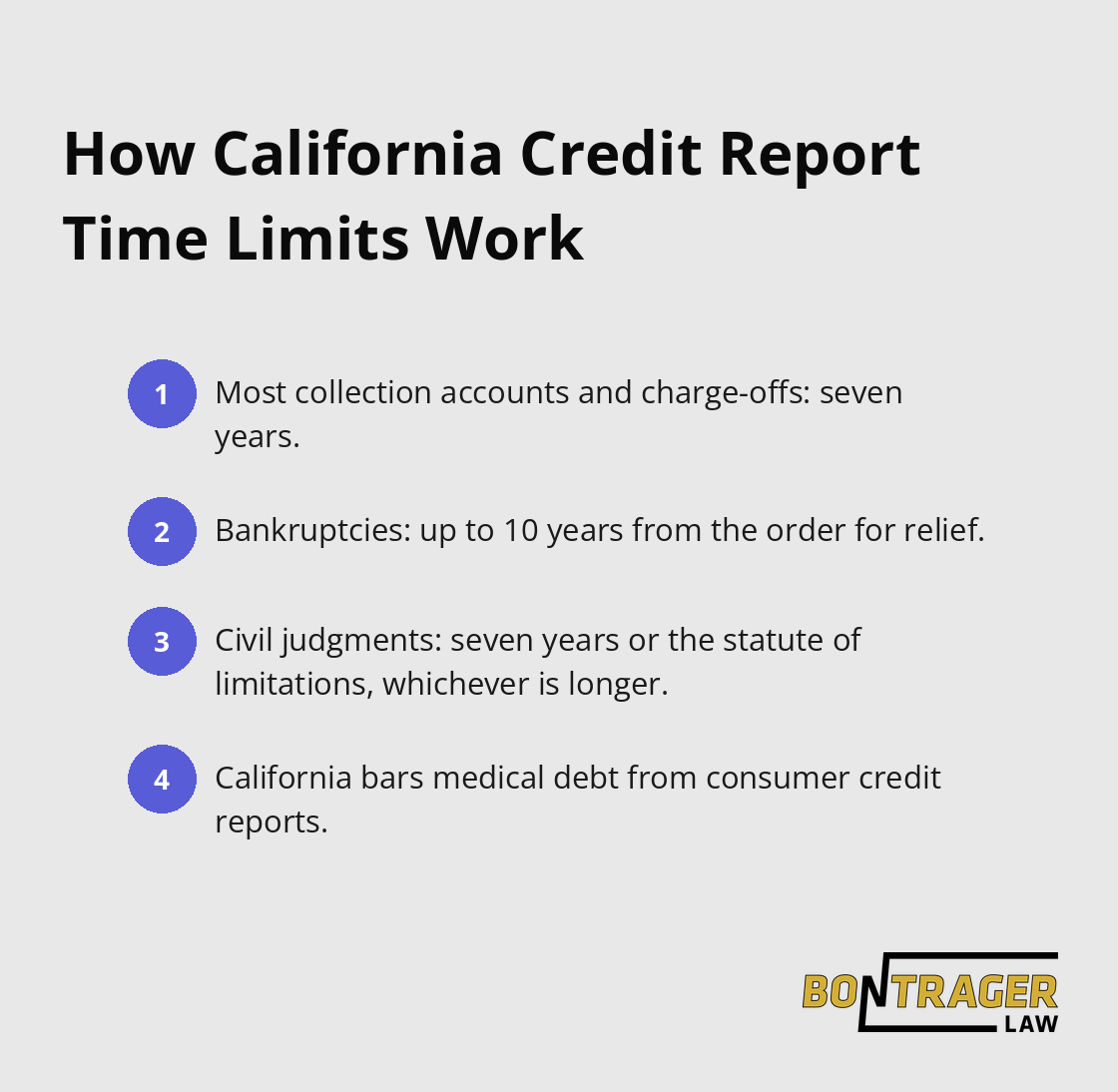
Under section 1681c(a), accounts placed for collection or charged to profit and loss may not be reported once they antedate the report by more than seven years. The same seven-year limit applies to paid tax liens, measured from the date of payment, and to most other adverse items of information. Civil suits and civil judgments may be reported for seven years from the date of entry or until the governing statute of limitations has expired, whichever is longer. California’s section 1785.13(a) uses the same seven-year structure for collection accounts, charge-offs, paid tax liens, suits and judgments, and other adverse information, and section 1785.13(d) adds that a consumer credit report shall not include any adverse information antedating the report by more than 10 years.
The Ten-Year Rule for Bankruptcies
Bankruptcy cases have a longer window. Section 1681c(a)(1) allows a bankruptcy case to be reported for up to 10 years from the date of entry of the order for relief or the date of adjudication. California’s section 1785.13(a)(1) similarly limits reporting of bankruptcies to 10 years from the date of the order for relief. Both laws also require the report to identify the chapter of the Bankruptcy Code under which the case arose when that information is available from the source, which can matter when a lender reviews your history.
Where California Goes Further
California law adds protections that federal law does not. Section 1785.13(a)(7) bars consumer credit reports from containing medical debt. Section 1785.13(a)(3) restricts reporting of unlawful detainer actions unless the landlord was the prevailing party as the statute defines it. And while the federal seven-year rule excludes records of criminal convictions, section 1785.13(a)(6) limits consumer credit reports to arrest and conviction records that are no more than seven years old from the date of disposition, release, or parole. Federal law also contains narrow exceptions to its time limits for certain reports used in large credit, life insurance, and employment decisions, so the purpose of a report can matter.
How to Spot and Dispute an Outdated Item
Knowing the limits is only half the job. The other half is figuring out when the clock actually started for each account and acting when an item should have dropped off. Many outdated entries survive simply because no one checks the dates. The steps below can help you review your report and challenge anything that has overstayed its welcome.
Find the Date the Clock Started
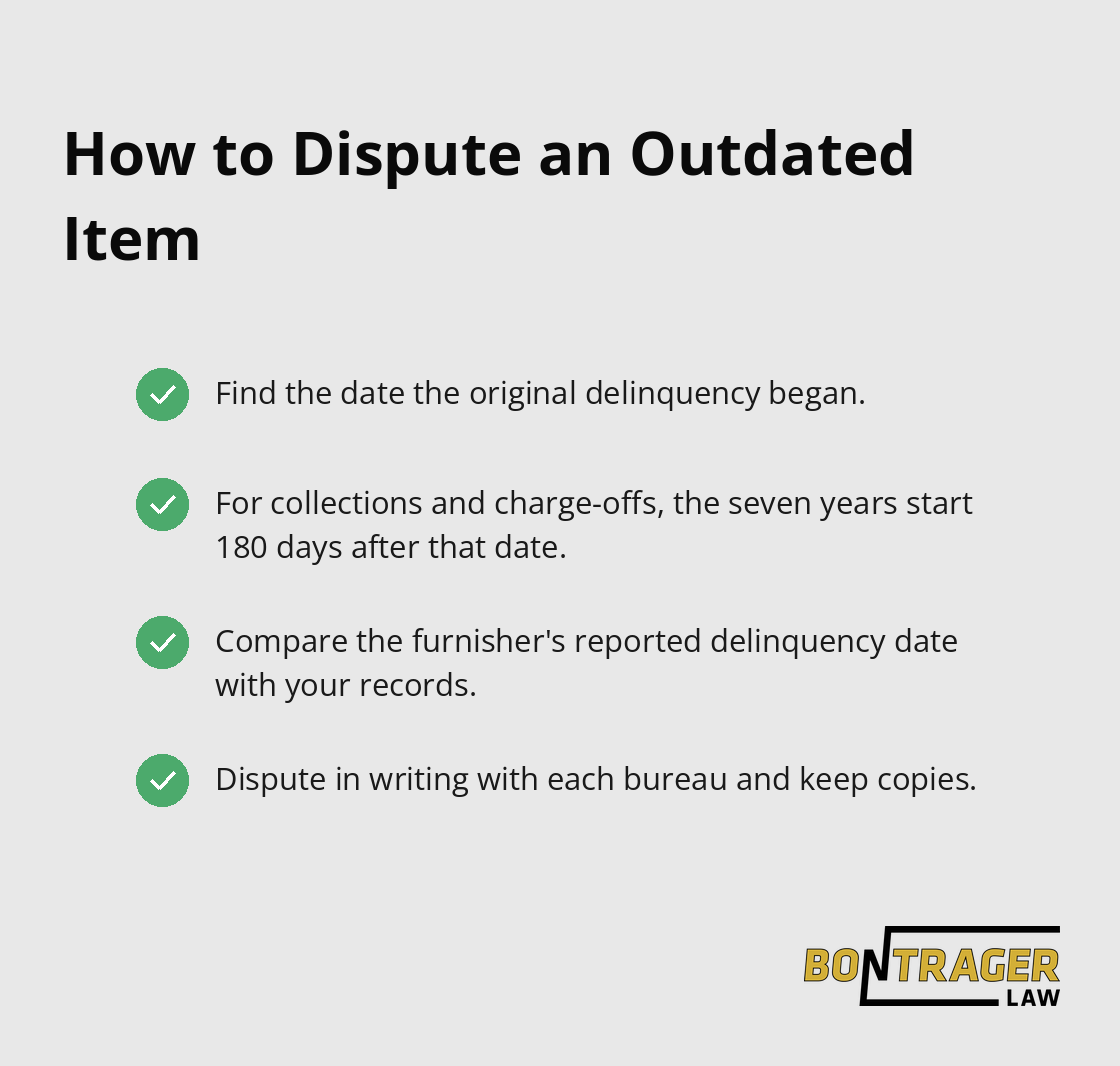
For collection accounts and charge-offs, the seven-year period does not begin on the day a collector buys the debt or the day the account is charged off. Section 1681c(c) states that the period begins upon the expiration of the 180-day period beginning on the date of the commencement of the delinquency that immediately preceded the collection activity, charge-off, or similar action. California’s section 1785.13(b) uses the same 180-day rule and adds that when more than one of these actions is taken on a particular account, the seven-year period runs concurrently from the date of the first action. Look for the date of first delinquency on each account and compare it with today’s date.
Check the Furnisher’s Reported Delinquency Date
Accurate dates depend on the companies that supply information to the bureaus. Under 15 U.S.C. section 1681s-2(a)(5), a furnisher that reports a delinquent account placed for collection or charged off must, not later than 90 days after furnishing the information, notify the agency of the date of delinquency, which is the month and year the delinquency began. The statute also treats a collector as complying when it reports the same date of delinquency the original creditor previously reported. If a collection account shows a much later delinquency date than the original account, that difference is worth questioning.
Dispute the Item With the Credit Bureau
If an item is past its reporting limit or shows a wrong date, dispute it directly with each bureau reporting it. Under 15 U.S.C. section 1681i, the bureau generally must conduct a reasonable reinvestigation within 30 days of receiving your dispute, and if the item is found to be inaccurate or incomplete or cannot be verified, the bureau must promptly delete or modify it. California’s Civil Code section 1785.16 sets its own reinvestigation period of 30 business days. Include copies of statements or letters that show the original delinquency date, and keep a complete record of everything you send and receive. Our guide to the FCRA method of verification explains what to ask if the bureau verifies the item anyway.
Ask the Bureau to Notify Recent Report Recipients
Removing an outdated item helps going forward, but lenders, landlords, or employers may have already seen it. California’s Civil Code section 1785.16(h) provides that after information is deleted following a dispute, the bureau, at your request, shall notify any person you designate who received a report containing that information for employment purposes within the prior two years, or for any other purpose within the prior 12 months. Making that request in writing helps make sure the correction reaches the people whose decisions may have been affected by the old entry.
Mistakes That Keep Old Negative Items on Your Report
Outdated entries rarely fix themselves. They tend to linger because of misunderstandings about how the clock works, a lack of documentation, or waiting too long to act. Avoiding the mistakes below can make the difference between an item quietly disappearing and one that keeps affecting your applications for credit, housing, and employment.
Assuming a Debt Sale Restarts the Clock
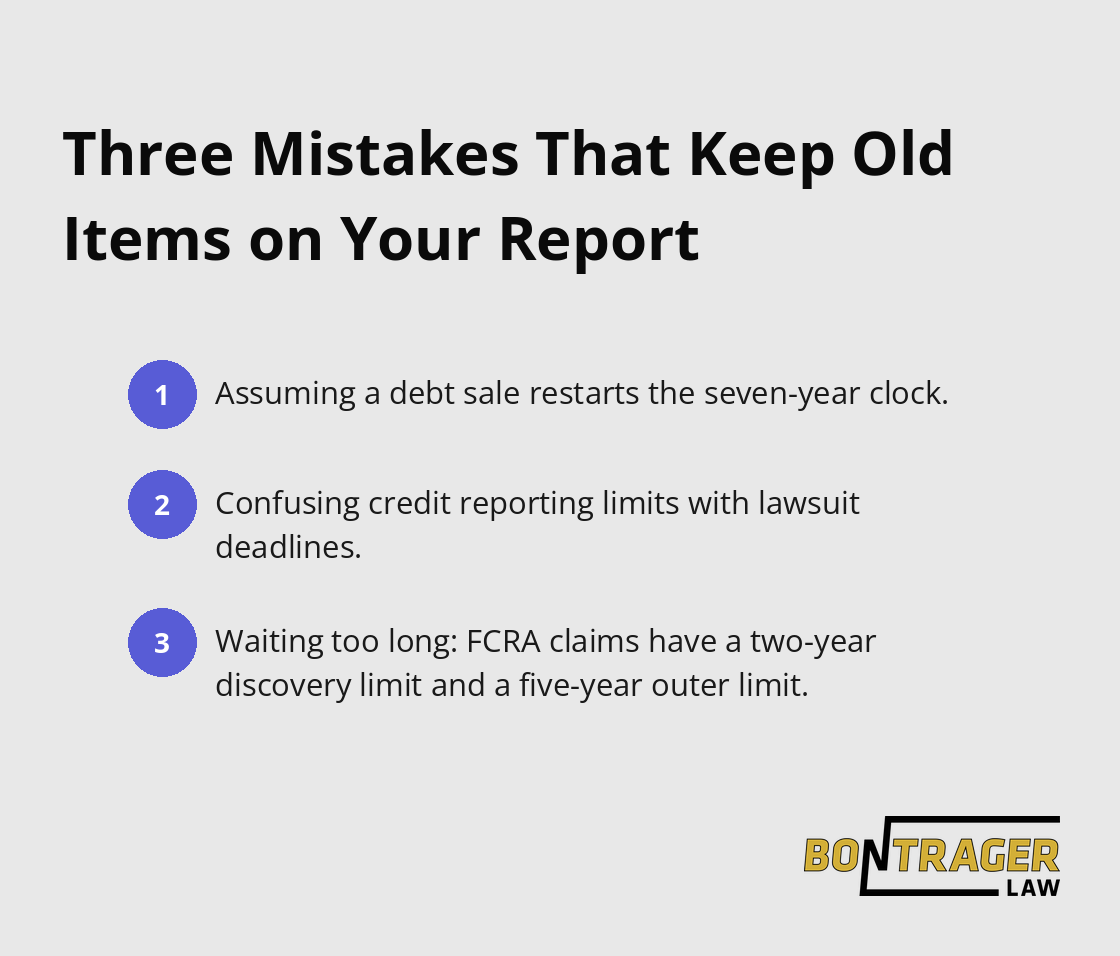
One of the most common misunderstandings is that a new collector means a new seven-year period. The statute ties the start of the reporting period to the original delinquency, not to the date a collector bought or began collecting the account. When a collection entry appears with a recent date even though you stopped paying the original creditor years ago, it may reflect what consumers often call re-aging. That is precisely the kind of inaccuracy the dispute process is designed to correct.
Confusing Reporting Limits With Lawsuit Deadlines
The time limits for credit reporting are separate from the deadlines for a creditor to sue you on a debt. An account can fall off your credit report while a lawsuit is still possible, or a lawsuit deadline can pass while the account is still within its reporting period. Mixing up these two concepts can lead to poor decisions about how to respond to collection letters. If you receive a demand on an old account, it is wise to understand both timelines before you respond or make any promise to pay.
Waiting Too Long to Act
Your own rights have deadlines, too. Under 15 U.S.C. section 1681p, an action to enforce liability under the FCRA must be brought no later than the earlier of 2 years after the date you discover the violation or 5 years after the date the violation occurs. Every month an outdated item stays on your report can also affect applications you submit in the meantime. Reviewing your reports regularly, disputing problems promptly, and saving copies of every letter keeps your options open if a bureau or furnisher fails to correct the record.
Final Thoughts
California credit report time limits give consumers real protection against old negative information. Federal law in 15 U.S.C. section 1681c and California’s Civil Code section 1785.13 cap how long most adverse items may be reported, both tie the clock for collection accounts to the original delinquency, and California adds limits on medical debt, unlawful detainer actions, and older criminal records.
Putting those rules to work means checking the dates on every negative entry, documenting the original delinquency, and disputing items that have outlived their reporting period. That approach turns a confusing report into a clear list of what belongs and what does not.
If an outdated or re-aged item is still on your credit report and you need help understanding your options, contact Bontrager Law to speak with our team. We will review your reports and dispute history, explain how the FCRA and California credit reporting rules may apply, and help you take a practical next step.