
California identity theft credit report problems can follow a victim long after the fraudulent accounts first appear. A stolen Social Security number, a forged application, or an account opened in your name can leave hard inquiries, collection entries, and balances that do not belong to you, and those errors can affect housing, employment screening, and everyday credit decisions. The longer fraudulent information stays in the file, the more chances a landlord, employer, or lender has to see a history that is not yours.
At Bontrager Law, we represent individuals across California in disputes over credit reporting errors and identity theft so you can move forward with a clearer file and a practical plan. This guide explains what the Fair Credit Reporting Act actually requires when identity theft pollutes a credit file, how disputes and blocking requests work, and the mistakes that commonly leave inaccurate information on the report longer than it should.
What FCRA Identity Theft Credit Report Protections Actually Cover
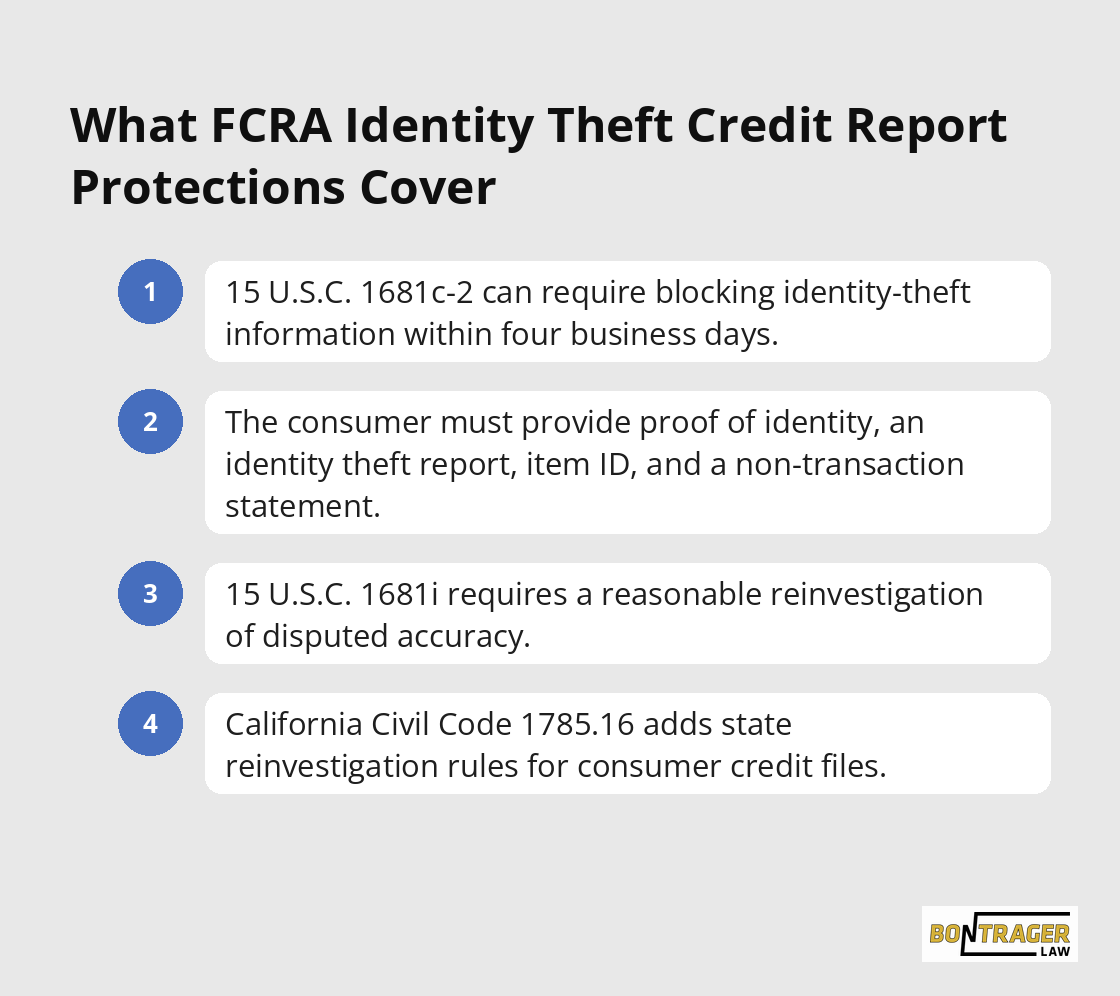
The Fair Credit Reporting Act, codified in relevant part at 15 U.S.C. section 1681c-2, requires a consumer reporting agency to block the reporting of information in a consumer’s file that the consumer identifies as resulting from alleged identity theft. The block generally must occur not later than four business days after the agency receives four things from the consumer: appropriate proof of identity, a copy of an identity theft report, identification of the information to block, and a statement that the information does not relate to any transaction by the consumer. That federal blocking tool is one of the strongest first moves available to California victims whose files show accounts they never opened.
Identity theft rarely stops at one lender. Fraudulent credit cards, personal loans, utility accounts, and medical billing entries can appear across multiple furnishers at once. When those entries are reported as belonging to you, later applications may be scored against a history you never created. Understanding the FCRA’s blocking and dispute rules early helps you separate accounts that should be removed from accounts that need a different kind of correction.
Separate from blocking, 15 U.S.C. section 1681i requires consumer reporting agencies to conduct a reasonable reinvestigation when a consumer disputes the completeness or accuracy of an item in the file. Subject to limited exceptions, the agency must, free of charge, reinvestigate and either confirm the current status of the information or delete it before the end of the thirty-day period that begins when the agency receives the dispute. California consumers often use both tools: a section 1681c-2 block aimed at identity-theft items, and a section 1681i dispute aimed at any inaccurate or unverifiable entries that remain.
The Four Pieces of a Federal Identity Theft Block Request
Section 1681c-2 is specific about what the consumer must provide. Proof of identity, an identity theft report, a clear identification of the information to block, and a statement that the information is not the consumer’s own transaction form the package the statute describes. An incomplete package can delay the four-business-day clock. California victims who gather a police report or a Federal Trade Commission IdentityTheft.gov report early usually move faster than those who try to dispute orally without documentation.
Ordinary Accuracy Disputes Still Matter After Identity Theft
Identity theft rarely leaves a single bad line. Mixed files, duplicated collection accounts, and incorrect personal identifiers often remain even after the most obvious fraudulent accounts are addressed. Section 1681i’s reinvestigation duty applies when the consumer disputes completeness or accuracy, and it requires the agency to notify the furnisher of the dispute. Victims who only ask for a block, and never dispute remaining inaccuracies, can leave damaging residue on the file.
California’s Consumer Credit Reporting Overlay
California also maintains state consumer credit reporting rules. Civil Code section 1785.16 addresses reinvestigation of disputed information by a consumer credit reporting agency, including timing expectations for investigating disputes conveyed directly to the agency. State and federal rules can both apply to a California identity theft credit report problem, so victims should not assume that a federal letter alone answers every California-specific process question. Coordinating the two frameworks keeps the dispute file coherent.
How California Identity Theft Credit Report Cleanup Actually Works
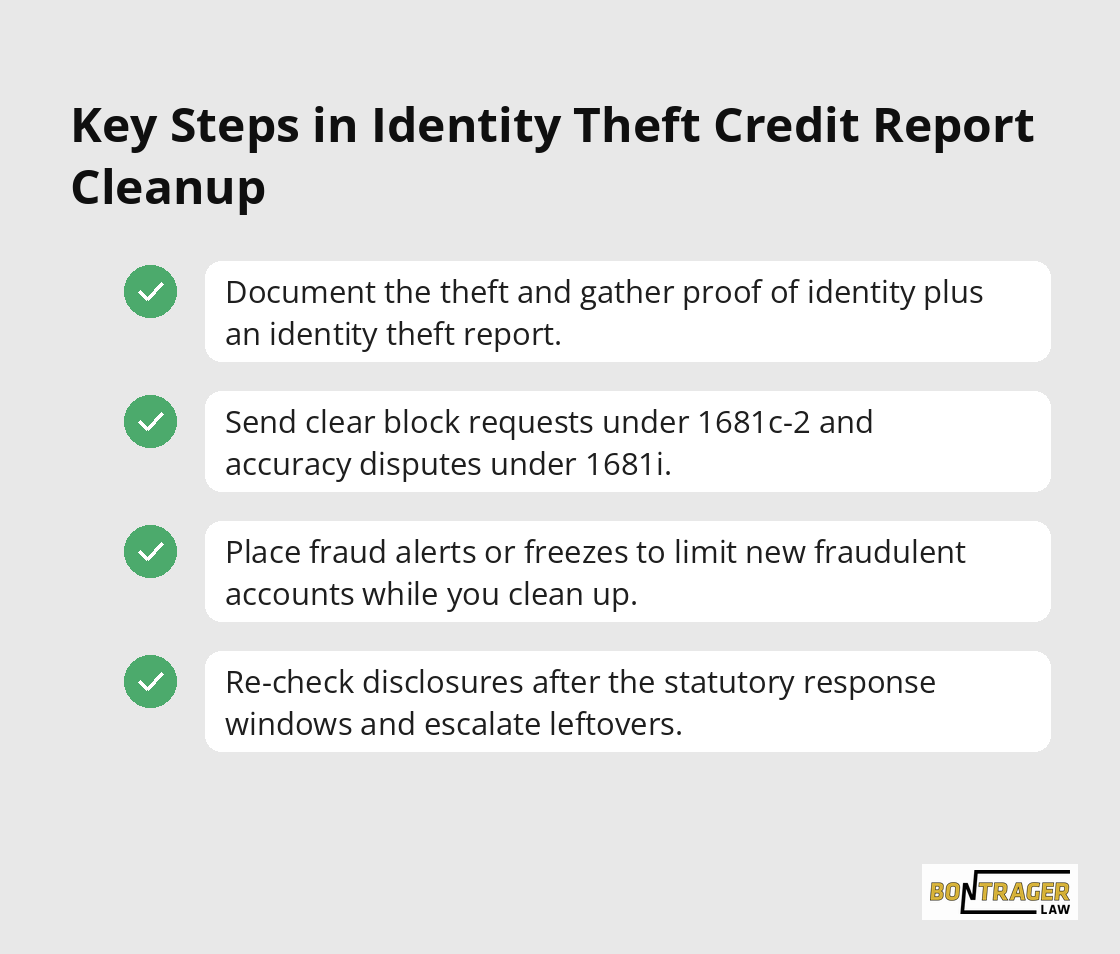
Cleanup is a sequence, not a single phone call. Victims usually document the theft, place fraud alerts or freezes as appropriate, send blocking and dispute packages to the nationwide consumer reporting agencies, notify furnishers, and then verify what still appears after the statutory response windows. Each step creates a paper trail that later proves what was requested and when. California residents in Los Angeles County and across the state often need that paper trail when an agency claims it never received a complete package or when a furnisher continues reporting after a block request.
Organize the file the way an investigator would: a copy of each credit disclosure, a list of disputed items, proof of identity, the identity theft report, and dated copies of every letter or online submission. That organization makes it easier to spot which agencies responded, which furnishers were notified, and which fraudulent lines are still visible after the statutory windows close.
Document the Theft and Freeze Further Damage
An identity theft report and proof of identity support the section 1681c-2 block. Many California consumers also place a fraud alert or credit freeze so new credit is harder to open while the cleanup continues. Those protective steps do not replace a formal block or dispute, but they reduce the chance that new fraudulent accounts appear while older ones are still being challenged. Keep copies of every confirmation number and mailed package.
Send Clear Block and Dispute Packages
Identify each fraudulent trade line, collection entry, and inquiry with enough detail that the agency can find it in the file. Attach the identity theft report and the statement that the information is not your transaction. Separately dispute any remaining inaccurate items under section 1681i so the agency must reinvestigate or delete within the thirty-day framework the statute describes, subject to its limited extensions and exceptions. Vague letters that say only “there are errors” often produce vague results.
Follow Furnisher Responses and Re-Check the File
Section 1681i requires prompt notice of a dispute to the furnisher of the information. Furnishers then have their own investigation duties under the FCRA framework. After the response window, pull fresh disclosures and compare them line by line with your dispute list. Information that was supposed to be blocked or deleted but still appears is a signal to escalate, not to wait passively. California victims who re-check the file catch incomplete corrections early.
What Commonly Derails California Identity Theft Credit Report Claims
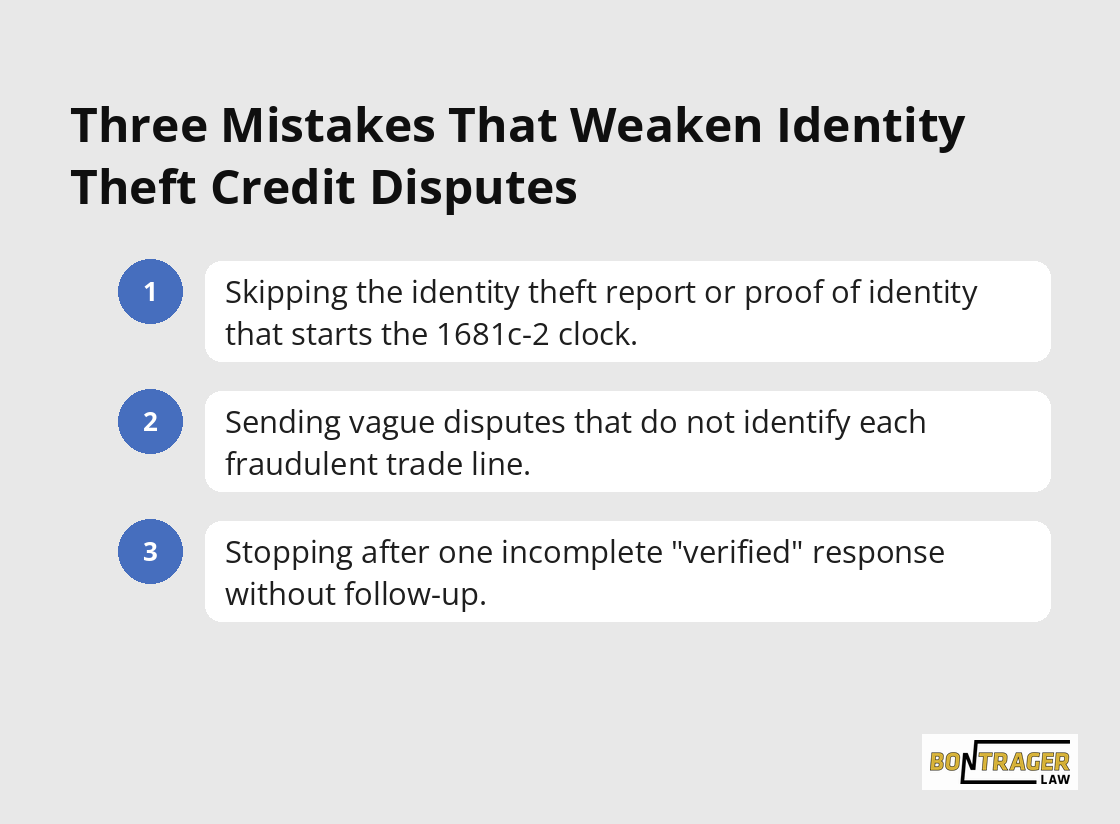
Strong federal tools still fail when documentation is thin, disputes are vague, or victims accept a single “verified” response without pushing for the statutory investigation standards. Identity theft cases also stall when people chase only one agency and ignore furnishers, or when they wait so long that new accounts compound the damage. A California identity theft credit report claim is strongest when every agency response is checked against the statute rather than accepted as final simply because a form letter arrived.
Skipping the Identity Theft Report or Proof of Identity
Section 1681c-2’s four-business-day block duty is tied to receipt of the listed materials. Victims who call an agency, explain the theft, and never send the identity theft report and proof of identity often never start that statutory clock. The documentation step is not paperwork for its own sake; it is what triggers the federal blocking obligation.
Disputing Without Identifying Each Fraudulent Item
Agencies and furnishers need to know which lines are challenged. A letter that fails to identify the information, or that mixes identity-theft blocks with ordinary accuracy disputes without clear labels, can produce partial fixes. California identity theft credit report cleanup works better when each trade line, collection, and inquiry is listed and categorized.
Stopping After One Round of Incomplete Results
A first response may delete some items, verify others, or leave gaps. Section 1681i contemplates deletion when information is inaccurate, incomplete, or cannot be verified. Accepting an unexplained “verified” result without reviewing the investigation basis can leave fraudulent data on the file. Persistence, organized follow-up, and counsel when agencies or furnishers stall are often what finishes the cleanup. Victims who keep a dated log of letters, online dispute confirmations, and report printouts are in a better position to show what remained unresolved after each cycle.
Final Thoughts
California identity theft credit report disputes sit at the intersection of federal FCRA blocking rules in 15 U.S.C. section 1681c-2, reinvestigation duties in section 1681i, and California’s own consumer credit reporting reinvestigation standards such as Civil Code section 1785.16. Victims who document the theft, identify each bad item, and follow through after the statutory response windows give themselves the best chance of clearing fraudulent information from the file.
If you are a California resident dealing with identity theft on your credit reports and need help understanding your options, contact Bontrager Law to speak with our team. We will review what appeared on your file, explain how FCRA and California credit reporting rules may apply, and help you take a practical next step.