
A single error on your credit report can cost you thousands in higher interest rates and rejected loan applications. At Bontrager Law, we’ve helped California residents correct credit report entries and fight back against inaccurate information that damages their financial future.
This guide walks you through your rights, the dispute process, and when legal action becomes necessary to protect your credit.
What Credit Report Errors Actually Cost You
A single error on your credit report can cost you thousands in higher interest rates and rejected loan applications. The Federal Trade Commission found that 20 percent of consumers have errors on their credit reports, and as many as 10 million people pay higher interest rates because of inaccurate information. When debt collection firms report incorrect data, those errors get reflected in your file and stay there for years unless you actively challenge them.

A late payment that wasn’t actually late, an account balance that’s listed twice, or a debt that doesn’t belong to you triggers higher interest rates on mortgages, car loans, and credit cards. Some employers and insurance companies pull credit reports too, meaning an error could affect whether you get a job or how much you pay for coverage.
California Law Provides Stronger Protections Than Most States
California law under Civil Code Section 1785.15 goes further than federal requirements. You can request a decoded copy of your entire credit file, see exactly what codes mean, and get your credit score plus the key factors affecting it. You gain the right to know every inquiry into your report for the past 12 months, and for employment inquiries, the past two years. If information is inaccurate, both the credit bureau and the company that reported it must correct the error for free. The bureau has 30 business days to investigate after you dispute, and if they determine your dispute is frivolous or irrelevant, they must notify you within five business days with their reasoning. This law forces companies to prove their claims are accurate or remove them.
Accurate Information Stays; Inaccurate Information Must Go
Accurate negative information stays on your report for seven years, and bankruptcy information for ten years. That’s the law, and no legitimate credit repair service can remove accurate information faster. Inaccurate information, however, has no legal right to be there. When you find errors and correct them, you receive a free updated copy of your report and can request that correction notices go to anyone who received your report in the past six months. If a furnisher (the company that reported the data) continues reporting disputed information after you’ve challenged it, they must tell the credit bureau that you’re disputing it. This creates a paper trail that future lenders see.
What Legal Action Can Recover
The Fair Credit Reporting Act and California law both allow you to sue for willful or negligent violations. Companies that violate these rules face liability for damages. If you’ve corrected errors on your credit report and still face financial harm from past inaccuracies, legal action becomes a realistic option to recover what those errors cost you. Understanding whether your situation qualifies for legal representation requires looking at the specific violations involved and the damages you’ve suffered.
How to Dispute Credit Report Errors Step by Step
Obtain Your Credit Report and Document All Errors
You must start by obtaining your credit report from the official source: AnnualCreditReport.com. The three major bureaus-Equifax, Experian, and TransUnion-provide your report at no cost once every 12 months, though Equifax currently allows six free reports per year through 2026.
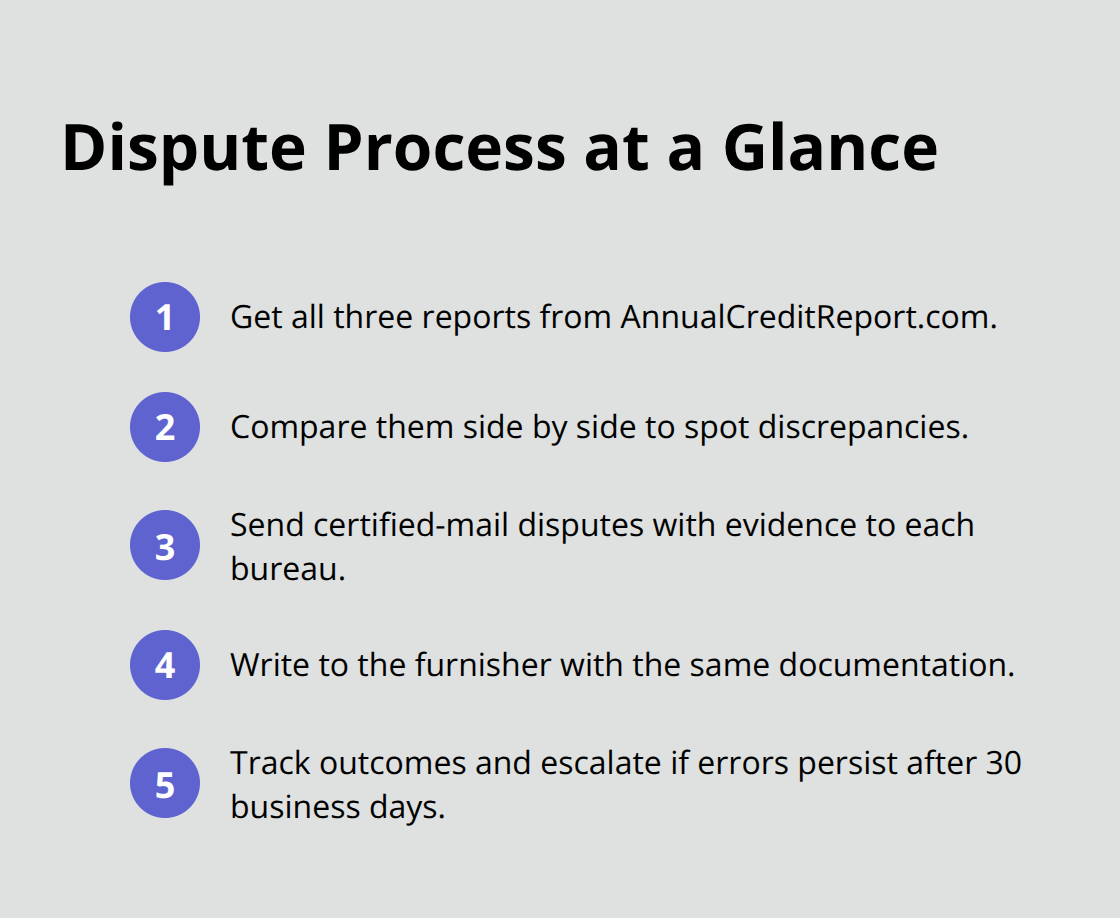
Pull all three reports at once rather than spacing them out over time; this approach lets you compare them side-by-side and catch discrepancies that appear on one bureau but not the others. Circle or highlight every error you find: a late payment showing as current, a balance listed twice, an account that isn’t yours, a closed account still marked open, or a debt that belongs to someone else. Write down the account number, the error description, and why it’s wrong. This documentation becomes your foundation for the dispute.
File Your Dispute with the Credit Bureau
Write to the credit bureau with your full contact information, the account number from your report, a clear explanation of what’s wrong, and copies of supporting documents that prove the error. The FTC recommends including your credit report confirmation number if available. Mail your dispute using certified mail with return receipt requested to Equifax Information Services LLC at P.O. Box 740256, Atlanta, GA 30348; Experian at P.O. Box 4500, Allen, TX 75013; or TransUnion LLC Consumer Dispute Center at P.O. Box 2000, Chester, PA 19016. You can also dispute online or by phone-Experian at 888-397-3742, TransUnion at 800-916-8800, and Equifax at 866-349-5191-but the paper trail from certified mail matters when you need proof later. The bureau has 30 days to investigate and must forward your dispute to the furnisher, the company that reported the data. If they decide your dispute is frivolous or irrelevant, they must tell you why within five business days.
Contact the Furnisher Directly
After disputing with the bureau, write directly to the furnisher using the same certified mail method. Include your account details, each disputed item, copies of your supporting documents, and a copy of your credit report with the mistakes circled. The furnisher must investigate within about 30 days and report back to all three bureaus if they find the information is inaccurate. If they confirm the error, they notify the bureaus to correct or delete it. If they disagree and keep reporting the information, they must tell the credit bureau that you’re disputing it, which flags the account on your future reports.
Monitor Your Reports and Document Results
After resolution, monitor all three bureaus to confirm the correction appears everywhere. If the dispute doesn’t resolve to your satisfaction, you can add a brief statement to your file explaining why you believe the information is inaccurate, and this statement appears on all future reports sent to lenders. Keep organized records of every dispute letter, every document, and every correspondence to build a solid paper trail. This documentation proves what you’ve done and what responses you’ve received-information that becomes critical if your situation requires further action.
When Legal Action Becomes Your Best Option
Disputes work when credit bureaus and furnishers respond correctly. Many do. But some credit reporting companies and data furnishers ignore disputes, fail to investigate properly, or continue reporting information they know is inaccurate. The Consumer Financial Protection Bureau found that nearly 40 percent of disputes against major credit reporting agencies involve debt collectors, and inaccuracies reported by collection firms often persist across all three bureaus despite repeated disputes. If you’ve sent certified letters, documented everything, and the errors remain on your report after 30 business days, you’ve reached the point where legal representation changes the outcome. Courts can force corrections that dispute letters cannot.
Violations That Justify Court Action
Credit reporting violations under the Fair Credit Reporting Act carry real financial consequences for companies that break the rules. If a bureau continues reporting information after you’ve disputed it and proven it false, or if a furnisher ignores your dispute entirely, those are violations. California law specifically allows you to recover damages for willful or negligent violations of credit reporting rules. The key question is whether your situation involves enough financial harm to justify litigation. If an error kept you from refinancing a mortgage when rates dropped, cost you a job opportunity, or caused an insurance company to charge higher premiums, those are quantifiable damages. If an error led to identity theft or fraud that required months to resolve, the costs mount quickly. Courts have awarded consumers thousands in damages for violations where companies failed to correct clear errors despite receiving proper disputes.
Your Documentation Becomes Evidence
Everything you documented during your dispute process becomes evidence in court. Certified mail receipts prove you sent disputes on specific dates. Copies of your letters show exactly what errors you identified and what documents you included. Your credit reports with errors circled and dated establish what information was wrong.

Records of phone calls with bureau representatives and the dates they occurred create a timeline. Correspondence from furnishers acknowledging receipt of your dispute or refusing to investigate demonstrates their response (or lack thereof). Each piece of documentation builds your case because it proves what you did and what response you received. Without this paper trail, proving violations becomes much harder. With it, proving negligence or willful violations becomes straightforward. Courts care about what actually happened, and your documentation shows what happened. Companies that ignore certified mail disputes or claim they never received your dispute lose credibility when you produce the return receipt. Furnishers that fail to investigate within 30 days violate the law, and your records prove the timeline.
When to Contact an Attorney
If you’ve completed the dispute process and errors remain on your report, an attorney can evaluate whether your situation qualifies for legal action. Bontrager Law, a Los Angeles-based consumer protection firm with nearly 20 years of experience, represents California residents in credit reporting disputes and has recovered millions for clients. The firm handles cases involving credit reporting errors, identity theft, unlawful debt collection, and related claims against banks, collectors, and large corporations. A free case review can determine whether violations occurred and what damages you might recover. You don’t pay upfront-attorneys’ fees come from money recovered on your behalf. This approach means your attorney has every incentive to fight hard for results. If your documentation shows clear violations and quantifiable harm, legal action becomes a realistic path to correction and compensation.
Final Thoughts
Correcting credit report entries requires persistence, but the process works when you follow each step correctly. You now understand your California and federal rights, know how to dispute errors with credit bureaus and furnishers, and recognize when legal action becomes necessary. The documentation you create during disputes-certified mail receipts, copies of your letters, highlighted reports, and correspondence from companies-builds the evidence that proves violations if your case reaches court.
California residents have stronger protections than most states, allowing you to access your full credit file, see what codes mean, know who pulled your report, and force companies to prove their claims are accurate or remove them. Start by pulling all three credit reports from AnnualCreditReport.com and comparing them side by side, then send certified mail disputes to each bureau and furnisher with supporting documents. Monitor your reports to confirm corrections appear everywhere, and keep every piece of paper you receive.
Many credit reporting companies and debt collectors ignore disputes or fail to investigate properly, which means legal action forces the corrections that letters cannot achieve. Courts award damages for willful or negligent violations, and your paper trail makes proving violations straightforward. We at Bontrager Law represent California residents in credit reporting disputes and can evaluate whether violations occurred in your situation during a free case review, with attorney fees paid only from money recovered on your behalf.