
Credit report errors after bankruptcy in California are frustrating because they can make a fresh start feel like no start at all. You went through the bankruptcy process, received your discharge, and expected your credit file to reflect that. Instead, an old credit card still shows a past-due balance, a collection account appears as if it is still active, or the bankruptcy itself is listed incorrectly. These mistakes can follow you into every new loan, apartment, or job application. Understanding how federal and California credit reporting laws apply after bankruptcy gives you real control over correcting the record.
We at Bontrager Law help California consumers dispute inaccurate credit reporting and hold credit bureaus and creditors accountable when they get it wrong, so you can move forward with confidence. This guide walks you through how bankruptcy information is supposed to be reported, how to dispute errors the right way, and the mistakes that can weaken a claim under the Fair Credit Reporting Act.
How Bankruptcy Reporting Actually Works Under the FCRA
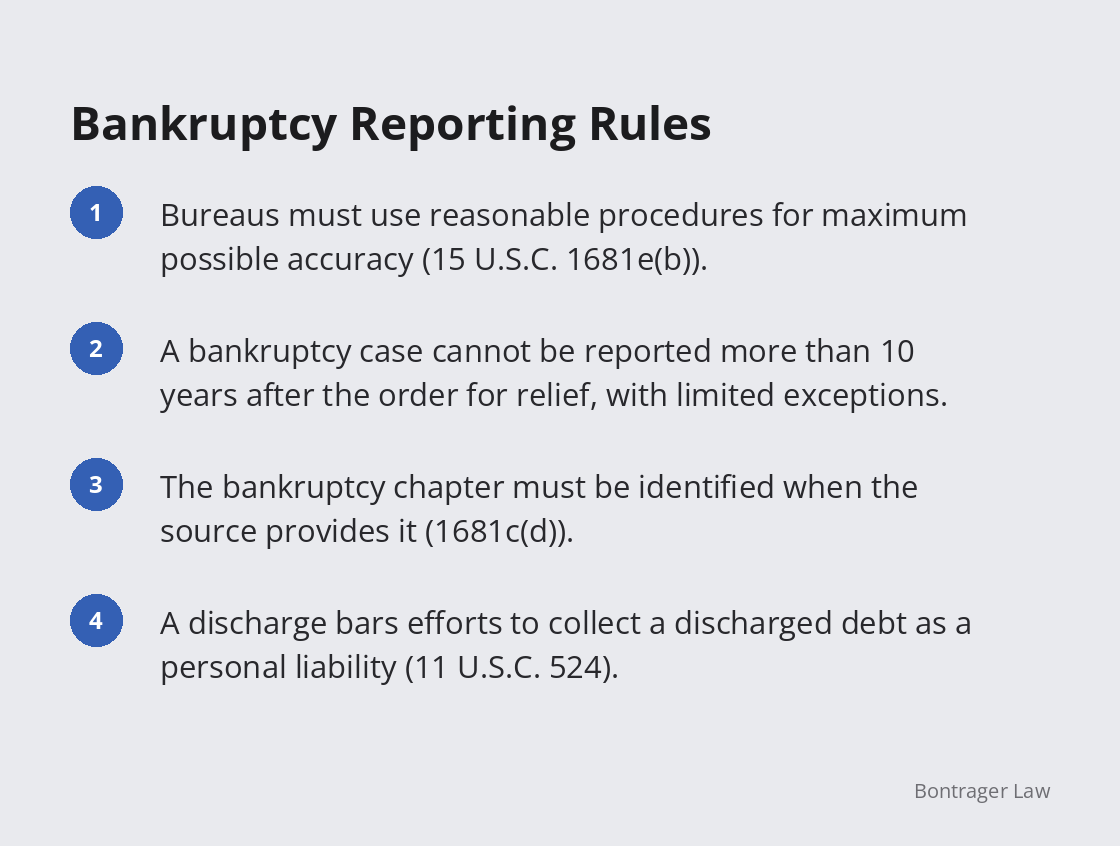
The Fair Credit Reporting Act sets the ground rules for what credit bureaus may report and how carefully they must report it. Under 15 U.S.C. Section 1681e(b), whenever a consumer reporting agency prepares a consumer report, it must follow reasonable procedures to assure maximum possible accuracy of the information about the person the report relates to. That accuracy duty does not stop because a consumer filed bankruptcy. If anything, the period after a discharge is when accurate reporting matters most, because lenders and landlords look closely at how past accounts were resolved.
How Long a Bankruptcy Can Stay on Your Report
Federal law limits how long the bankruptcy case itself may appear. Section 1681c(a)(1) bars a consumer reporting agency from including bankruptcy cases that, from the date of entry of the order for relief or the date of adjudication, antedate the report by more than 10 years, subject to limited exceptions written into the statute. California’s Consumer Credit Reporting Agencies Act contains a parallel rule. Civil Code Section 1785.13(a)(1) prohibits a consumer credit reporting agency from reporting bankruptcies that, from the date of the order for relief, antedate the report by more than 10 years.
The Chapter Must Be Identified
The type of bankruptcy matters to anyone reading your report. Under Section 1681c(d)(1), a consumer reporting agency that reports a bankruptcy case must identify the chapter of the Bankruptcy Code under which the case arises if the source of the information provided it. The same section requires the report to show that a case was withdrawn by the consumer before a final judgment once the agency receives documentation certifying the withdrawal. California Civil Code Section 1785.13(c) also requires identification of the chapter when it can be determined from what the source provided.
What a Discharge Means for Old Accounts
A bankruptcy discharge changes the legal status of the debts it covers. Under 11 U.S.C. Section 524(a)(2), a discharge operates as an injunction against any action or act to collect, recover, or offset a discharged debt as a personal liability of the debtor. When a creditor or bureau keeps reporting a discharged account as currently past due, as owing a balance you are personally obligated to pay, or as an active collection, the report can paint a misleading picture of your finances. Not every debt is discharged, however, since Section 523 lists categories of debts that a discharge does not cover, so reviewing your discharge order and schedules is an important first step.
How to Dispute Post-Bankruptcy Errors in California
Disputing a bankruptcy reporting error works best when it is organized, specific, and documented. The FCRA gives consumers a formal dispute process with real deadlines, and the way you use that process can shape what happens later if the error is not fixed. Starting with clear records makes it far easier to show exactly what is wrong.
Gather Your Bankruptcy Documents
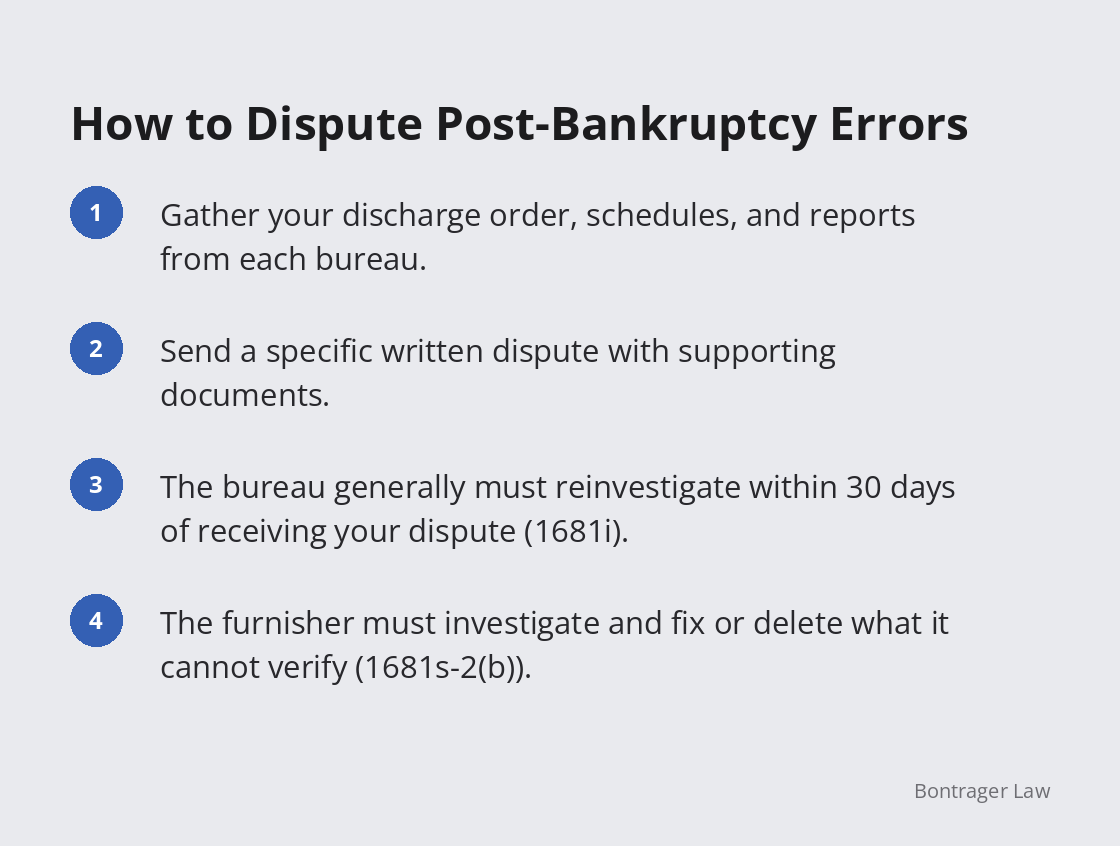
Before you contact any credit bureau, collect your discharge order, the schedules listing your creditors, and your most recent credit reports from each nationwide bureau. Compare every account line by line. Look for accounts that were included in the bankruptcy but still show a balance owed, late payments reported after the discharge, collection accounts that appear newly opened, duplicate entries for the same debt, or a bankruptcy listed under the wrong chapter. Write down each item, what is wrong with it, and which document proves the correct information.
Pay close attention to dates. The date your case was filed, the date the discharge was entered, and the date each account was last reported all help show whether a furnisher kept reporting a debt as if nothing had changed. If an account shows new late payments for months after your discharge, that pattern can be strong evidence that the furnisher never updated its records. Organizing these dates in a simple timeline before you dispute makes your letter clearer and helps anyone reviewing your case understand the error quickly.
File a Written Dispute With the Credit Bureau
Under 15 U.S.C. Section 1681i(a)(1)(A), when a consumer disputes the completeness or accuracy of an item and notifies the agency, the agency must conduct a reasonable reinvestigation at no charge and record the current status of the item or delete it before the end of the 30-day period that begins on the date the agency receives the dispute. Section 1681i(a)(1)(B) allows that period to be extended by up to 15 days in limited situations, such as when you send additional relevant information during the first 30 days. Within five business days of receiving the dispute, the agency must notify the company that furnished the information under Section 1681i(a)(2). If the item is found to be inaccurate, incomplete, or cannot be verified, Section 1681i(a)(5) requires the agency to promptly delete or modify it, and Section 1681i(a)(6) requires written notice of the results within five business days after the reinvestigation is completed.
The Creditor’s Duty to Investigate
Creditors that report information to the bureaus, called furnishers, have their own obligations. Once a furnisher receives notice of a dispute from a credit bureau, 15 U.S.C. Section 1681s-2(b) requires it to conduct an investigation, review all relevant information the bureau provided, and report the results. If the information is inaccurate, incomplete, or cannot be verified, the furnisher must promptly modify, delete, or permanently block the reporting of that item. California adds its own rule in Civil Code Section 1785.25(a), which says a person shall not furnish information to a consumer credit reporting agency if the person knows or should know the information is incomplete or inaccurate.
Mistakes That Can Weaken Your FCRA Claim
Many people give up after a first dispute is rejected, or they take steps that make a later claim harder to prove. Bankruptcy reporting errors often require persistence, and the details of how you dispute can matter as much as the error itself. Avoiding a few common missteps keeps your options open.
Sending Vague or Incomplete Disputes
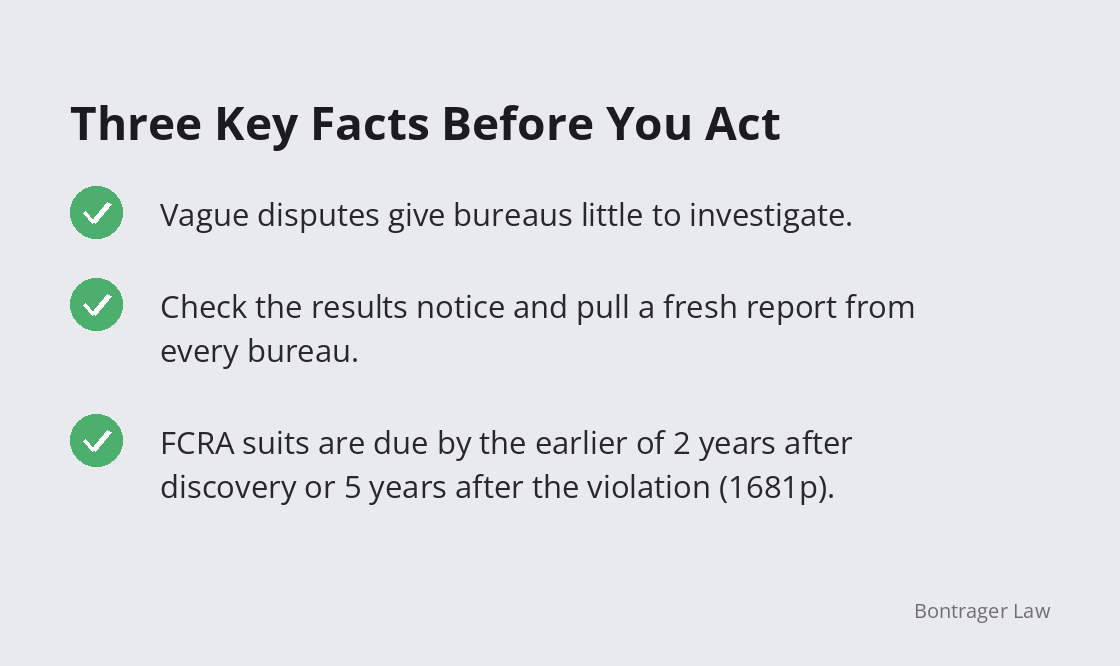
A dispute that simply says an account is wrong gives the bureau and furnisher little to investigate. Clear disputes name the account, explain that the debt was discharged or included in a specific bankruptcy case, state exactly how the reporting is inaccurate, and attach supporting documents such as the discharge order. Keeping copies of everything you send, along with proof of the date it was received, creates the paper trail that shows what the bureau and furnisher knew and when they knew it.
Ignoring the Results Letter
The results of a reinvestigation can reveal whether the bureau actually fixed the problem. Read the results carefully and pull a fresh report afterward to confirm the change. Sometimes an error is corrected at one bureau but not the others, or an item is updated but still shows a balance owed. If an item that was deleted later reappears, the FCRA has specific rules about reinsertion, and a related article on FCRA lawsuit deadlines in California explains what to consider before taking the next step.
Waiting Too Long to Act
FCRA claims have time limits. Under 15 U.S.C. Section 1681p, an action must be brought not later than the earlier of two years after the date the plaintiff discovers the violation or five years after the date the violation occurs. Because the clock can start when you learn about the problem, delaying for months after a failed dispute can shrink your options. Acting while your records are fresh also makes it easier to connect the reporting error to the credit denials or other harm it caused.
Final Thoughts
A bankruptcy discharge is meant to give you a genuine fresh start, and accurate credit reporting is part of that promise. Federal law requires credit bureaus to use reasonable procedures for maximum possible accuracy, to identify the bankruptcy chapter, and to reinvestigate disputes within set deadlines. Creditors must investigate disputes passed along by the bureaus and correct information they cannot verify, and California law adds its own duties for both bureaus and furnishers.
Correcting these errors often takes more than one letter, but a careful, well-documented dispute puts you in the strongest position. When bureaus or creditors ignore clear evidence that a debt was discharged, the law gives you ways to hold them accountable.
If your credit report still shows discharged debts as owed after bankruptcy, contact Bontrager Law to speak with our team about your situation. We represent consumers across California in credit reporting disputes and will review your reports, explain your rights, and help you decide on the best next step.