
Credit report reinsertion in California is one of the most frustrating experiences a consumer can face. You spot an error, file a dispute, and finally receive confirmation that the inaccurate account has been deleted. Then, weeks or months later, the same item quietly reappears on your report, often without any warning. Federal and California law both treat that situation seriously. They limit when a credit bureau can put deleted information back into your file, require written notice when it happens, and require procedures designed to stop deleted errors from coming back. Knowing those rules gives you real control over what happens next.
At Bontrager Law, we help consumers across California hold credit bureaus and the companies that furnish information accountable under the Fair Credit Reporting Act so you can move forward with confidence. This guide explains what reinsertion actually is, the steps the law requires before deleted information can return, and the mistakes that can weaken your position when an error reappears.
What Credit Report Reinsertion Actually Means
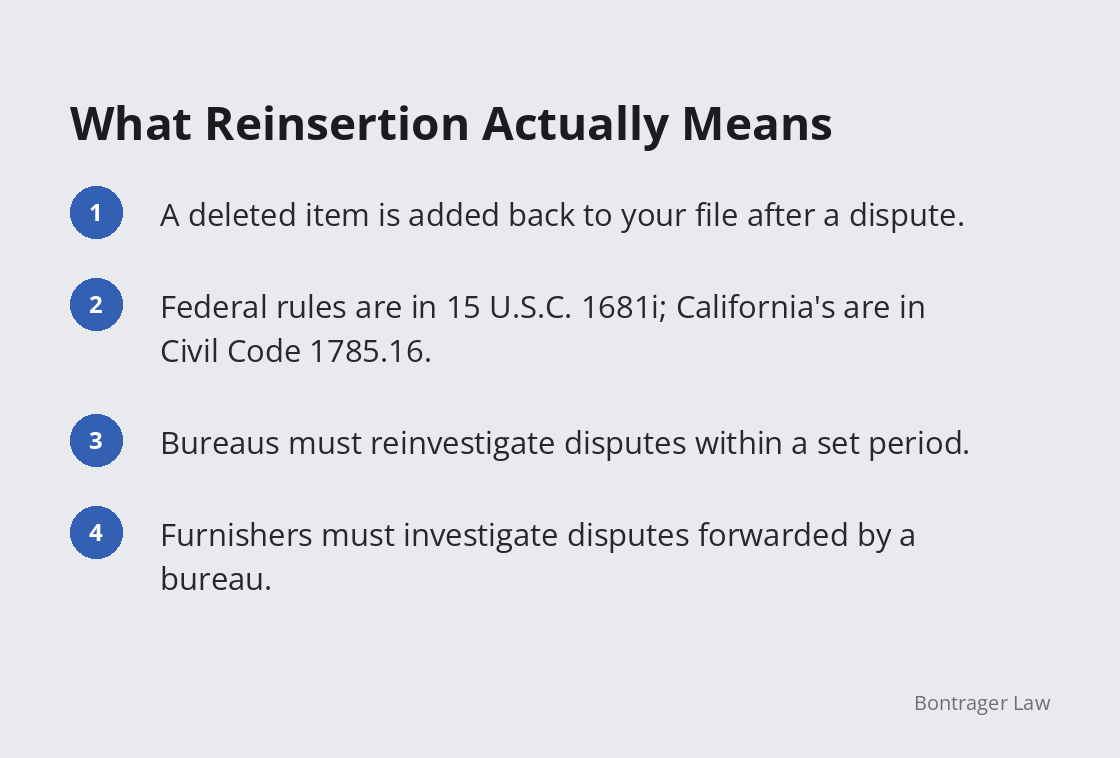
Reinsertion happens when a consumer reporting agency deletes an item from your file after a dispute and later adds that same item back. The federal Fair Credit Reporting Act addresses this directly in 15 U.S.C. Section 1681i, the section that governs how credit bureaus handle disputes. California’s Consumer Credit Reporting Agencies Act contains a parallel rule in Civil Code Section 1785.16. Together, these laws make clear that a deletion after a dispute is not supposed to be temporary or casual. Deleted information can come back only after specific steps, and you are entitled to know when it does.
How a Dispute Leads to Deletion
Under Section 1681i(a)(1)(A), when you dispute the completeness or accuracy of an item in your file and notify the agency directly or through a reseller, the agency must conduct a reasonable reinvestigation to determine whether the disputed information is inaccurate, or delete the item, before the end of the 30-day period beginning on the date it receives your notice. Section 1681i(a)(5)(A) then provides that if the item is found to be inaccurate or incomplete or cannot be verified, the agency must promptly delete or modify it and promptly notify the company that furnished the information. California’s Section 1785.16(a) sets a similar reinvestigation duty, measured as 30 business days, and Section 1785.16(b) requires the agency to promptly add, correct, or delete information found to be inaccurate, missing, or no longer verifiable.
Why Deleted Errors Come Back
Deleted items most often return because the company that originally reported the account sends the same data again in a later monthly update, or because an account is sold or transferred and a new company reports it under a different name or account number. In other cases, a furnisher responds to the original dispute late and the bureau treats that response as a basis to restore the item. Whatever the cause, the law does not leave the decision to chance. The bureau must follow defined rules before it can put deleted information back.
The Furnisher’s Role
Credit bureaus do not create most of the information in your file. Banks, lenders, collectors, and other furnishers supply it. When a bureau forwards your dispute, 15 U.S.C. Section 1681s-2(b) requires the furnisher to conduct an investigation, review all relevant information the bureau provided, and report the results back. If the information is found to be inaccurate or incomplete or cannot be verified, the furnisher must promptly modify, delete, or permanently block the reporting of that item. A furnisher that simply re-reports a deleted account without addressing the dispute may have its own responsibility under the law.
The Rules That Must Be Followed Before Reinsertion
Both federal and California law allow reinsertion only in narrow circumstances and only with notice to you. These requirements are what give consumers leverage when a deleted error reappears, because a bureau that skips them has not followed the law.
The Certification Requirement
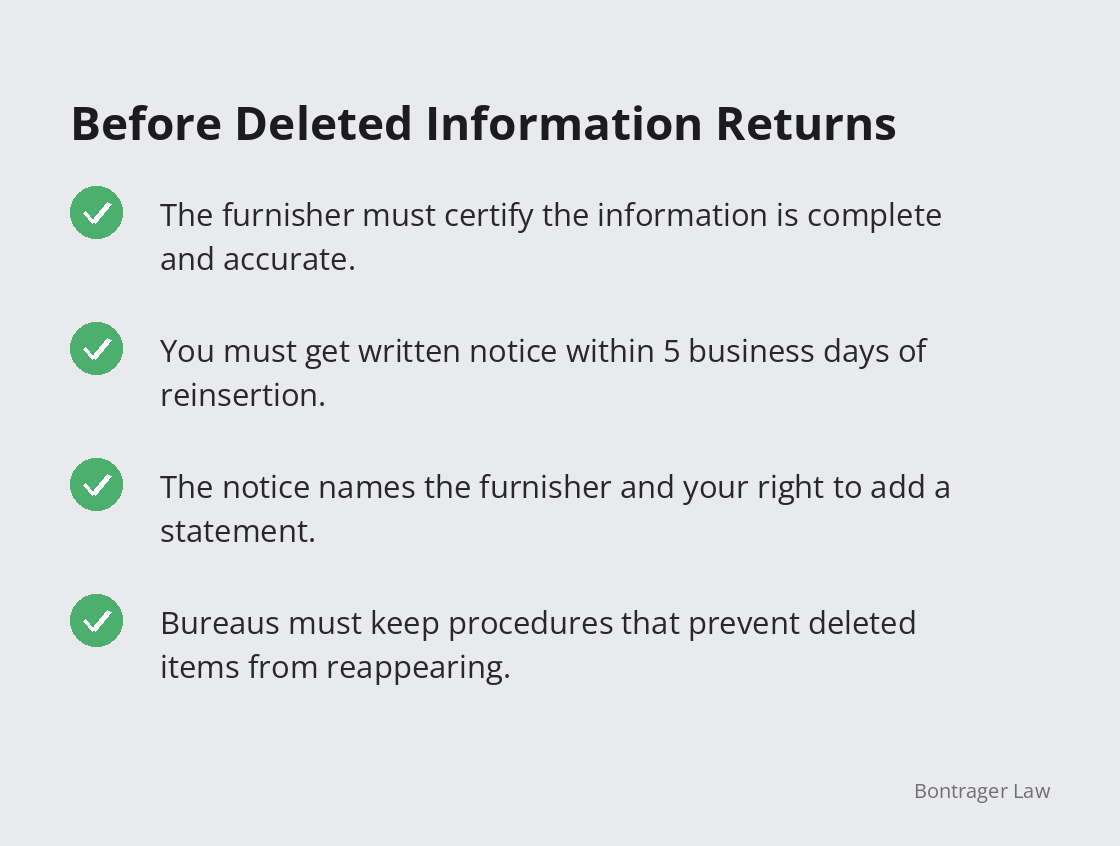
Section 1681i(a)(5)(B)(i) states that information deleted after a dispute may not be reinserted in your file unless the person who furnishes the information certifies that the information is complete and accurate. California’s Section 1785.16(c) uses similar language, providing that no information may be reinserted after deletion unless the person who furnished the information certifies that it is accurate. This means a bureau cannot restore a deleted account simply because the same data showed up again in a routine update. A furnisher must stand behind the information first.
Written Notice Within Five Business Days
If deleted information is reinserted, Section 1681i(a)(5)(B)(ii) requires the bureau to notify you of the reinsertion in writing not later than 5 business days after the reinsertion, or by other means if you authorized them. Under Section 1681i(a)(5)(B)(iii), that notice must include a statement that the disputed information has been reinserted, the business name and address of the furnisher involved and its telephone number if reasonably available, and a notice that you have the right to add a statement to your file disputing the accuracy or completeness of the information. California’s Section 1785.16(c) requires similar written disclosures within five business days of reinsertion and adds a notice that you have the right to a reinvestigation of the reinserted information.
Procedures to Prevent Reappearance
The law also looks forward. Section 1681i(a)(5)(C) requires a consumer reporting agency to maintain reasonable procedures designed to prevent the reappearance in your file, and in consumer reports about you, of information that was deleted, other than information properly reinserted after certification. California’s Section 1785.16(i) contains the same type of requirement. Section 1681i(a)(5)(D) adds that bureaus that compile files nationwide must maintain an automated system that lets furnishers report reinvestigation results that find inaccurate or incomplete information to the other nationwide bureaus. When a deleted error keeps returning, these procedure requirements often become the center of the case.
Mistakes That Weaken a Reinsertion Claim
A reappearing error is upsetting, but how you respond can make a significant difference. The most common problems come from losing track of documents, waiting too long, and treating a reinsertion as the end of the road rather than a new dispute.
Discarding Dispute Results
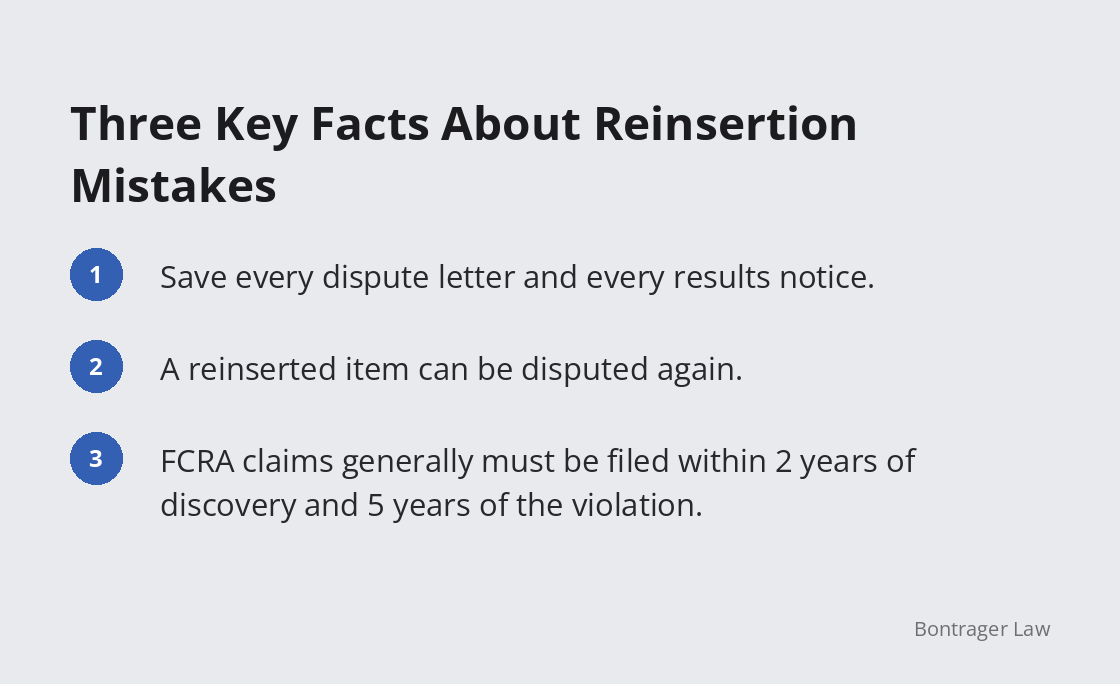
Under Section 1681i(a)(6), the bureau must give you written notice of the results of a reinvestigation within 5 business days after completing it, including a statement that the reinvestigation is complete and a consumer report based on your revised file. That letter is often the single most important piece of evidence in a reinsertion case, because it proves the item was deleted and when. Consumers who throw away those results, or who do not save copies of their dispute letters and mailing receipts, can find it much harder to show what happened.
Assuming the Reinsertion Is Final
A reinserted item is not beyond challenge. You can dispute it again, and California’s Section 1785.16(c) expressly requires the bureau to tell you that you have the right to a reinvestigation of reinserted information. If a reinvestigation does not resolve the dispute, Section 1681i(b) allows you to file a brief statement setting out the nature of the dispute, and Section 1681i(c) requires the bureau to note in later reports that the information is disputed and include your statement or a clear summary. Asking how the information was verified, including what the furnisher certified, can also reveal whether the required steps were actually taken.
Waiting Too Long to Act
The Fair Credit Reporting Act has a firm time limit. Under 15 U.S.C. Section 1681p, an action to enforce liability under the Act must be brought not later than the earlier of 2 years after the date you discover the violation, or 5 years after the date the violation occurs. Sections 1681n and 1681o allow consumers to seek damages for willful or negligent noncompliance with the Act. Because reinsertion problems often unfold over several months, it is wise to have your situation reviewed soon after you notice a deleted item has returned, rather than waiting to see whether it disappears on its own.
Final Thoughts
Credit report reinsertion in California is not supposed to happen quietly. Federal and state law require a furnisher to certify that deleted information is accurate before it returns, require written notice to you within five business days, and require bureaus to maintain procedures that keep deleted errors from reappearing. When those steps are skipped, consumers have the right to dispute again and to hold the responsible companies accountable. If you are dealing with other reporting problems, our guide to the FCRA method of verification explains how to find out what a bureau actually did with your dispute.
The most effective step you can take right now is to gather your dispute letters, the results you received, and a current copy of your report showing the reinserted item. Those documents tell the story of what happened and when.
If a deleted error has reappeared on your credit report, contact Bontrager Law to speak with our consumer protection team. We will review your reports and dispute history, explain your rights under the Fair Credit Reporting Act and California law, and help you decide on the right next step with confidence.