
EFTA error resolution in California gives you a real path to get money back when a debit card charge, ATM withdrawal, or online transfer leaves your account without your permission. Finding an unfamiliar transfer on your bank statement is alarming, and many people assume the bank will simply fix it. Sometimes that happens. Other times the bank denies the claim, takes weeks to respond, or tells you the transfer looked legitimate. Knowing what federal law requires of your bank, and what it requires of you, makes a real difference in how that story ends.
At Bontrager Law, we help consumers across California hold banks and other financial institutions to their obligations under the Electronic Fund Transfer Act so you can move forward with confidence. This guide explains what the error resolution process actually covers, the steps and timelines your bank must follow after you report a problem, and the mistakes that most often weaken an otherwise strong claim.
What EFTA Error Resolution Actually Covers
The Electronic Fund Transfer Act, found at 15 U.S.C. section 1693 and following, protects consumers who move money electronically. It applies to debit card purchases, ATM withdrawals, direct deposits, automatic bill payments, and many online and app-based transfers out of a consumer account. The Consumer Financial Protection Bureau implements the law through Regulation E, located at 12 C.F.R. Part 1005. Together, the statute and the regulation set out a structured process that your bank must follow when you tell it something is wrong with your account.
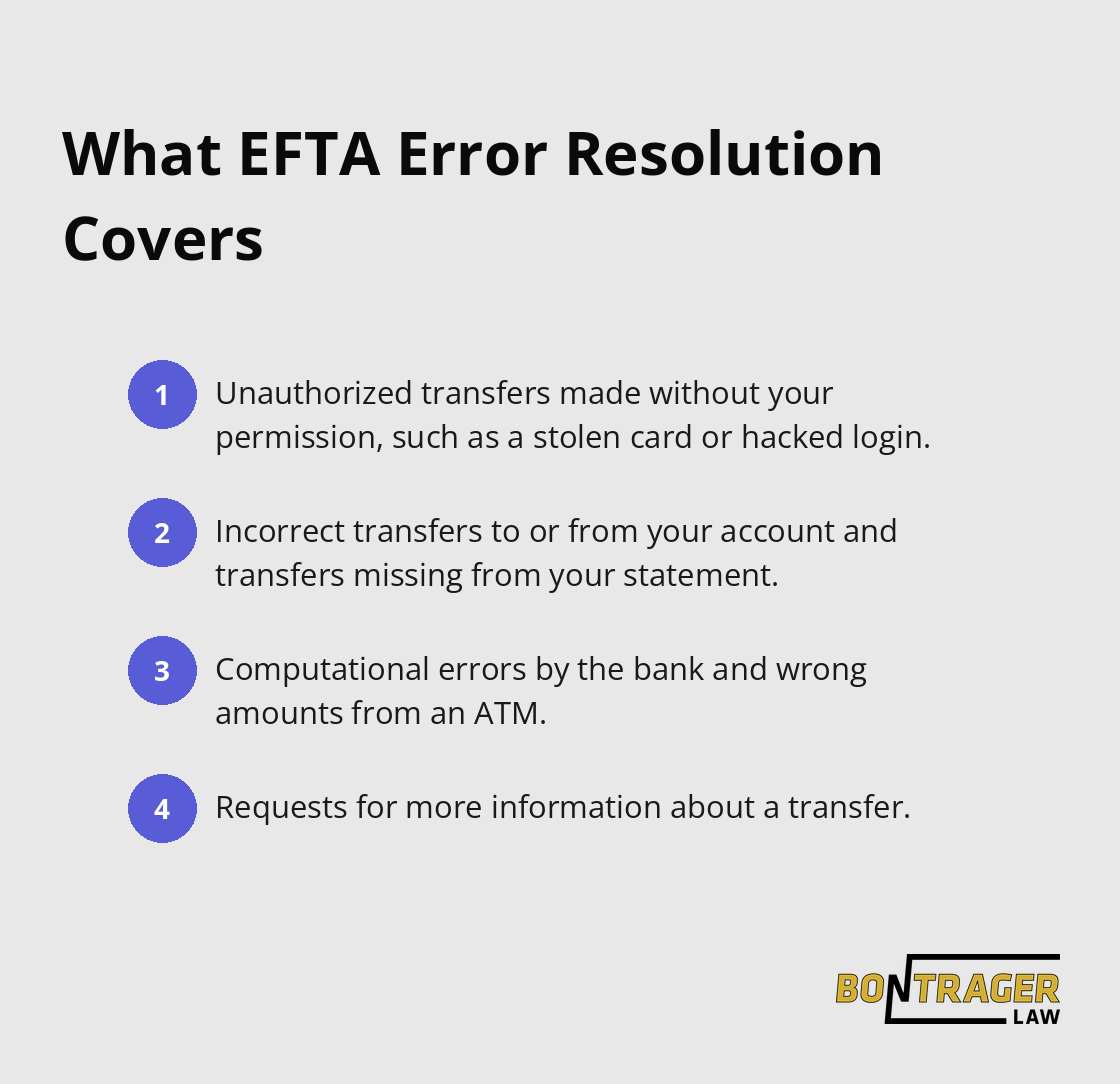
That process is called error resolution, and it is broader than many people realize. Under section 1693f(f), an error includes an unauthorized electronic fund transfer, an incorrect transfer to or from your account, a transfer that should have appeared on your periodic statement but did not, a computational error by the institution, receiving the wrong amount of money from an ATM, and a request for additional information or clarification about a transfer. In other words, the law does not only protect you from thieves. It also protects you from your bank’s own mistakes.
What Counts as an Unauthorized Transfer
Section 1693a(12) defines an unauthorized electronic fund transfer as one initiated by someone other than you, without actual authority, and from which you receive no benefit. That covers a stolen debit card, a skimmed card number, or a criminal who takes over your online banking login. The definition matters because a transfer that fits it triggers both the error resolution rules and the federal limits on how much responsibility can be placed on you for the loss.
Transfers the Definition Leaves Out
The same definition contains important exceptions. A transfer is not unauthorized if it was made by someone you gave your card, code, or other means of access to, unless you had already told the bank that person was no longer allowed to make transfers. It also excludes transfers made with fraudulent intent by you or anyone acting with you, and transfers that are simply errors committed by the financial institution, which are handled as other types of errors. If you shared a PIN with a family member or roommate, for example, the analysis becomes more complicated, and it helps to have the facts reviewed carefully before you assume you have no claim.
Why the Burden of Proof Matters
One of the most consumer-friendly parts of the law is found in section 1693g(b). In any action involving your liability for an unauthorized transfer, the burden of proof is on the financial institution to show that the transfer was authorized. Banks sometimes send a short letter stating that their review found no error, as if that ends the matter. It does not. When the bank later has to justify that decision, it is the bank that must back it up, not you who must prove a negative.
How the Error Resolution Process Works After You Report
The error resolution process begins with your notice and then runs on deadlines that apply to the bank. Those deadlines are written into both section 1693f and Regulation E section 1005.11, and they are not suggestions. Understanding them helps you recognize when a bank is following the rules and when it is falling short.
Giving Your Bank Timely Notice
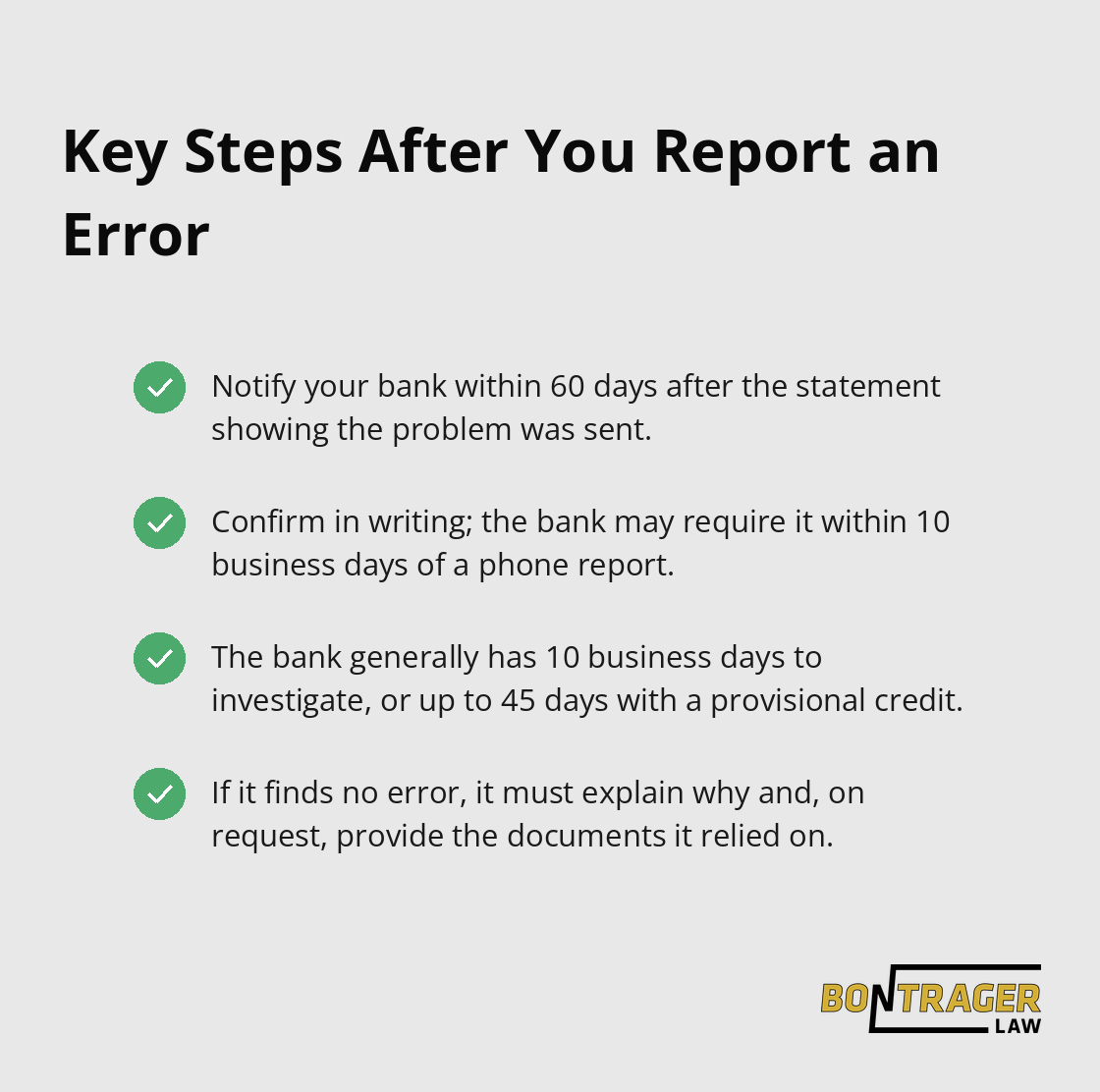
Under section 1693f(a), the protections apply when the bank receives your oral or written notice within sixty days after it sent you the statement or other documentation showing the problem. Your notice should identify your name and account number, explain that you believe there is an error and roughly how large it is, and give your reasons for believing an error occurred. A phone call counts, but the bank may require written confirmation within ten business days of an oral notice if it tells you so at the time of the call and gives you the address to send it to. Following up in writing is almost always the safer approach, because it creates a clear record of exactly what you reported and when.
Investigation and Provisional Credit Deadlines
Once the bank receives proper notice, Regulation E section 1005.11(c) generally requires it to investigate and determine whether an error occurred within ten business days. If it cannot finish that quickly, it may take up to forty-five days from receiving your notice, but only if it provisionally credits your account for the amount in dispute within ten business days and gives you full use of those funds while the investigation continues. The bank must also tell you about the provisional credit within two business days after making it. Longer periods apply in certain situations, such as point-of-sale debit card transactions, transfers not initiated within a state, and transfers on new accounts, where the investigation window can extend to ninety days. If the bank determines that an error did occur, it must correct it within one business day of that determination.
When the Bank Says There Was No Error
If the bank concludes that no error occurred, section 1693f(d) requires it to send you an explanation of its findings within three business days after finishing its investigation. That explanation must tell you that you have the right to request copies of the documents the bank relied on, and the bank must promptly provide those copies if you ask. Requesting them is one of the most useful steps you can take. The documents often reveal whether the bank actually investigated or simply relied on the fact that a correct card number or password was used, which does not by itself prove that you authorized the transfer.
Mistakes That Weaken an EFTA Claim
Many EFTA claims fail not because the consumer was wrong, but because of avoidable missteps early in the process. The law rewards prompt, documented action, and banks pay close attention to whether consumers met each requirement. Avoiding the following mistakes keeps your options open if the bank refuses to make things right.
Waiting to Review Statements or Report a Lost Card
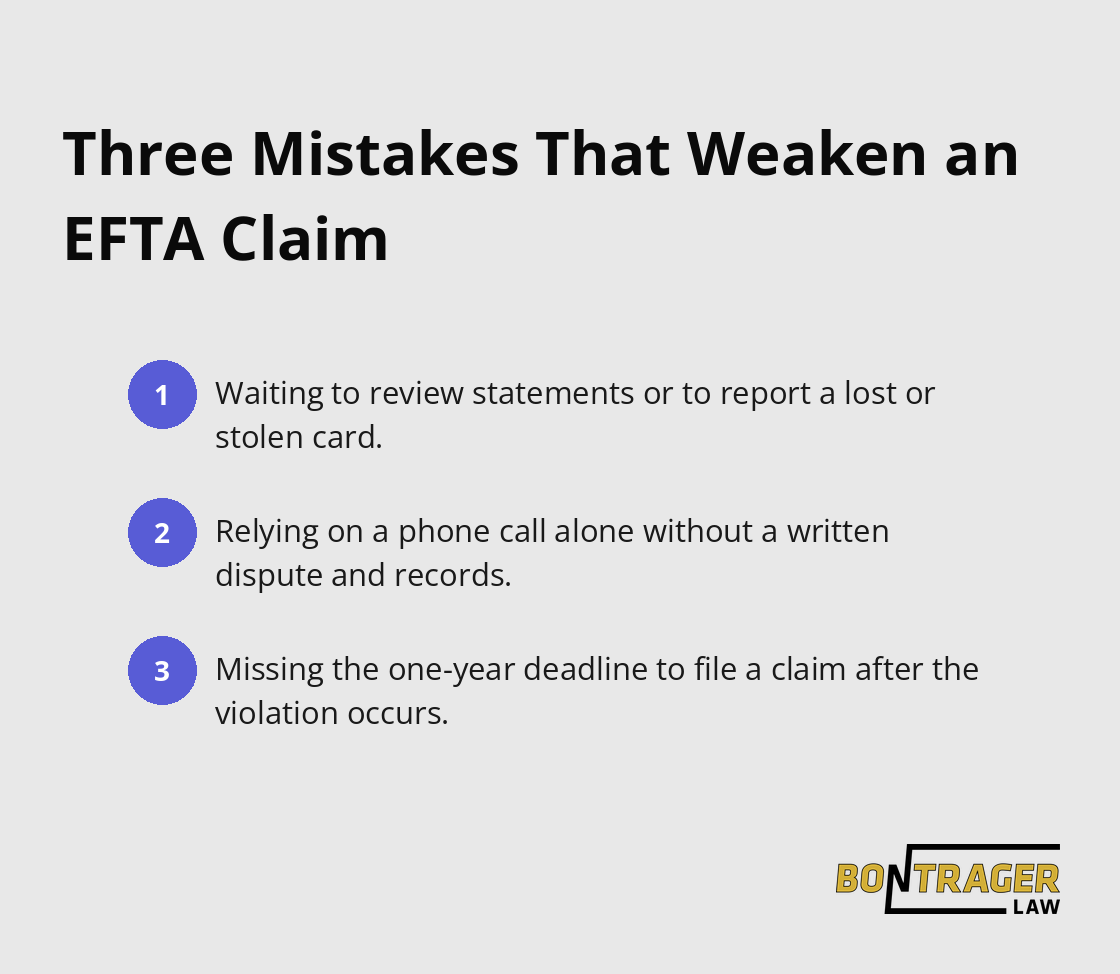
Section 1693g links your potential responsibility for unauthorized transfers to how quickly you act. The statute treats a report made within two business days after you learn your card or other access device was lost or stolen differently from a later report, and it allows a bank to deny reimbursement for losses it can show would not have occurred if you had reported unauthorized transfers within sixty days after your statement was sent. The law does allow a longer, reasonable period in extenuating circumstances such as extended travel or hospitalization, but you should never count on that. Reviewing every statement as soon as it arrives and reporting a missing card immediately is the simplest way to protect yourself.
Relying Only on a Phone Call
Calling the bank’s fraud line is a sensible first step, but it should not be the only one. Phone conversations are easy to misremember and hard to prove, and a bank that has asked for written confirmation is not required to provisionally credit your account if that confirmation does not arrive within ten business days. Send a written dispute that lists each transaction, the date you discovered it, and why you did not authorize it. Keep copies of everything you send and receive, along with any police report or identity theft report you file.
Missing the Deadline to File a Claim
If the bank does not follow the law, section 1693m allows you to bring a civil action against it, but the window to do so is short. Under section 1693m(g), an action must be brought within one year from the date of the occurrence of the violation. That is considerably shorter than the deadlines under many other consumer protection laws. If you have already received a denial letter, or the bank is ignoring its own investigation deadlines, it is wise to have your situation reviewed sooner rather than later so that the clock does not run out while you wait for a response.
Final Thoughts
EFTA error resolution in California is built to protect you when money leaves your account without your permission or because of a bank mistake. The law gives you a clear way to report the problem, sets firm deadlines for your bank’s investigation, often requires a provisional credit while that investigation is underway, and places the burden on the bank to show that a disputed transfer was authorized. Your part is to act quickly, put your dispute in writing, and keep careful records.
If your bank has denied your claim or failed to respond on time, you do not have to accept that as the final word. You can learn more about our Electronic Fund Transfer Act work and how these claims are handled.
If you are dealing with an unauthorized transfer or a denied dispute, contact Bontrager Law to speak with our team about your situation. We’ll review what happened, explain your rights under federal law, and help you take the next step toward getting your account back to where it should be.