
Credit reporting errors can wreck your finances and your future. At Bontrager Law, we’ve seen how inaccurate information on your credit file can tank your loan applications, raise your interest rates, and damage your reputation.
California fair credit reporting laws give you real power to fight back. You have the right to know what’s in your file, challenge false information, and recover money when bureaus break the rules.
What California’s Fair Credit Reporting Act Actually Protects
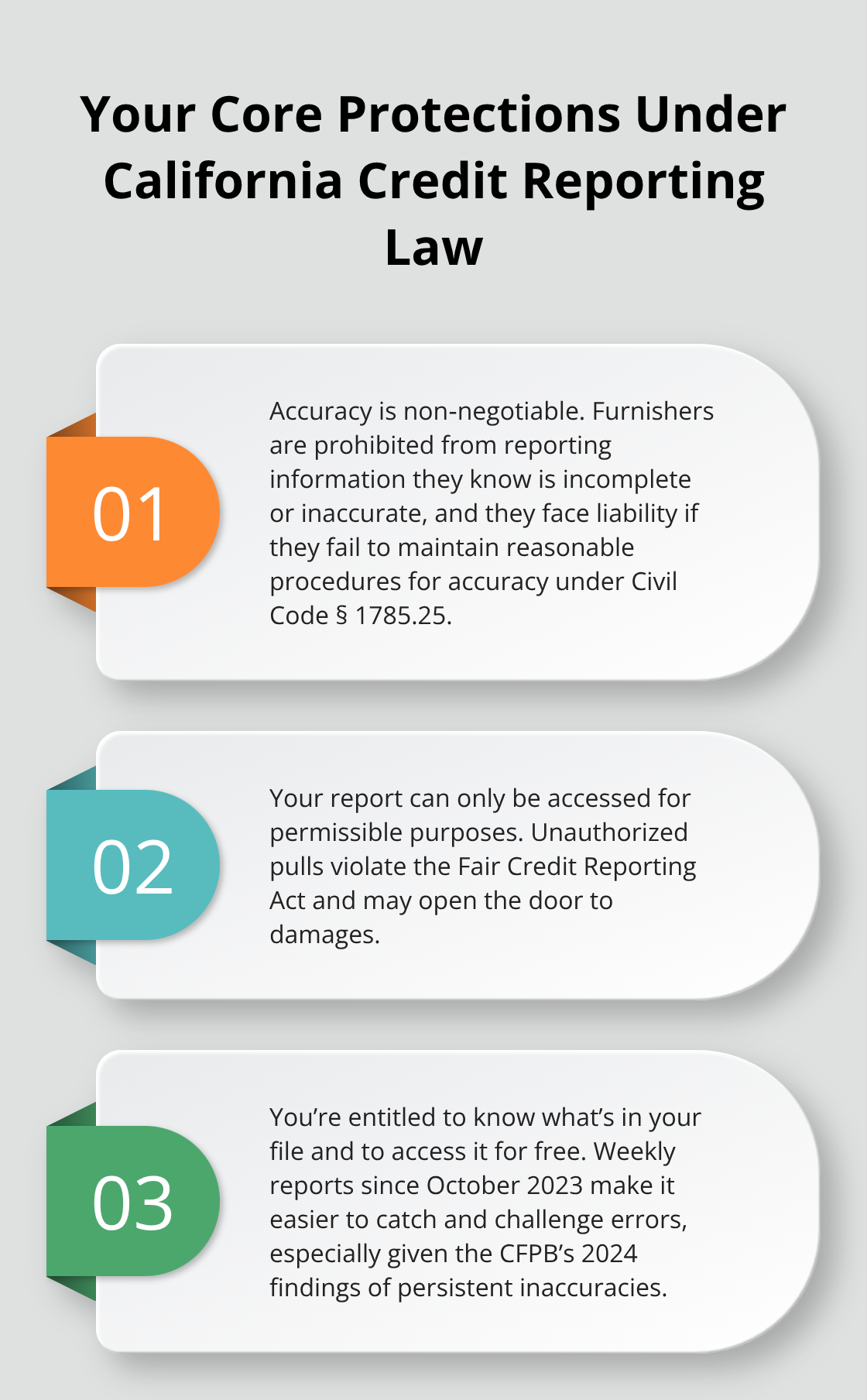
California law grants you three concrete protections that most people overlook. First, you hold the absolute right to accurate information in your credit file. The California Consumer Credit Reporting Agencies Act prohibits furnishers-the banks, creditors, and collection agencies reporting to credit bureaus-from sending information they know is incomplete or inaccurate. If a furnisher identifies an error after reporting it, they must notify the credit bureau and supply corrections within a specific timeframe. This carries real consequences: under California Civil Code Section 1785.25, furnishers face liability if they fail to maintain reasonable procedures for accuracy. Second, you have protection against unauthorized inquiries into your credit file. Credit bureaus can only pull your report for permissible purposes defined by federal law-credit decisions, employment screening, tenant applications, insurance underwriting, and similar legitimate reasons. Unauthorized access violates the Fair Credit Reporting Act and opens the door to damages. Third, you have the right to know exactly what’s in your file and to access it for free. Since October 2023, you can check your credit report from Equifax, Experian, and TransUnion once per week at no cost, in addition to your annual free report. This frequent access matters because the CFPB reported in August 2024 that significant errors persist in credit files, including disputes that furnishers fail to reinvestigate properly and negative items that should have been removed.
Furnishers Must Investigate Your Disputes
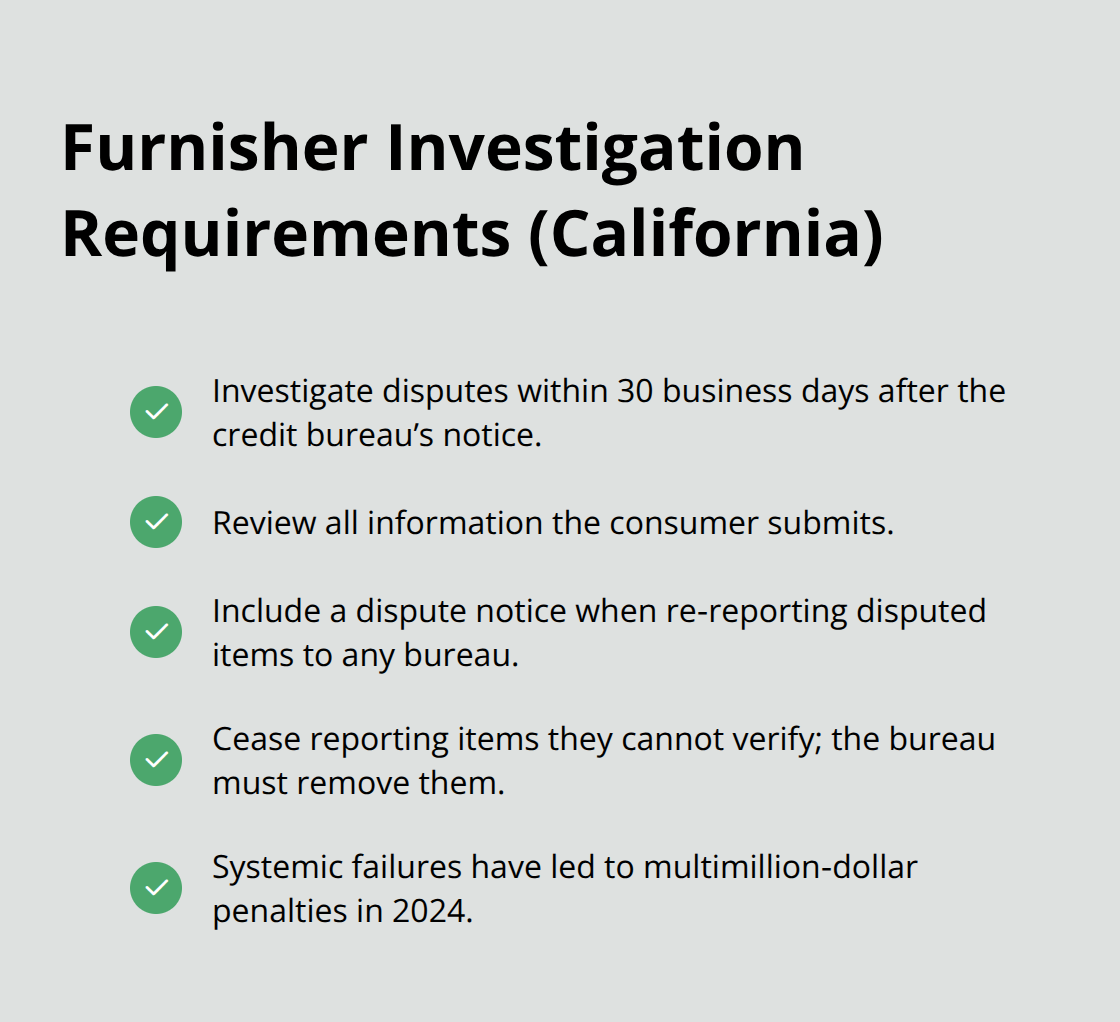
Furnishers cannot ignore your disputes. California law requires them to investigate disputed information within 30 business days of receiving notice from a credit bureau. During that investigation, they must review all information you submit and cannot re-report disputed items to other credit bureaus without including a notice that you dispute it. If the furnisher cannot verify the information, the credit bureau must remove it. The CFPB’s enforcement actions reveal how serious this obligation is: in 2024, TransUnion paid $23 million for improper reporting and background-check practices, and Toyota Motor Credit paid $60 million for violations including slow dispute investigations. These weren’t isolated incidents-they reflect systemic problems in how major companies handle your data.
Access Your Reports Regularly and Strategically
California residents gain more frequent access to credit reports than the federal minimum requires. Pull your reports regularly and look for accounts you don’t recognize, late payments that don’t match your records, and accounts marked as closed that you actually paid off. Negative information has time limits: most negative items stay for seven years, though bankruptcies remain for ten. Medical debt, which once crushed credit scores, can no longer appear on credit reports as of 2025 under CFPB rules. When you spot errors during your review, document them immediately and file a dispute with the credit bureau. The law requires the bureau to investigate, and if they cannot verify the information within 30 days, it must come off your file.
What Happens When Furnishers Fail to Correct Errors
When a furnisher fails to correct inaccurate information or refuses to investigate your dispute properly, you have legal recourse. The furnisher’s obligation extends beyond a single credit bureau-they must correct information across all credit reporting agencies where they reported the error. If they report disputed information without including a dispute notice, or if they fail to investigate within the required timeframe, they violate California law. These violations create the foundation for your legal claim, which we’ll explore in detail in the next section on how to dispute credit reporting errors and what steps you need to take to protect your rights.
How to Dispute Credit Reporting Errors That Stick
Start your dispute the moment you spot an error on your credit report. The faster you act, the faster the credit bureau must investigate and the sooner inaccurate information leaves your file. Contact the credit bureau in writing-this creates a paper trail and forces them to follow the 30-day investigation timeline required by California law. You can dispute online through the bureaus’ websites, but sending a certified letter to their dispute department works better. Include your name, address, account number if applicable, and a clear description of what’s wrong. State exactly why you dispute the item: Is the account not yours? Is the balance incorrect? Was the late payment reported after you paid it? The more specific you are, the harder it becomes for the furnisher to dismiss your claim.
Gather Documentation That Proves Your Case
Include copies of supporting documents with your dispute letter-payment receipts, bank statements showing the transfer, letters from the creditor confirming payment, or anything else proving the information is false. Do not send originals; keep those for your records and for potential legal action later. The credit bureau must acknowledge your dispute within five business days and begin its investigation immediately. Many people assume the bureau will contact them with updates, but that’s not guaranteed. Instead, contact the bureau every 15 days to confirm the investigation is moving forward. Ask for the case number and the name of the investigator. This pressure matters because the CFPB found in August 2024 that many furnishers and bureaus drag out investigations or fail to reinvestigate properly, especially for disputes involving complex accounts or older tradelines.
What to Do When the Bureau Closes Your Dispute Without Removing the Item
If the credit bureau closes your dispute after 30 days but refuses to remove the inaccurate information, the problem likely lies with the furnisher. The furnisher claims they verified the information as correct, which means they either did not investigate properly or they have documentation supporting their position. Request a copy of the furnisher’s investigation results from the credit bureau-you have the right to see what they found. If the investigation was sloppy or incomplete, file a second dispute with the credit bureau and include the evidence showing the furnisher’s investigation failed. At the same time, contact the furnisher directly in writing. Send a certified letter to their dispute department with the same documentation you submitted to the credit bureau. Many furnishers respond more aggressively when they receive direct contact rather than communication filtered through the credit bureau.
When the Furnisher Refuses to Correct the Error
If the furnisher still refuses to correct the error after 30 days, they have violated California Civil Code Section 1785.25, which prohibits furnishing information the furnisher knows is incomplete or inaccurate. This violation forms the legal basis for a claim against them, whether through a demand letter or a lawsuit. Keep copies of every letter you send, every response you receive, and every document supporting your position. This documentation becomes critical if you decide to escalate to legal action. When furnishers fail to correct errors across all credit reporting agencies where they reported the mistake, or when they report disputed information without including a dispute notice, they create additional violations that strengthen your legal position. These failures open the door to the remedies available under California law-remedies that can recover both the actual financial harm you suffered and statutory damages that punish the furnisher for their violations.
Your Legal Remedies for Credit Reporting Violations
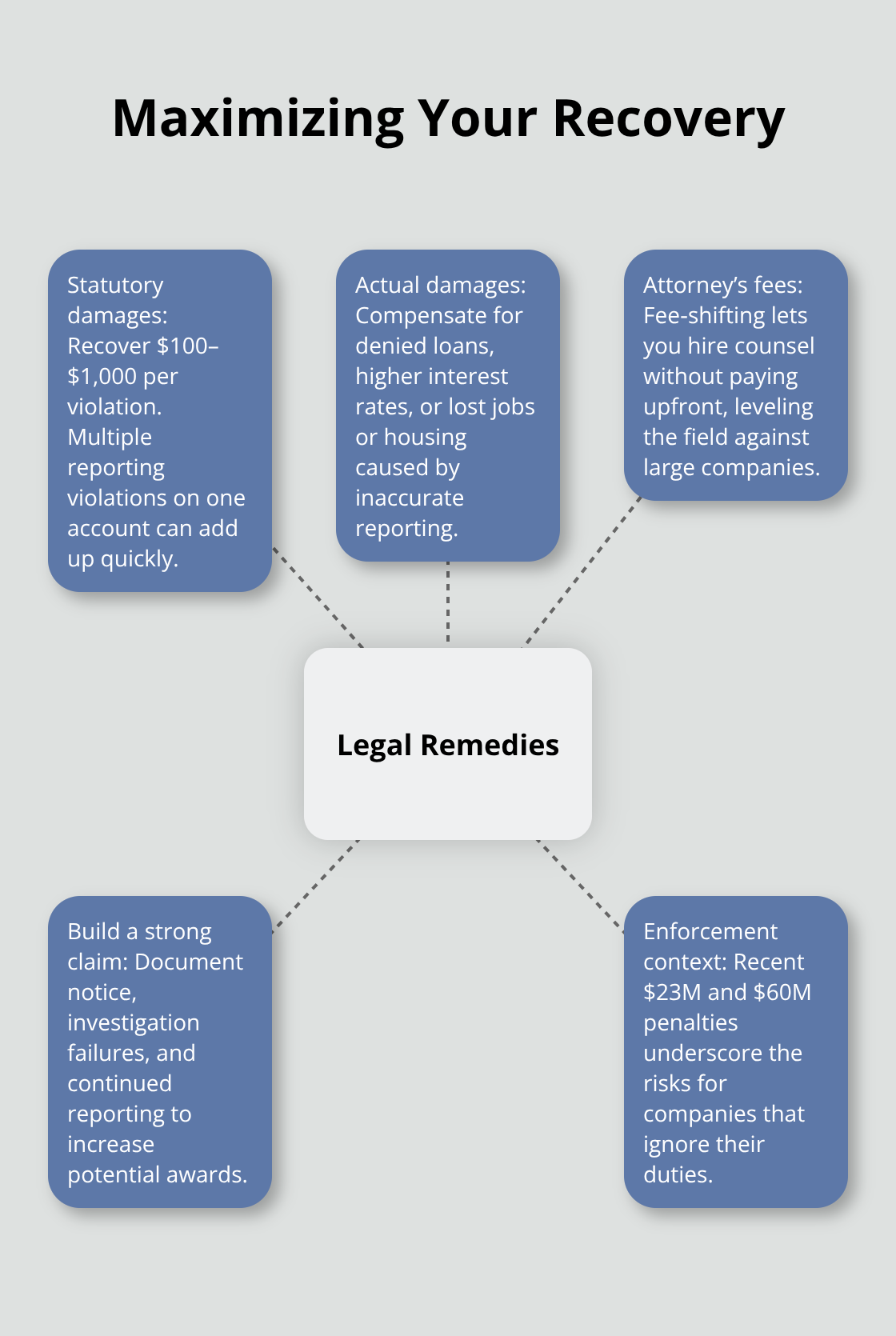
California law provides three distinct paths to recover money when furnishers and credit bureaus violate your rights. Statutory damages offer a fixed amount per violation regardless of your actual financial loss, making substantial compensation possible even when proving specific harm proves difficult. The CFPB’s enforcement actions show real numbers: TransUnion paid $23 million in 2024 for improper reporting and background-check practices, and Toyota Motor Credit paid $60 million for violations including slow dispute investigations. These settlements reflect what happens when companies systematically fail to investigate disputes or report inaccurate information.
Statutory Damages: Fixed Recovery Per Violation
You can pursue statutory damages of $100 to $1,000 per violation under California Civil Code Section 1785.25 for furnishers who knowingly report incomplete or inaccurate information. A single account with multiple reporting violations could generate thousands in statutory damages alone. This fixed-amount approach removes the burden of calculating your exact financial loss-the law itself sets the compensation floor. Furnishers who re-report disputed information without the required dispute notice, or who fail to investigate your claim within 30 business days, trigger these statutory damages. Courts take these violations seriously because they reflect deliberate or reckless disregard for your rights.
Actual Damages: Recovery for Real Financial Harm
Actual damages cover the real financial harm you suffered: denied loans, higher interest rates, job rejections, or housing denials directly tied to inaccurate reporting. If a lender denied your mortgage application because of a false late payment on your credit file, you can recover the difference between the loan rate you would have received and the rate you actually paid elsewhere, or the full loan denial if you couldn’t obtain financing at all. Employment-related damages are equally concrete-if you lost a job opportunity because an inaccurate background check included credit information the employer shouldn’t have considered under California law, that lost income becomes recoverable actual damage. Medical expenses, stress-related costs, and other documented consequences of the reporting error also qualify as actual damages.
Attorney’s Fees and Cost Recovery
Attorney’s fees and court costs shift the financial burden to the violator, which matters because credit reporting violations typically require legal representation to pursue effectively. California law allows prevailing parties to recover reasonable attorney’s fees from furnishers and credit bureaus, making it financially feasible for you to hire counsel without paying out of pocket upfront. This fee-shifting provision levels the playing field against large corporations with in-house legal teams. You don’t face the choice between protecting your rights and protecting your wallet.
Building a Strong Claim for Maximum Recovery
The strength of your recovery depends on how thoroughly you documented the violation and the impact it caused. Courts take seriously cases where furnishers ignore the 30-business-day investigation requirement or fail to correct information across all credit reporting agencies. You need clear evidence showing the furnisher knew or should have known the information was inaccurate, received your dispute notice, failed to investigate properly, and continued reporting the error. Payment receipts, bank statements, and written communications with the furnisher all strengthen your position. Many violations involve furnishers re-reporting disputed information without the required dispute notice, or furnishers who never investigate your claim at all-these egregious failures typically result in higher damages awards. The combination of statutory damages, actual damages, and attorney’s fees means your total recovery can far exceed what you might expect from a single inaccurate account entry.
Final Thoughts
Contact a consumer protection attorney the moment a furnisher refuses to correct errors after 30 business days or when inaccurate information continues appearing on your credit file despite your disputes. You hold grounds for a claim under California fair credit reporting law whenever a furnisher fails to investigate, re-reports disputed items without proper notice, or knowingly reports incomplete information. California law shifts attorney’s fees to the violator, so you can pursue your case without paying out of pocket.
Your recovery includes statutory damages of $100 to $1,000 per violation, actual damages covering denied loans or higher interest rates caused by the inaccurate reporting, and attorney’s fees that make representation affordable. Combined, these remedies can total thousands or tens of thousands of dollars depending on how many violations occurred and how long the furnisher continued reporting false information. After a successful resolution, the furnisher must correct information across all credit reporting agencies, your credit file becomes accurate again, and your credit score rebounds.
We at Bontrager Law represent California residents in these disputes and can show you whether you have a viable claim through a free case review. Your financial future depends on taking action when furnishers violate your rights, not waiting months hoping the problem resolves itself.