
The California Consumer Credit Reporting Agencies Act is the state law that sits alongside the federal Fair Credit Reporting Act, and for many Californians it adds protections that the federal statute alone does not provide. If a credit bureau keeps reporting a debt you never owed, or a lender keeps sending inaccurate information after you have told it about the problem, knowing how both laws work together can change what you are able to do about it. Understanding the state rules gives you real control over the accuracy of your credit file.
At Bontrager Law, we help consumers across California protect their credit files and hold credit bureaus and furnishers accountable so you can move forward with confidence. This guide explains what the California act actually covers, how its dispute and accuracy rules work in practice, and the mistakes and deadlines that most often weaken a claim.
What the California Consumer Credit Reporting Agencies Act Actually Covers
The act is found in Title 1.6 of the California Civil Code, beginning with Section 1785.1. It regulates two main groups. The first group is consumer credit reporting agencies, the companies that compile credit files and provide credit reports to lenders, landlords, and other users. The second group is furnishers, the lenders, servicers, and collectors that send information about your accounts to those agencies. Many of its duties mirror the federal Fair Credit Reporting Act, but the California statute has its own text, its own deadlines, and its own remedies.
That difference matters when you are deciding how to respond to an error. A dispute letter that cites only the federal statute may overlook state duties that apply to the same conduct, and a claim that relies on only one law may leave useful remedies unused. Looking at both statutes from the start helps you frame your dispute, preserve the right evidence, and understand which companies may be responsible for the harm the error caused.
Accuracy Duties for Credit Reporting Agencies
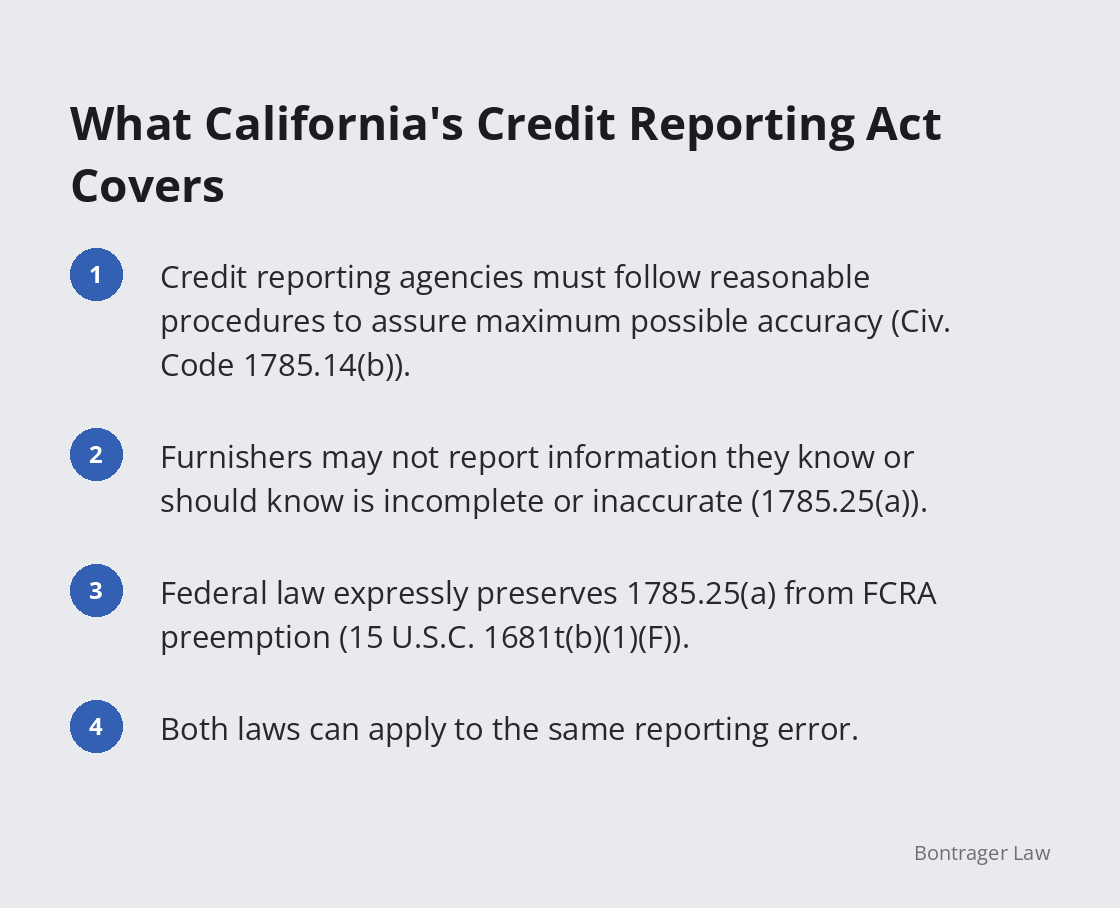
Civil Code Section 1785.14(b) requires that whenever a consumer credit reporting agency prepares a consumer credit report, it must follow reasonable procedures to assure maximum possible accuracy of the information concerning the individual about whom the report relates. Section 1785.14(a) also requires agencies to maintain reasonable procedures to limit furnishing of reports to the purposes the law allows, including requiring prospective users to identify themselves and certify why they want the information. These are not suggestions. They are legal duties that apply every time a report is prepared about you.
Duties for Lenders and Other Furnishers
Section 1785.25(a) states that a person shall not furnish information on a specific transaction or experience to any consumer credit reporting agency if the person knows or should know the information is incomplete or inaccurate. Other parts of Section 1785.25 address corrections, disputed accounts, and investigations by furnishers. As explained below, however, federal law limits which state furnisher rules can be enforced, and the rule in subdivision (a) is the one Congress expressly preserved. That makes the knows-or-should-know standard the centerpiece of most California furnisher claims under state law.
How State and Federal Law Work Together
The federal Fair Credit Reporting Act, in 15 U.S.C. Section 1681t(b), lists subjects on which no requirement or prohibition may be imposed under state law. One of those subjects is the responsibilities of furnishers under Section 1681s-2, but Section 1681t(b)(1)(F) carves out an exception for Section 1785.25(a) of the California Civil Code. Another, in Section 1681t(b)(1)(B), covers the time by which a credit reporting agency must act in a dispute, except for state laws in effect on September 30, 1996. In practical terms, California’s rule against furnishing information a company knows or should know is inaccurate continues to apply alongside the federal rules, while many dispute deadlines are best measured under federal law. For California consumers, the preserved state rule is one of the most important reasons to consider both statutes.
How Disputes Work Under California’s Credit Reporting Law
The act gives you a structured way to challenge information in your credit file. When you understand each step and the timelines that apply, you can build a clear record that shows whether the credit reporting agency and the furnisher did what the law requires. That record becomes the foundation of any later claim.
Filing a Dispute With the Credit Reporting Agency
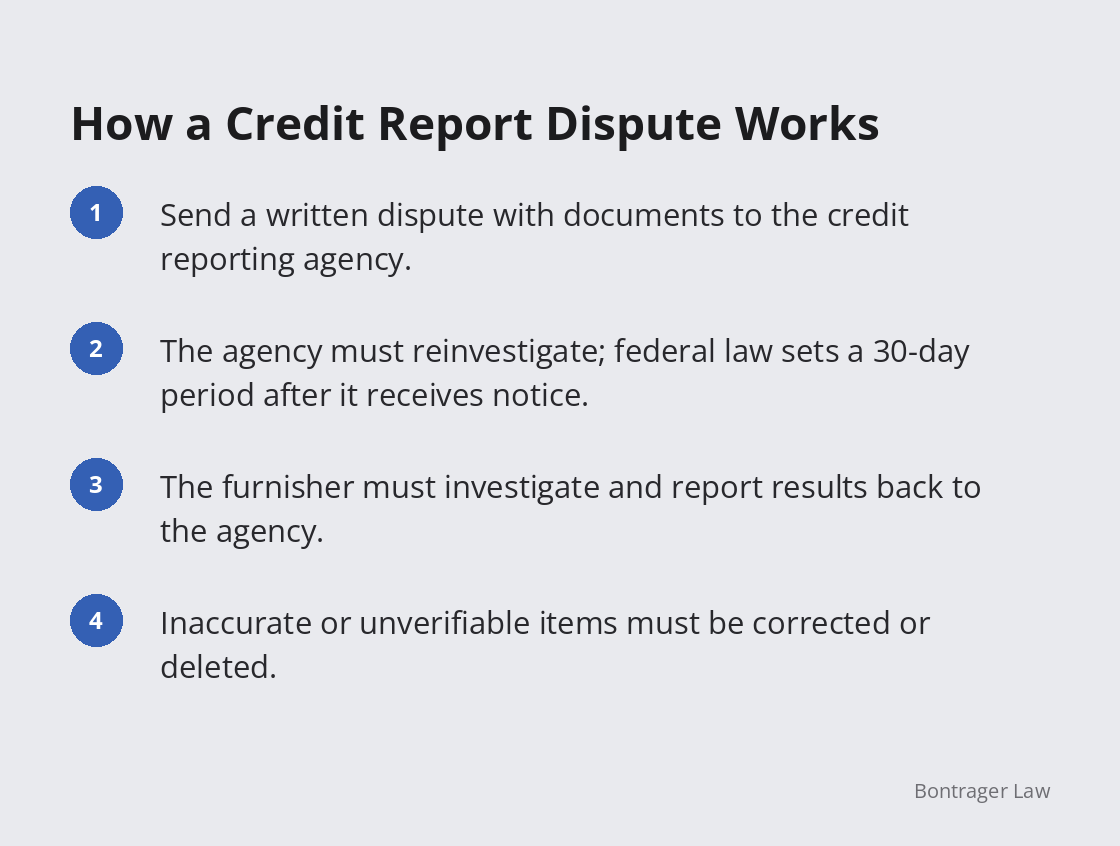
Under Civil Code Section 1785.16(a), if you dispute the completeness or accuracy of an item in your file and convey that dispute directly to the agency, the agency must reinvestigate and record the current status of the disputed information. The California section states a 30-business-day period, while the federal statute, 15 U.S.C. Section 1681i(a)(1), requires a reasonable reinvestigation before the end of the 30-day period that begins when the agency receives notice of the dispute. Because federal law limits state timing rules, tracking the federal period is the safest approach. An agency may require that disputes be in writing under the California statute, so sending a written dispute with supporting documents is usually the strongest approach.
What the Agency Must Do With Your Evidence
Section 1785.16(b) requires the agency to review and consider all relevant information you submit. If the disputed item is found to be inaccurate, missing, or can no longer be verified by the evidence submitted, the agency must promptly add, correct, or delete that information. Under Section 1785.16(d), the agency must give you written notice of the results, including a revised report and a description of any changes made as a result of the reinvestigation. Section 1785.16(e) also states that the presence of contradicting information in your file does not, by itself, give the agency reasonable grounds to treat your dispute as frivolous or irrelevant.
Furnisher Investigations and Reinserted Information
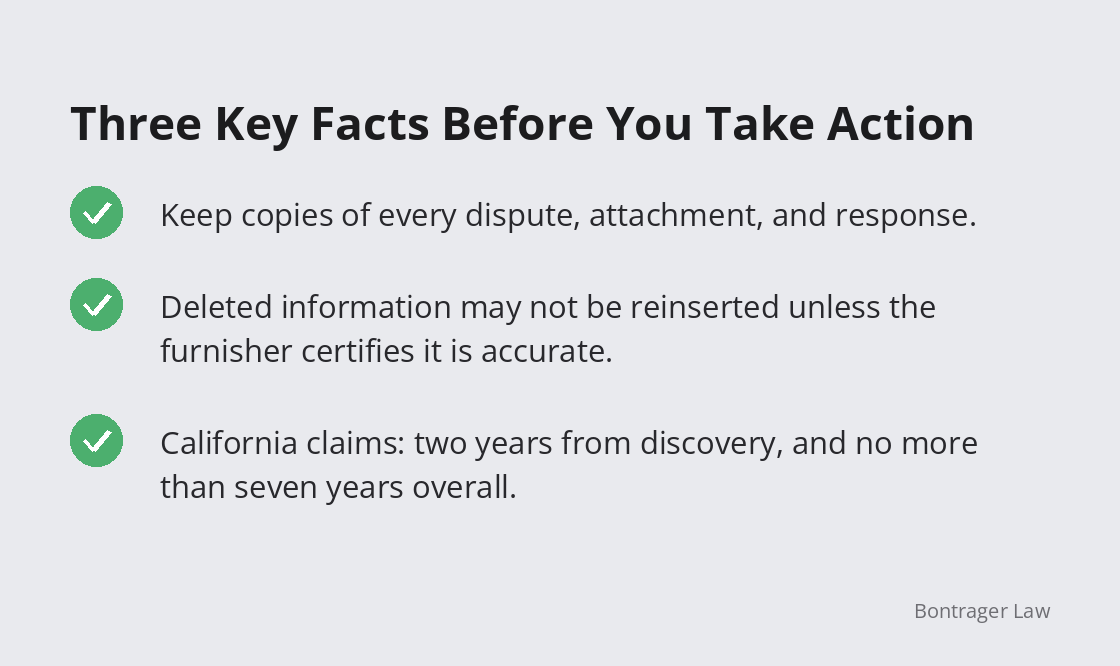
When a credit reporting agency passes your dispute to the furnisher, federal law sets the furnisher’s duties. Under 15 U.S.C. Section 1681s-2(b)(1), the furnisher must conduct an investigation, review all relevant information the agency provided, report the results to the agency, and modify, delete, or permanently block information found to be inaccurate, incomplete, or unverifiable. If deleted information later reappears, California Civil Code Section 1785.16(c) provides that it may not be reinserted unless the furnisher certifies it is accurate, and the agency must notify you of the reinsertion. Our guide to credit report reinsertion in California explains that situation in more detail.
Mistakes and Deadlines That Weaken California Credit Reporting Claims
Strong credit reporting claims are built on documentation and timing. Many consumers have valid claims but lose leverage because they cannot show what they disputed, when they disputed it, or how the agency and furnisher responded. A few common mistakes are worth avoiding from the start.
Disputing Without a Paper Trail
Quick online disputes can be convenient, but they often leave you without a clear record of exactly what you said and what documents you provided. Keep copies of every dispute letter, the evidence you attached, proof of mailing or delivery, and every response you receive. Pull your credit reports again after each reinvestigation to confirm whether the information was actually corrected. Our guide to direct disputes with a creditor in California explains how disputes sent to the furnisher fit into this process.
Assuming Only Federal Law Applies
Some consumers and even some companies focus only on the federal statute. California’s act has its own remedies under Section 1785.31, which allows a consumer who suffers damages from a violation to bring an action, with remedies that differ depending on whether the violation was negligent or willful. Section 1785.31(b) also makes injunctive relief available to any consumer aggrieved by a violation or threatened violation, whether or not the consumer seeks any other remedy.
Missing the Filing Deadline
Civil Code Section 1785.33 states that an action to enforce liability under the chapter may be brought within two years from the date the plaintiff knew of, or should have known of, the violation, but not more than seven years from the earliest date on which liability could have arisen. A separate rule applies when a defendant has materially and willfully misrepresented information it was required to disclose. Federal claims have their own deadline, which our guide to an FCRA lawsuit in California explains. Waiting too long can end a claim that would otherwise have been strong.
Final Thoughts
The California Consumer Credit Reporting Agencies Act gives Californians a second layer of protection on top of the federal Fair Credit Reporting Act. Section 1785.14 sets accuracy duties for credit reporting agencies, Section 1785.25(a) bars furnishing information a company knows or should know is inaccurate and survives federal preemption, Section 1785.16 governs reinvestigations, and Section 1785.33 sets the time limits for bringing a claim.
These protections work best when you use them deliberately. A clear written dispute, supported by documents and followed by a careful review of the results, creates the record that shows whether the agency and the furnisher met their obligations. When they did not, that same record becomes the backbone of any claim under California or federal law.
If inaccurate information keeps appearing on your report, keep organized records of your disputes and the responses, review your reports after every reinvestigation, and keep the filing deadlines in mind.
If a credit bureau or furnisher has failed to correct errors on your California credit report, contact Bontrager Law to speak with our consumer protection team. We will review your reports and your dispute history, explain your rights under California and federal law, and help you take the next step with confidence.