
A credit freeze in California is one of the strongest tools you have when you suspect someone is trying to open accounts in your name. Many consumers hear the terms security freeze, fraud alert, and security alert used as if they mean the same thing, but each one works differently, lasts for a different period, and places different duties on the businesses that pull your credit report. Understanding how these protections work gives you real control over who can see your file and when.
At Bontrager Law, we help consumers across California protect their credit files and hold credit bureaus accountable under the Fair Credit Reporting Act so you can move forward with confidence. This guide explains what a security freeze and a fraud alert actually do, how to place and lift them under federal and California law, and the mistakes that can weaken your protection.
What a Credit Freeze in California Actually Does
Federal law and California law both give you the right to restrict access to your credit report. The federal rules are found in the Fair Credit Reporting Act at 15 U.S.C. Section 1681c-1, which covers fraud alerts, active duty alerts, and the national security freeze. California’s Consumer Credit Reporting Agencies Act adds its own security freeze and security alert provisions in Civil Code Sections 1785.11.2 and 1785.11.1. It helps to understand how each protection is designed before you decide which one fits your situation.
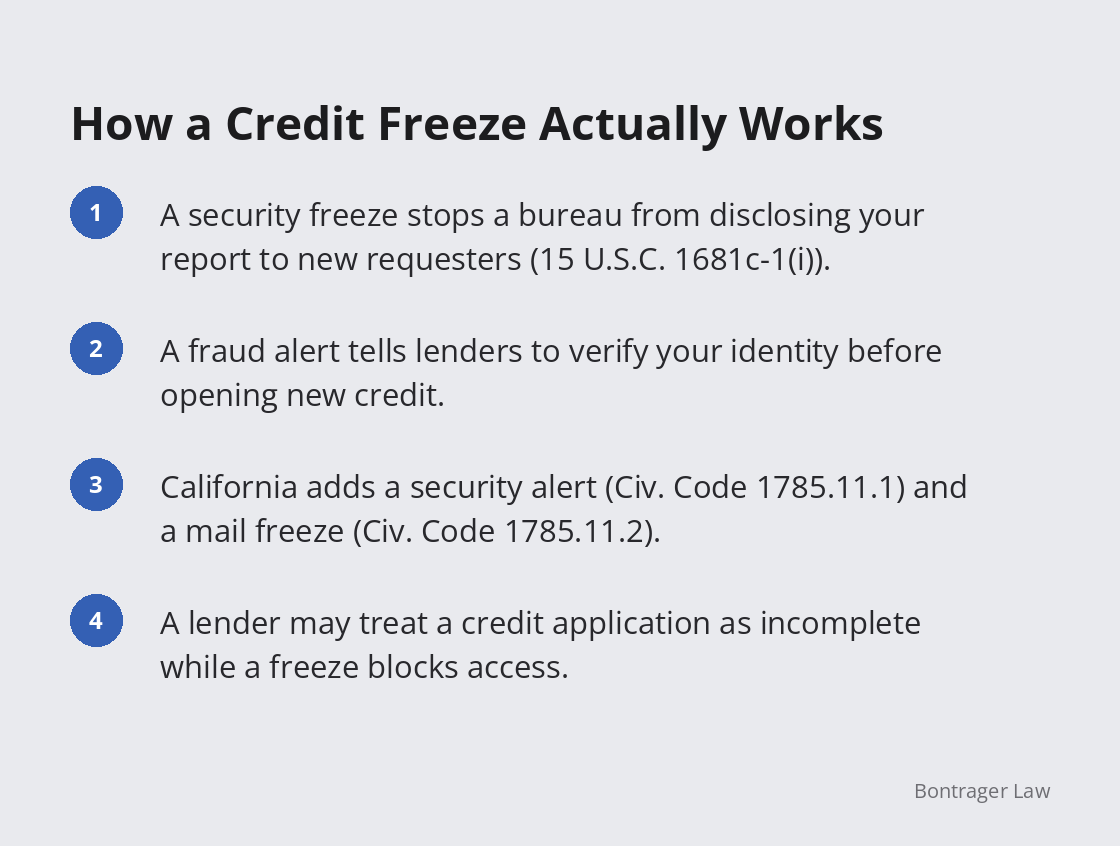
How a Security Freeze Blocks Access to Your File
Under the FCRA, a security freeze is a restriction that prohibits a consumer reporting agency from disclosing the contents of a consumer report that is subject to the freeze to any person requesting the report. California law describes it in similar terms, as a notice placed in your credit report at your request that, subject to certain exceptions, prohibits the credit bureau from releasing your report or any information from it without your express authorization. Under the federal statute, a third party that requests your report in connection with an application for credit may treat that application as incomplete if you do not allow access. That is what makes a freeze so effective against identity thieves, who usually cannot get new credit approved without a credit check.
How a Fraud Alert Changes What Lenders Must Do
A fraud alert works differently. Instead of blocking access to your report, it adds a notice that tells prospective users that you do not authorize new credit in your name without additional steps. Under Section 1681c-1(h), a business that receives a report with an initial fraud alert may not open a new credit plan, issue an additional card, or grant a credit limit increase you requested unless it uses reasonable policies and procedures to form a reasonable belief that it knows the identity of the person making the request. If you listed a telephone number for identity verification, the business must call that number or take reasonable steps to verify your identity and confirm the application is not the result of identity theft. For extended alerts, the rule is stricter: the business must contact you in person or through the contact method you designated before approving the application.
California’s Security Alert and Security Freeze
California law provides its own versions of these protections, and they apply alongside the federal rules. Under Civil Code Section 1785.11.1, you may place a security alert by making a request in writing or by telephone, and the credit bureau must place it no later than five business days after receiving the request. The alert stays in place for at least 90 days, and you have the right to request a renewal. Under Civil Code Section 1785.11.2, you may request a security freeze in writing by mail, and the credit bureau must place it no later than three business days after receiving your written request. The bureau must then send written confirmation within 10 business days and provide a unique personal identification number or password you will use when authorizing access to your report.
How to Place and Lift a Freeze or Fraud Alert in California
The federal rules set firm timelines that make these protections fast to put in place. Each nationwide credit bureau must also maintain a webpage that allows you to request a security freeze, an initial fraud alert, an extended fraud alert, and an active duty alert, and the Federal Trade Commission maintains a single webpage on IdentityTheft.gov that links to each of them.
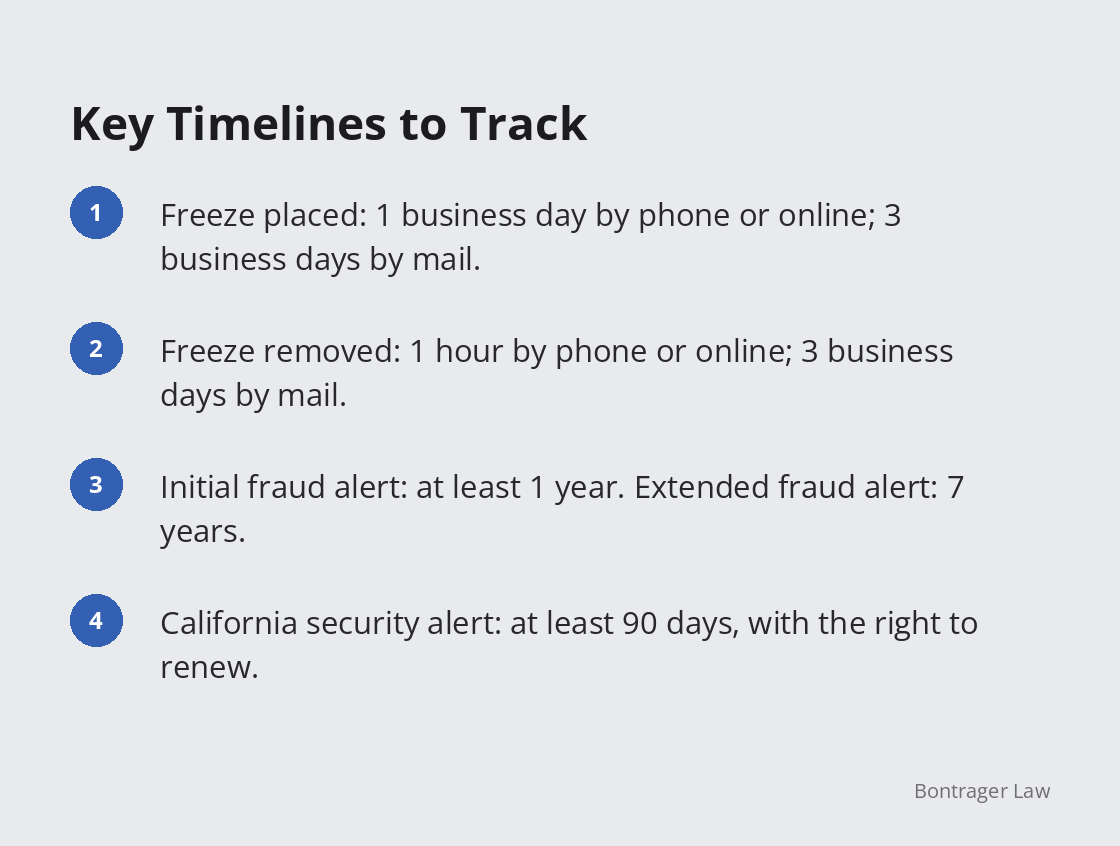
Deadlines for Placing a Security Freeze
Under 15 U.S.C. Section 1681c-1(i)(2), when you make a direct request and provide proper identification, a nationwide credit bureau must place the security freeze no later than one business day after receiving a request made by telephone or secure electronic means, or three business days after receiving a request by mail. Within five business days after placing the freeze, the bureau must send you confirmation and explain the process for removing the freeze, including a way to authenticate your identity. Unlike an initial fraud alert, which the bureau must refer to the other nationwide bureaus, the freeze provision contains no referral requirement, so you should make the request with each nationwide bureau. Keeping the confirmations together gives you a clear record if a bureau later releases information it should not have.
Lifting a Freeze When You Need Credit
A freeze does not have to stand in the way of your own applications. Under the federal statute, a freeze remains in place until you directly request that it be removed, and you may also request a temporary removal for a period of time you specify. When you make a removal request by telephone or secure electronic means and provide proper identification, the bureau must remove the freeze no later than one hour after receiving the request; for a request by mail, the deadline is three business days. California’s statute separately requires a bureau to honor a request to temporarily lift a freeze it placed under state law no later than three business days after receiving the request. Planning ahead before a major application lets you lift the freeze briefly and restore protection afterward.
Choosing Between Initial, Extended, and Active Duty Alerts
The FCRA recognizes three kinds of alerts. An initial fraud alert is available when you assert in good faith a suspicion that you have been or are about to become a victim of fraud or identity theft, and it lasts for not less than one year; the bureau that receives your request must refer the alert to the other nationwide bureaus. An extended fraud alert is available when you submit an identity theft report, and it lasts for seven years while also excluding you from prescreened credit and insurance offers for five years. Active duty military consumers may request an active duty alert that lasts for not less than 12 months and excludes them from prescreened lists for two years. Families can also act for children: federal law allows a parent or other representative with sufficient proof of authority to place a freeze for a protected consumer, which includes a child under 16, and the bureau must create a record for the child if no file exists yet.
Mistakes That Leave Your Credit File Exposed
A freeze or fraud alert is only as strong as the steps you take around it. Avoiding a few common mistakes keeps your protection working and preserves your rights if a bureau or lender fails to follow the law.
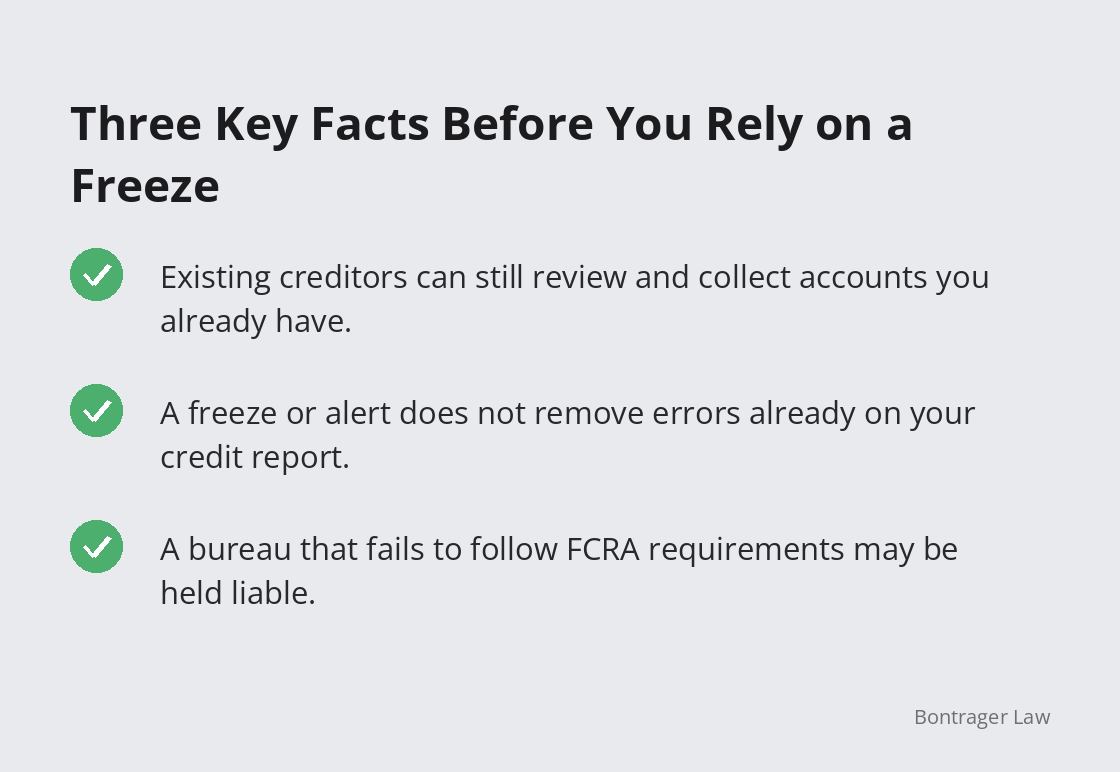
Assuming a Freeze Stops Every Credit Check
A security freeze is not absolute. Under Section 1681c-1(i)(4), a freeze does not apply to a company with which you already have an account when it reviews or collects that account, which includes account maintenance, monitoring, and credit line increases. It also does not apply to credit monitoring services you have subscribed to, to requests for your own copy of your report, to insurance underwriting, to employment, tenant, or background screening, and to certain government and court-ordered requests. California’s freeze statute contains a similar list of exceptions. That means a freeze will not stop an existing creditor from reviewing your account or a landlord’s screening company from pulling your report, so watching your file remains important even after a freeze is in place.
Treating an Alert as a Fix for Errors Already on Your Report
A freeze or fraud alert protects you going forward, but it does not remove anything already on your credit report. If an identity thief has already opened an account, or if a collection or late payment that is not yours appears on your file, you still need to dispute that information with each credit bureau that reports it. The bureaus’ investigation duties under the FCRA are triggered by your dispute, not by the alert. Our guide to identity theft credit report disputes walks through how that process works for fraud victims, and keeping your dispute letters and bureau responses together will make every later step easier.
Ignoring a Bureau That Fails to Follow the Rules
The timelines in Section 1681c-1 are requirements, not suggestions. If a bureau fails to place a freeze or alert on time, releases a frozen report to a new creditor, or loses track of an alert, that failure may be a violation of the FCRA. Claims under the FCRA also come with firm filing deadlines. Our overview of FCRA lawsuit deadlines in California explains how those time limits work. Writing down dates, confirmation numbers, and the names of anyone you spoke with gives you the evidence you need if the bureau’s handling of your request becomes the basis for a claim.
Final Thoughts
A credit freeze in California gives you strong control over who can see your credit file, while fraud alerts and California’s security alert add a layer of identity verification for new credit. Federal law sets short deadlines for placing and lifting a freeze, California law adds its own written-request option, and each protection comes with exceptions you should understand before relying on it.
The safest approach usually combines these tools with close attention to your reports, prompt disputes of any inaccurate entries, and a careful record of every request and confirmation.
If you placed a freeze or fraud alert and still found new accounts or errors on your credit report, contact Bontrager Law to speak with our consumer protection team. We will review your reports and your dispute history, explain your rights under the Fair Credit Reporting Act and California law, and help you take the next step with confidence.