
Wage garnishment in California can feel overwhelming, especially when a court hearing looms ahead. The good news is that you have legal options and protections available to you.
At Bontrager Law, we help people navigate wage garnishment cases and fight for their financial stability. This guide walks you through what to expect, how to prepare, and what strategies might work in your situation.
How California Wage Garnishment Actually Works
The Legal Limits on What Creditors Can Take
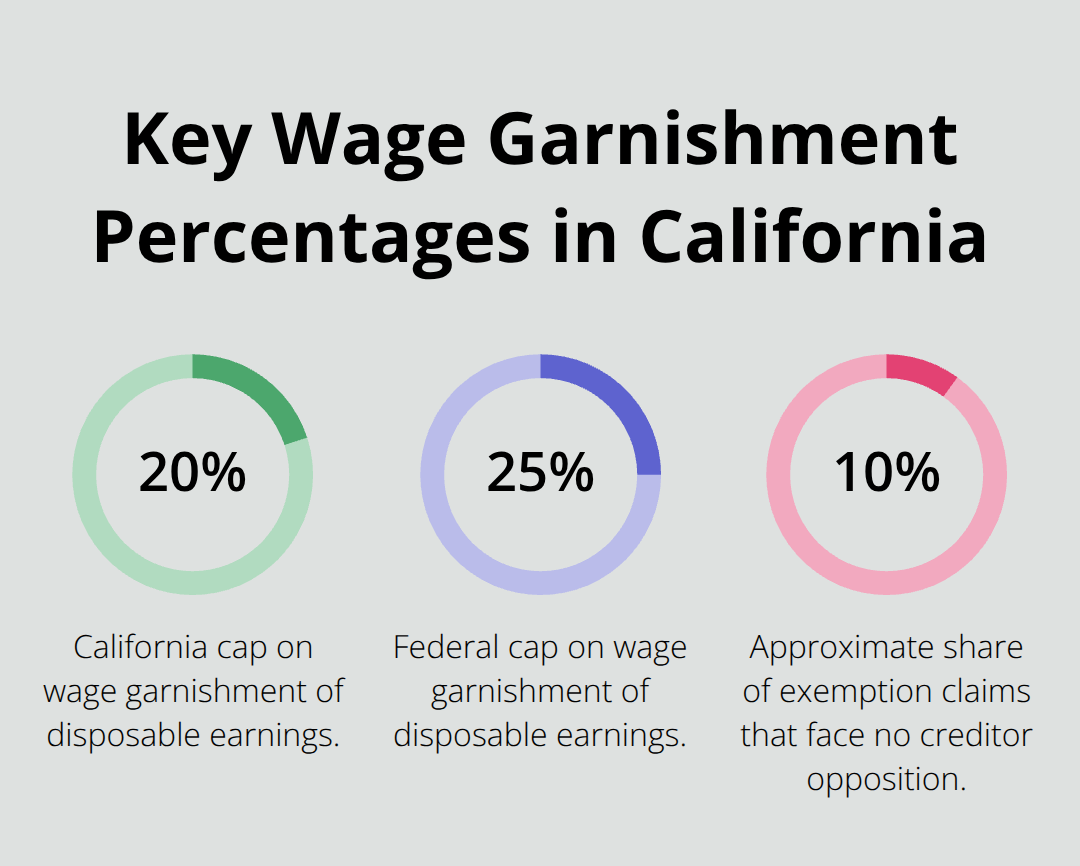
Wage garnishment in California allows creditors to claim up to 20% of your disposable earnings through a court order, though some debts like child support, taxes, and federal student loans can be garnished without a judgment at all. Disposable earnings represent what remains after mandatory deductions like Social Security, Medicare, and income taxes-not your gross pay. California law protects more of your paycheck than federal rules do: the federal limit is 25% of disposable earnings or the amount by which your weekly earnings exceed 30 times the federal minimum wage, but California caps garnishment at the lesser of 20% of disposable earnings or the amount by which your weekly earnings exceed 48 times California’s state minimum wage ($16.50 per hour as of 2026).
Assembly Bill 2837, which took effect in 2025, added stricter requirements that creditors must follow. These include address verification and notice of enforcement before garnishment begins. Creditors cannot simply take money from your paycheck-they must obtain a court judgment first in most cases, serve you with proper notice, and follow California’s procedural requirements. These steps create real opportunities to challenge or reduce the amount taken.
What Happens When You Receive the Order
The moment you receive an Earnings Withholding Order, time becomes critical. The levying officer, usually the sheriff, will be listed on the order and must provide you a copy within 10 days. You hold a powerful right: you can file a Claim of Exemption if the garnishment prevents you from paying for basic needs like housing, food, utilities, and childcare. California courts regularly grant exemptions when workers prove hardship.
The timeline matters significantly. You must file your Claim of Exemption and Financial Statement forms with the levying officer promptly. If the creditor does not respond within 10 days, your claim receives automatic approval. Should the creditor oppose your claim, you will receive a hearing notice, and money garnished during the waiting period will return to you if you win. Federal law also protects your job-your employer cannot fire you for a single wage garnishment.
Debts That Trigger Garnishment and Your First Action
Common debts triggering garnishment include unpaid taxes, child support and alimony, defaulted federal student loans, and court judgments for credit card debt or medical bills. Each type carries different rules and protections, which makes understanding your specific situation essential before the hearing.
Your most important action right now is straightforward: gather your pay stubs, bank statements, and bills that document your basic living expenses. These documents become your strongest evidence at a hearing. Collect them before you meet with anyone about your case, as they form the foundation of any exemption claim or defense strategy you might pursue.
Preparing for Your Court Hearing
Collect the Documents That Win Cases
Preparation separates people who win exemptions from those who lose them. The California Courts Self-Help Guide confirms that creditors respond to roughly 10% of exemption claims without opposition, meaning your case becomes decided without a hearing if you file correctly and the creditor ignores you. However, if the creditor does respond, you need documents that prove hardship.
Start by collecting three months of recent pay stubs showing your gross income and all deductions, at least two months of bank statements that display account balances and regular expenses, and current bills for rent or mortgage, utilities, childcare, insurance, and food costs. The Financial Statement form WG-007/EJ-165 requires you to list monthly income and expenses, and judges take this seriously-incomplete or vague statements weaken your case significantly. Black out account numbers on all documents before filing to protect your privacy.
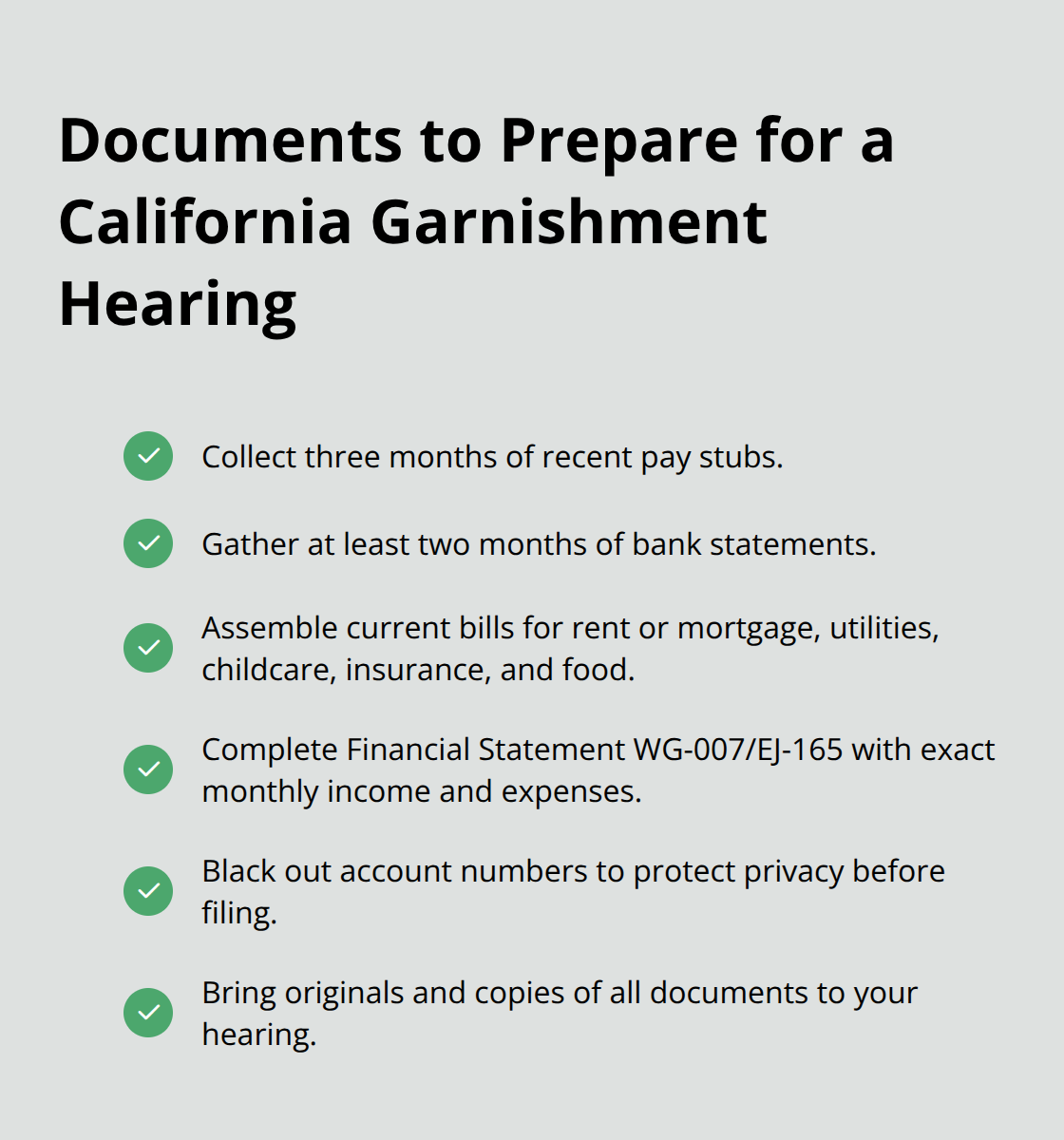
Many California workers file their Claim of Exemption without supporting numbers, then lose at hearing because they cannot show the court actual proof of hardship. Your documents must demonstrate that the garnishment would make it impossible to afford basic necessities, not just inconvenient. Bring originals and copies of everything to the hearing-pay stubs, bank statements, bills, and proof of dependents if you support children or a spouse.
Know What California Law Protects
Understanding what California law actually protects gives you real strength in your case. You have the right to keep enough of your paycheck to cover essential expenses, and courts regularly grant partial or full exemptions when workers present evidence of genuine need. If you earn $2,500 monthly and spend $2,400 on housing, food, utilities, and childcare, a judge will likely reduce or eliminate the garnishment because you cannot afford basic needs.
California law protects more of your paycheck than federal rules do. The state caps garnishment at the lesser of 20% of disposable earnings or the amount by which your weekly earnings exceed 48 times California’s state minimum wage. This protection exists specifically to prevent creditors from taking money you need for survival.
Understand the Hearing Format and Timeline
The hearing itself follows a straightforward format: the creditor or their lawyer presents their case first, then you explain why the garnishment creates hardship and present your documents as evidence. Speak clearly and stick to facts; judges respond poorly to emotional arguments without supporting numbers.
If the creditor opposes your claim, you will receive a Notice of Opposition and a Notice of Hearing with specific dates and times at least 10 days before the hearing, giving you time to prepare. Some California courts post tentative rulings the day before hearings, so contact your court clerk to ask whether this applies to your case-if a tentative ruling favors you and you do not object, the hearing may be canceled and you win without appearing.
If the court grants your exemption, the sheriff stops or reduces the garnishment and returns any money taken beyond the exempt amount. Money garnished during the waiting period will return to you if you win. Federal law also protects your job-your employer cannot fire you for a single wage garnishment, which means you can focus on your case without fear of retaliation.
With your documents organized and your understanding of California’s protections in place, you now need to explore the specific legal strategies that work in your situation.
What Actually Works to Stop or Reduce Wage Garnishment
Challenge the Debt’s Validity
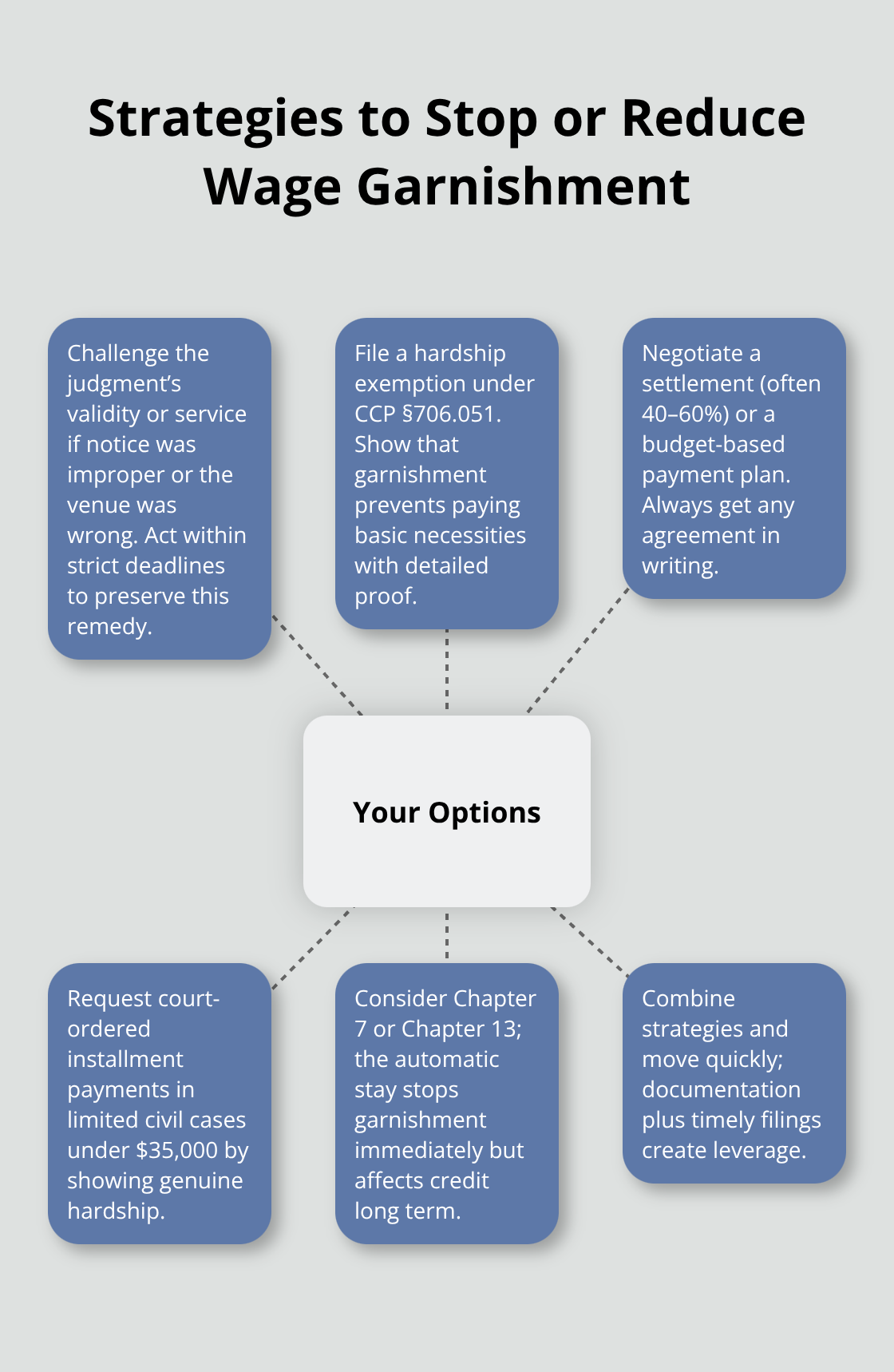
Challenging the debt itself rarely succeeds once a judgment exists, but proving the debt is invalid or improperly served opens a narrow but real path forward. If the creditor failed to serve you with proper notice before obtaining the judgment, or if they sued in the wrong county, the judgment may be voidable. However, this requires acting fast-California gives you only 30 days from service to file a motion to quash service of summons. The debt must be genuinely incorrect, not just disputed; if you legitimately never owed the money or the amount is mathematically wrong, request the creditor provide proof of the original debt obligation. Most creditors cannot produce original contracts or account statements without delay, which creates leverage in negotiation. Challenging validity works best when combined with an exemption claim because even if the debt is real, you still have the right to keep money for basic needs.
File a Hardship Exemption Claim
Claiming a hardship exemption under California Code Section 706.051 is your strongest practical tool because courts grant these regularly when evidence is solid. The standard is straightforward: you must prove that continuing the garnishment would make it impossible to pay for housing, food, utilities, childcare, or other basic necessities. Bring pay stubs showing exactly what you earn after taxes and mandatory deductions-judges focus on disposable earnings, not gross pay. If your monthly disposable income is $1,800 and your essential expenses total $1,750, a court will almost certainly reduce or eliminate the garnishment because you have almost nothing left.
Document everything: rent or mortgage statements, utility bills, childcare invoices, insurance premiums, and grocery or food assistance receipts. Courts do not care about discretionary spending like streaming services or dining out, only survival costs. If you support dependents, bring proof of their relationship to you because courts grant larger exemptions to workers supporting children or disabled adults. File your Financial Statement form with specific numbers, not ranges or estimates, because vague claims fail consistently at hearings. Many workers lose exemption cases not because they lack hardship but because they submit incomplete financial information that judges cannot verify.
Negotiate a Settlement or Payment Plan
Negotiating a settlement or payment plan often produces better results than fighting at hearing because creditors prefer certainty over court risk. Contact the creditor or debt collector and propose a lump-sum settlement for 40 to 60 percent of the judgment amount, or request a monthly payment plan that respects your actual budget. If you can pay $300 monthly without affecting basic needs, offer that instead of the garnishment taking 20 percent of your paycheck unpredictably. Get any agreement in writing before making payments.
For limited civil cases where the judgment is under $35,000, California allows you to file a motion to pay the judgment in installments, which the court may grant if you show genuine financial hardship. This formal process sometimes carries more weight than informal negotiation. If settlement fails and your exemption claim is denied, filing for bankruptcy under Chapter 7 or Chapter 13 stops garnishment immediately through the automatic stay, though this carries long-term credit consequences. Bankruptcy should be your last resort, but it remains a legitimate option when garnishment threatens your family’s survival and no other path works.
Final Thoughts
Wage garnishment in California creates real financial pressure, but you now understand the tools available to fight back. The path forward depends on your specific situation: filing a hardship exemption claim works when you can document genuine need, challenging the debt’s validity succeeds in narrow circumstances, and negotiating a settlement often produces faster results than court hearings. Your strongest position comes from gathering solid documentation, understanding California’s protections, and acting quickly before deadlines pass.
The documents you collect matter more than emotional arguments-pay stubs, bank statements, and bills showing basic living expenses form the foundation of any successful exemption claim. Courts grant these regularly when workers present clear evidence that garnishment prevents them from affording housing, food, utilities, or childcare. If you support dependents, that strengthens your case significantly, and many workers lose not because they lack hardship but because they file incomplete financial information that judges cannot verify.
Time works against you once garnishment begins, so wage garnishment California help requires immediate action. You can pursue exemptions through the court system, negotiate directly with creditors, or explore bankruptcy as a last resort when other options fail. Contact Bontrager Law to discuss your options and protect your income.