
An unauthorized credit inquiry in California can feel like a small line on your credit report, but it often signals something bigger. A hard inquiry you never approved may mean a company pulled your report without a lawful reason, a creditor confused you with someone else, or an identity thief applied for credit in your name. Federal and California law both limit who may access your credit report and why. Understanding those limits gives you real control over who sees your financial history and what you can do when a company crosses the line.
At Bontrager Law, we help consumers across California hold credit bureaus and the companies that pull reports accountable under the Fair Credit Reporting Act so you can move forward with confidence. This guide explains how permissible purpose actually works, how to identify and challenge an inquiry you did not authorize, and the mistakes that most often weaken a claim.
How Permissible Purpose Actually Works
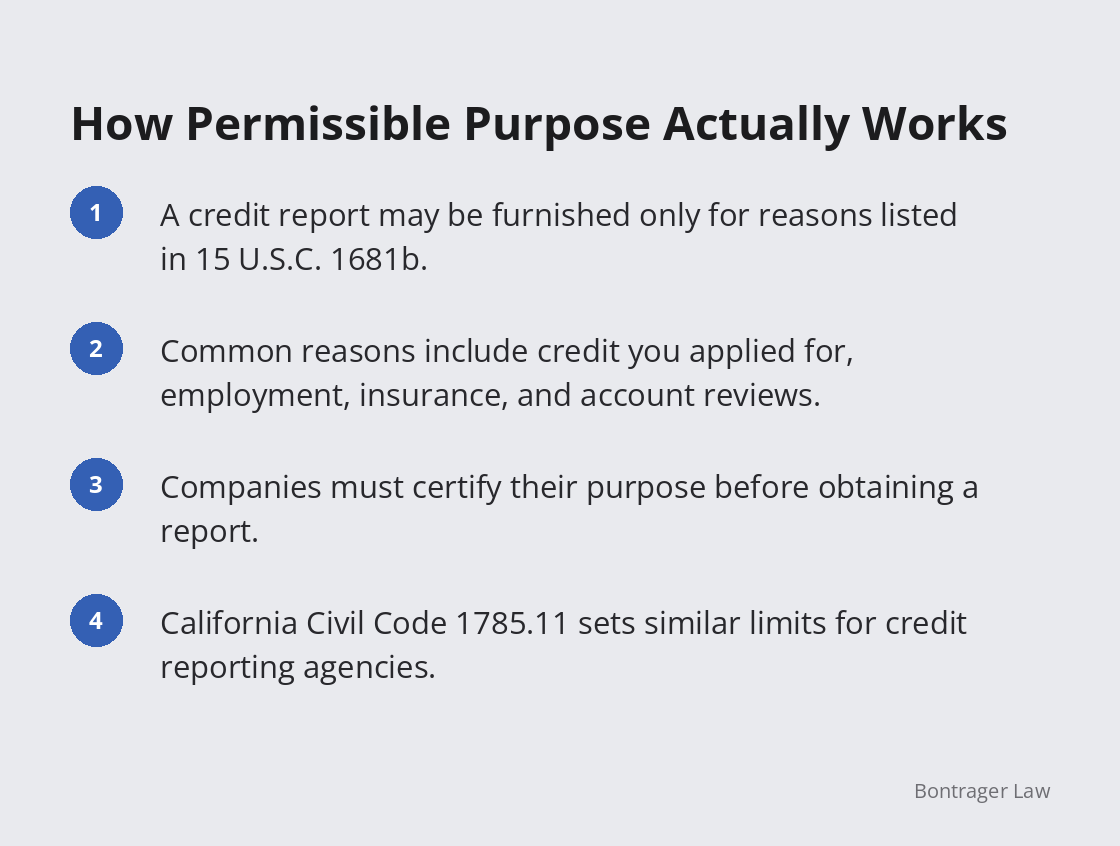
A credit report is not open to anyone who asks for it. The Fair Credit Reporting Act, at 15 U.S.C. Section 1681b, lists the specific circumstances in which a consumer reporting agency may furnish a consumer report, and it states that reports may be furnished under those circumstances and no other. This concept is called permissible purpose, and it is the foundation for deciding whether an inquiry on your report was lawful. When a business pulls your report, the question is always whether it had one of the reasons the statute allows.
The Reasons the Law Allows
Section 1681b(a)(3) allows a report to go to a person the agency has reason to believe intends to use it in connection with a credit transaction involving you, for employment purposes, for underwriting insurance involving you, for certain government license or benefit decisions, for valuing or assessing risk on an existing credit obligation, or where the person otherwise has a legitimate business need in connection with a business transaction you initiated or to review an account to see whether you still meet its terms. The law also permits reports in response to certain court orders and subpoenas, and in accordance with your own written instructions. Outside those categories, a company has no business pulling your file.
The Rule for Companies That Pull Reports
The statute does not only regulate credit bureaus. Section 1681b(f) provides that a person shall not use or obtain a consumer report for any purpose unless the report is obtained for a purpose the law authorizes and the purpose is certified in accordance with Section 1681e. Under Section 1681e(a), consumer reporting agencies must maintain reasonable procedures that require prospective users to identify themselves, certify the purposes for which they seek the information, and certify that it will be used for no other purpose. When a company falsely certifies a purpose or pulls a report it has no right to, it can violate the law even if the credit bureau followed its own procedures.
How California Law Adds Protection
California has its own Consumer Credit Reporting Agencies Act. Civil Code Section 1785.11(a) states that a consumer credit reporting agency shall furnish a consumer credit report only under specific listed circumstances, which track the federal categories closely and also include renting a dwelling unit. Section 1785.11(b) limits reports for credit transactions you did not initiate to situations where you authorized the report or the transaction involves a firm offer of credit. Section 1785.11(c) adds that a consumer credit reporting agency generally shall not furnish to any person a record of inquiries solely resulting from credit transactions you did not initiate, which is one reason promotional activity is treated differently from an application you actually made.
How to Identify and Challenge an Unauthorized Inquiry
Spotting an unauthorized inquiry starts with knowing what is in your file and who has looked at it. Once you find an inquiry you do not recognize, a careful, documented approach gives you the best chance of correcting your report and preserving any claim you may have against the company involved.
Request Your File and the List of Who Pulled It
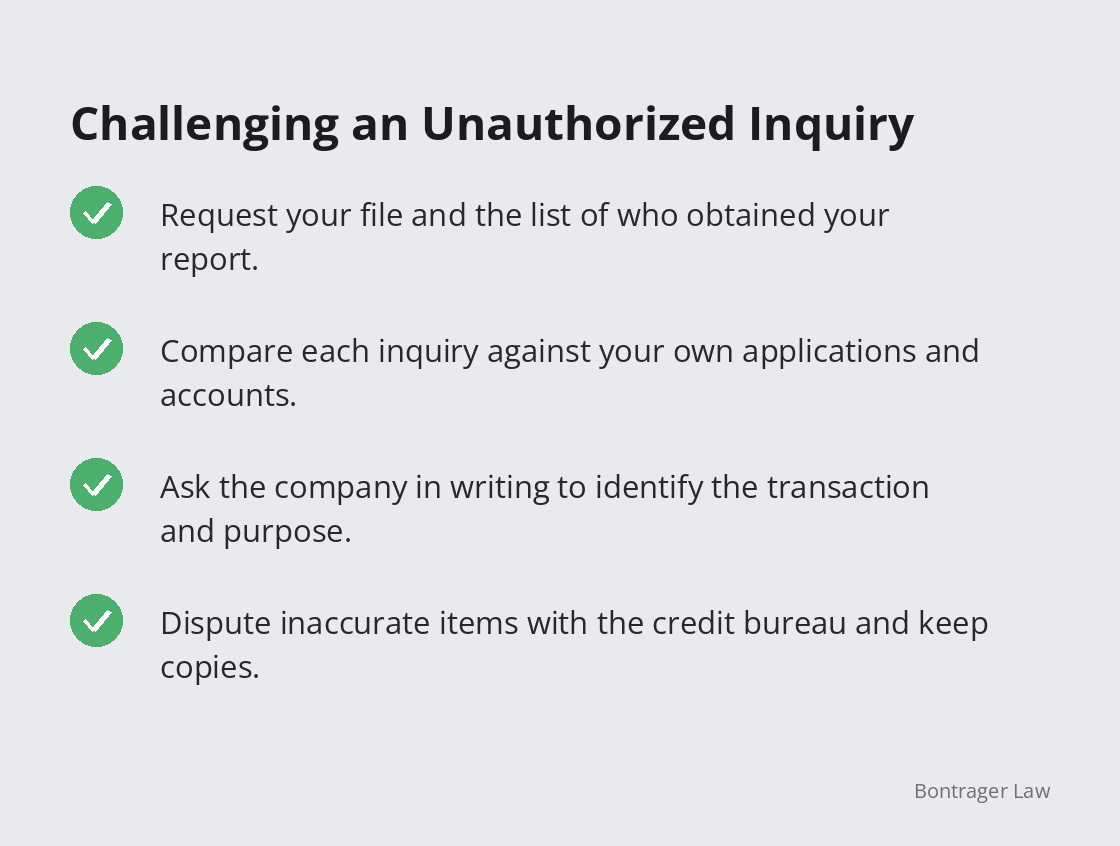
Under 15 U.S.C. Section 1681g(a)(3), every consumer reporting agency must, upon request, disclose the identity of each person that procured a consumer report about you during the 2-year period before your request for employment purposes, or during the 1-year period before your request for any other purpose. Upon your request, the agency must also provide the address and telephone number of that person. Requesting disclosures from each of the national credit bureaus lets you compare the inquiry lists side by side and see whether the same unknown company appears more than once.
Sort Out What the Inquiry Really Is
Not every unfamiliar name is a violation. Lenders sometimes appear under a parent company or trade name, and an existing creditor reviewing your account may have a lawful reason under Section 1681b(a)(3)(F). Promotional screenings for firm offers of credit or insurance follow a separate path under Section 1681b(c). Before you dispute anything, compare the name and date against your records of applications, account openings, rental applications, and job applications. If you still cannot connect the inquiry to anything you did, contact the company in writing and ask it to identify the transaction and the purpose it certified when it obtained your report.
Dispute the Inquiry With the Credit Bureau
If the inquiry resulted from identity theft or a mistake, you can dispute it. Section 1681i(a)(1)(A) requires a consumer reporting agency to conduct a reasonable reinvestigation when you dispute the completeness or accuracy of any item of information in your file, and to complete it before the end of the 30-day period beginning on the date it receives your dispute, subject to limited extensions. Explain clearly that you did not apply for credit with the company, include any supporting documents, and keep copies of everything you send and receive. If identity theft is involved, our guide to identity theft credit report disputes explains additional steps that may apply.
Common Mistakes That Weaken an Inquiry Claim
Many consumers notice an unauthorized inquiry, feel frustrated, and then let the issue drop. Others act quickly but in ways that make it harder to show what happened later. Avoiding a few common mistakes keeps your options open and strengthens any claim against the company that pulled your report.
Ignoring the Inquiry Because It Seems Minor
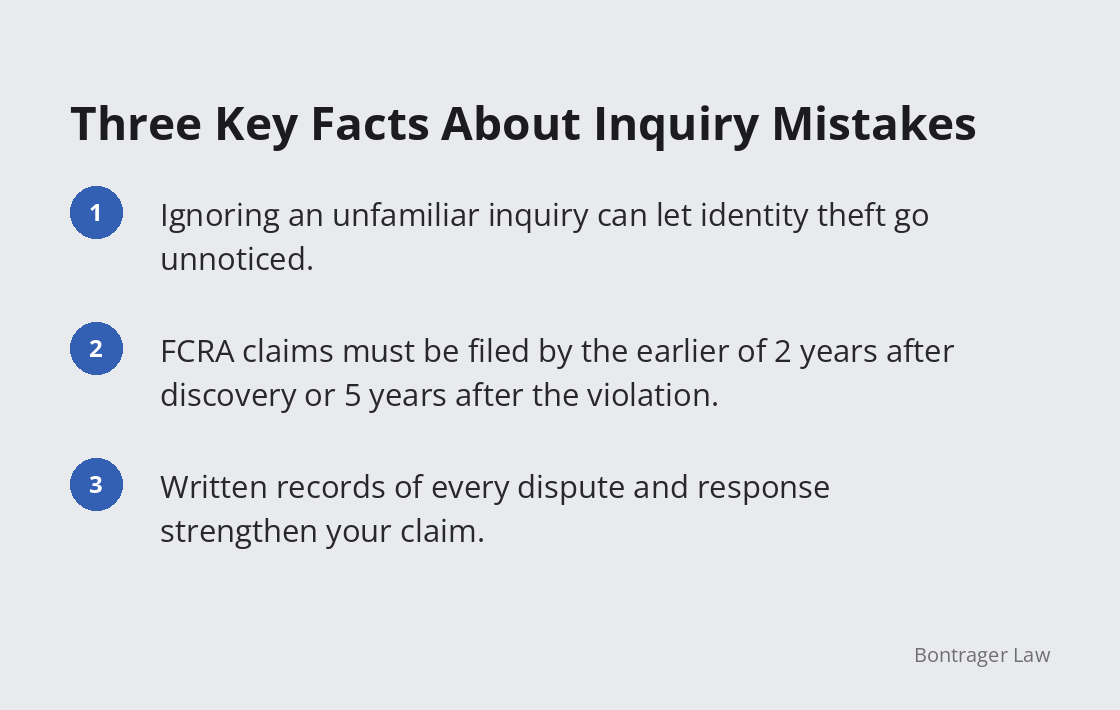
An inquiry you never authorized can be the first visible sign of identity theft, and it can also reflect a company that ignores the rules for accessing credit files. The Fair Credit Reporting Act provides civil remedies for both willful and negligent violations. Section 1681n creates liability for any person who willfully fails to comply with the Act, and it specifically addresses a person who obtains a consumer report under false pretenses or knowingly without a permissible purpose. Section 1681o separately creates liability for negligent noncompliance. Federal law also treats knowingly and willfully obtaining consumer information under false pretenses as a crime under Section 1681q. Treating the inquiry seriously from the start helps you protect both your credit and your rights.
Waiting Too Long to Act
Time limits apply to these claims. Under 15 U.S.C. Section 1681p, an action to enforce liability under the Fair Credit Reporting Act must be brought not later than the earlier of 2 years after the date you discover the violation or 5 years after the date the violation occurs. Because the discovery date can matter, write down when and how you first noticed the inquiry, save the report that shows it, and keep a timeline of every contact with the credit bureau and the company. Waiting months to act can make it harder to reconstruct what happened and may shorten the time you have to file.
Failing to Keep a Paper Trail
Phone calls are easy to forget and hard to prove. Disputes and requests sent in writing create a record of what you asked for, what you were told, and when. Keep copies of your credit reports before and after the dispute, the inquiry disclosure lists, every letter and online confirmation, and any denial or adverse action notice you received around the same time. If you choose to stop prescreened offers, note the date of your election, since Section 1681b(e) and California Civil Code Section 1785.11(d) both give consumers a way to opt out of lists used for transactions they did not initiate. That documentation often becomes the backbone of a strong claim.
Final Thoughts
An unauthorized credit inquiry is more than an annoyance. Federal law and California law both limit who may access your credit report and require companies to have, and certify, a lawful reason before they pull it. By requesting your file, identifying who accessed it, disputing inquiries that do not belong to you, and keeping careful records, you protect your credit and preserve your rights. Our Fair Credit Reporting Act page explains more about how these protections work for California consumers.
You do not have to sort through inquiry lists and dispute letters on your own. A careful review of your reports often reveals whether an inquiry was a simple mix-up or a sign that a company accessed your file without permission.
If you believe a company pulled your credit report without a permissible purpose, contact Bontrager Law to speak with our team. We’ll review your reports and records, explain your rights under the Fair Credit Reporting Act and California law, and help you take the next step with confidence.