
You might have a legal claim worth money and not even know it. Credit reporting errors, identity theft, and unlawful debt collection happen to thousands of Californians every year, and many have no idea they can recover compensation.
At Bontrager Law, we offer a free case review in California so you can understand your rights without spending a dime. We’ll assess your situation, explain your options, and answer your questions-all at no cost to you.
Why a Free Case Review Matters
Most Californians don’t realize they have legal claims until it’s too late. The Federal Trade Commission reported that in 2023, consumers filed over 2.6 million complaints related to identity theft, credit reporting, and debt collection-yet the vast majority of victims never pursued compensation because they assumed nothing could be done. A free case review changes that equation. It gives you a clear picture of whether your situation qualifies as a legal claim, what damages you might recover, and whether pursuing action makes financial sense. Without this assessment, you operate blind, unaware of protections California law provides specifically to you.
Spotting Claims You Didn’t Know Existed
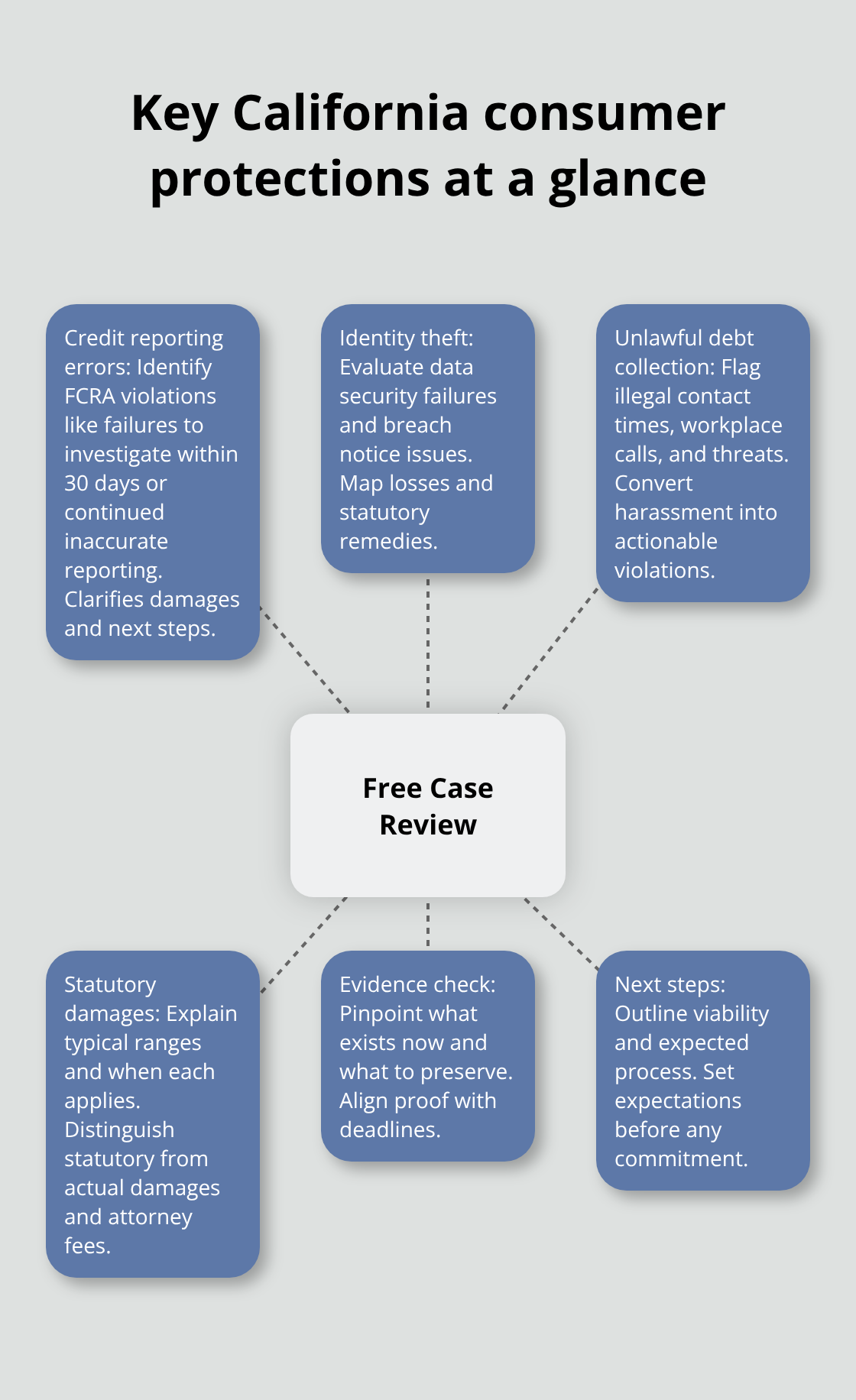
Credit reporting errors seem minor until they cost you a mortgage or job opportunity. Identity theft feels like a personal nightmare rather than a legal matter. Unlawful debt collection feels like harassment you must tolerate. None of these situations is inevitable or something you must accept. California law protects consumers in all three areas, and violations carry real damages-statutory damages, actual damages, and attorney fees. A case review identifies whether the actions against you crossed legal lines. For example, if a debt collector contacted you at work after you told them not to, or if a credit bureau failed to investigate an error you disputed, those aren’t just frustrations; they’re violations with financial consequences. The review process determines which violations apply to your specific facts and what compensation ranges are realistic based on similar cases.
Understanding Your Rights Without Risking Money
Fear of legal costs keeps most people from seeking help. A free case review eliminates that barrier entirely. You receive an assessment of your situation without paying anything upfront, and you learn exactly what your options are before you commit to anything. This means you gain clarity on whether representation makes sense financially-whether the potential recovery justifies the effort. You also learn about statutes of limitations specific to your claim type, which matters because California deadlines are unforgiving. Most consumer protection claims have a four-year window from when the violation occurred, but waiting costs you. Evidence deteriorates, witness memories fade, and company records get deleted. A review conducted now, not next month or next year, preserves your strongest position and gives you the most time to act.
Why Timing Matters More Than You Think
The longer you wait, the weaker your case becomes. Surveillance video gets overwritten within weeks or months. Witnesses move away or forget details. Debt collectors and credit bureaus destroy internal communications that would prove their violations. California law gives you a limited window to file claims (typically four years for consumer protection matters), but that window closes whether you’re ready or not. A case review done today establishes what evidence exists now and what you can still recover. It also determines whether your claim falls within the statute of limitations or whether you’ve already lost the right to pursue it. This assessment shapes everything that follows-your strategy, your timeline, and your potential outcome.
What Happens During Your Free Case Review
How the Process Works
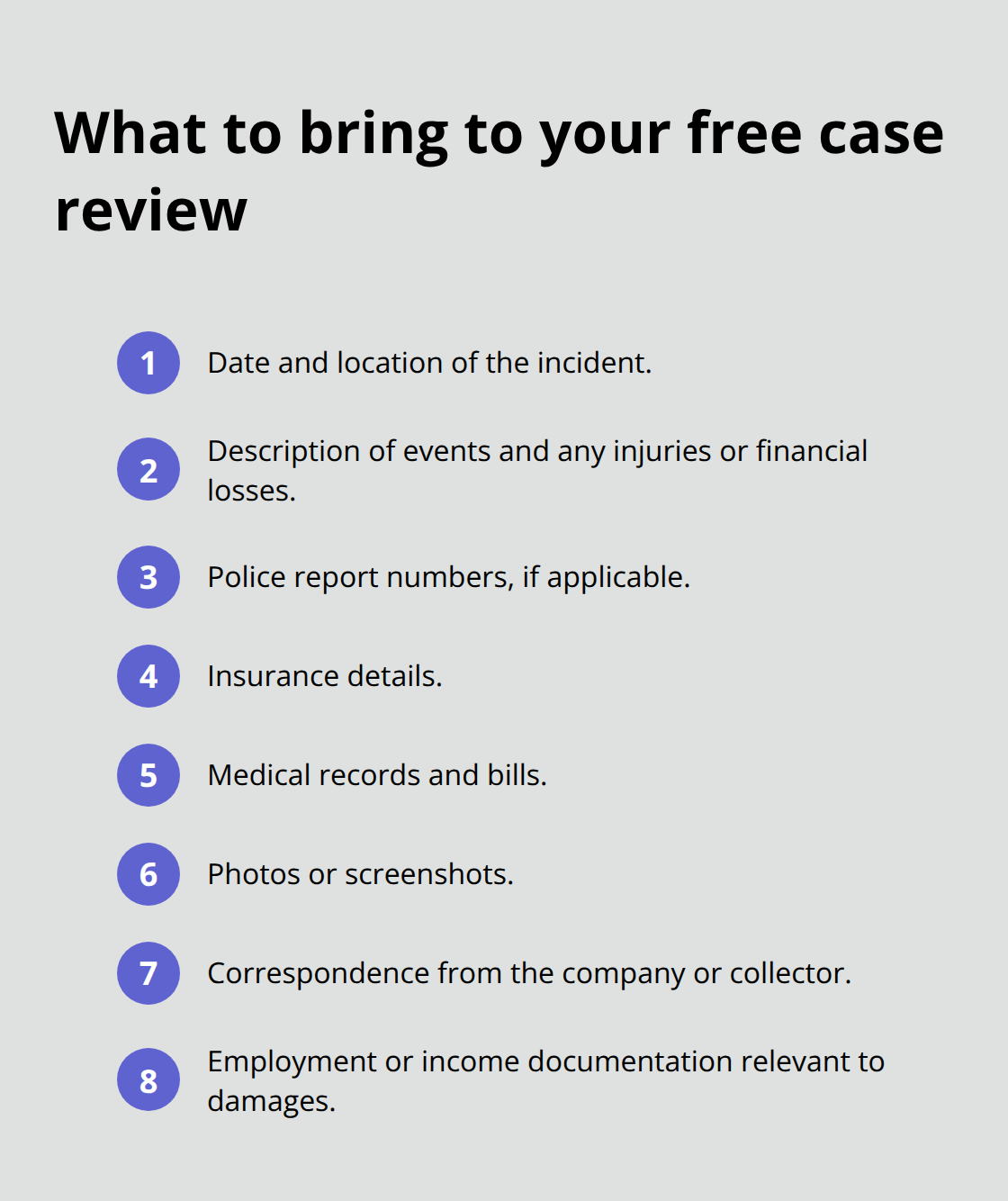
The case review takes 30 minutes on average, though complex situations may require follow-up discussions after we review additional documentation. We start by gathering the facts of your situation-when the violation occurred, what happened, who was involved, and what impact it had on you. Bring the date and location of the incident, a description of what happened and any injuries or financial losses, police report numbers if applicable, insurance details, medical records, photos, correspondence from the company or collector, and employment or income documentation if relevant to your damages claim. The more information you have ready, the more accurate our assessment becomes.
What We Ask and Why It Matters
We ask about previous attempts to resolve the issue and whether you’ve contacted other attorneys. This isn’t about judgment; it’s about understanding the full picture so we can identify what evidence still exists and what may have already been lost. California’s four-year statute of limitations sounds generous until you realize that companies routinely destroy records after 18 to 24 months, so the timing of your review directly affects what we can prove.
Identifying Violations and Calculating Damages
During the review, we examine your credit reports from all three bureaus to identify errors and violations. For credit reporting errors, we determine whether the bureau failed to investigate your dispute within 30 days as required by the Fair Credit Reporting Act, or whether they continued reporting inaccurate information after you notified them. For debt collection violations, we assess whether collectors contacted you at work after you requested they stop, called before 8 a.m. or after 9 p.m., or threatened consequences they couldn’t legally enforce. For identity theft claims, we evaluate the financial harm and whether the company that allowed the theft failed to protect your data reasonably.
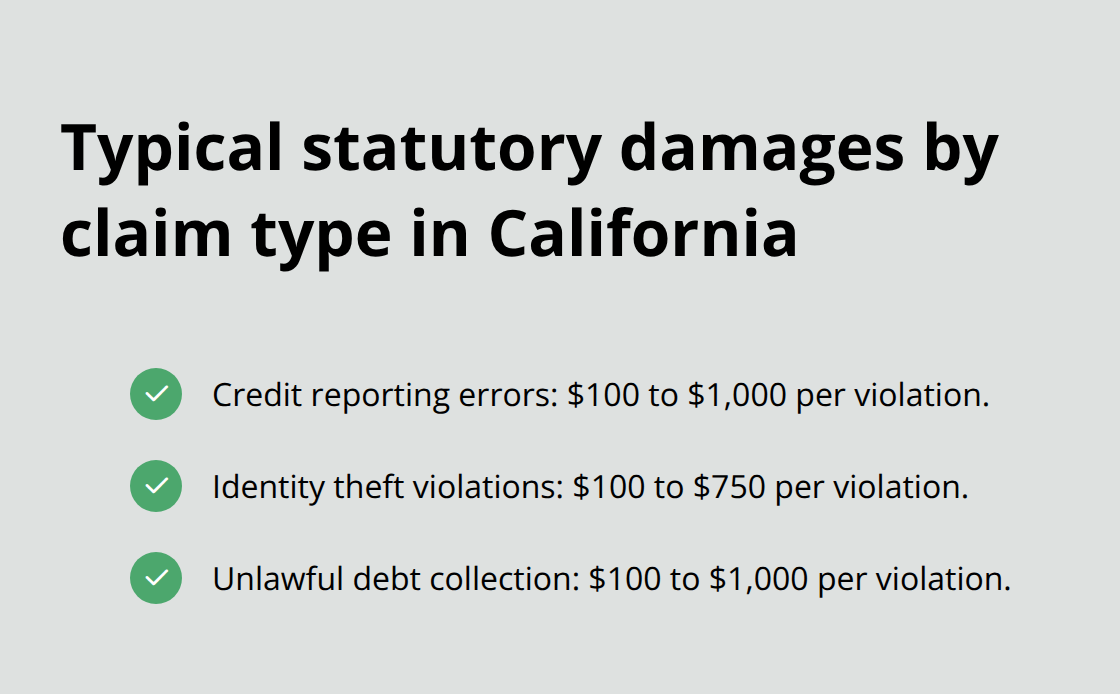
We then explain the potential compensation range based on similar cases-statutory damages typically range from $100 to $1,000 per violation depending on the claim type, plus actual damages for any out-of-pocket losses, plus attorney fees that the company must pay if you win.
Honest Assessment and Next Steps
We answer your questions about how representation works, what happens next, and whether your claim makes financial sense to pursue. Most importantly, we tell you honestly whether we believe your case is viable. If we don’t think you have a strong claim, we say so and may refer you to resources that can actually help. This straightforward approach means you walk away with a clear understanding of your position-and if your claim does move forward, you’ll know exactly what to expect in the chapters ahead.
What Consumer Protection Violations Look Like in California
Credit Reporting Errors That Cost You Opportunities
Credit reporting errors affect roughly 1 in 5 Americans according to the Federal Trade Commission, but most Californians don’t realize these errors qualify as legal violations until they’ve already lost a job opportunity or been denied a mortgage. When a credit bureau fails to investigate a dispute within 30 days as required by the Fair Credit Reporting Act, or continues reporting information you’ve clearly marked as inaccurate, that violation carries statutory damages between $100 and $1,000 per incident. The damage multiplies if multiple bureaus report the same error-you could have three separate claims, three separate compensation opportunities.
Identity Theft: A Legal Problem, Not Just a Personal One
Identity theft operates differently but causes equal financial devastation. California saw 276,000 identity theft reports in 2023 according to the FBI, yet victims often don’t file claims because they assume the theft is purely a personal problem rather than a legal one. When a company fails to implement reasonable data security and your information gets stolen, or when they fail to notify you of the breach within the timeframe California law requires, they’ve violated consumer protection statutes. The compensation calculation includes out-of-pocket losses like fraudulent charges, plus statutory damages that typically range from $100 to $750 per violation depending on whether the violation was negligent or willful.
Unlawful Debt Collection: Recognizing What’s Illegal
Unlawful debt collection happens daily in California, and most people tolerate it because they don’t recognize it as illegal. Debt collectors calling you at work after you’ve explicitly told them not to, contacting you before 8 a.m. or after 9 p.m., threatening wage garnishment they have no authority to pursue, or continuing collection efforts after you’ve sent written dispute notice-these all violate the Fair Debt Collection Practices Act and California’s Rosenthal Fair Debt Collection Practices Act. Each violation carries statutory damages of $100 to $1,000, and if a collector makes multiple calls or sends multiple letters after you’ve requested they stop, each contact becomes a separate violation with separate damages.
Why Companies Count on Your Silence
Companies count on victims not understanding their rights. They expect you to pay disputed debts rather than contest them, to accept credit reporting errors as permanent, to absorb identity theft losses rather than hold the responsible party accountable. The practical reality is that violations are widespread, but recovery depends on taking action before evidence disappears and statutes of limitations expire. The four-year window California provides sounds adequate until you realize companies routinely destroy internal communications, call logs, and security records within 18 to 24 months (making early action essential). A case review conducted now captures what evidence exists today, identifies which violations apply to your specific facts, and determines whether pursuing compensation makes financial sense given the realistic recovery range.
Final Thoughts
California’s statutes of limitations are not suggestions-most consumer protection claims expire four years from the date the violation occurred, but that deadline arrives whether you act or not. Once it passes, your right to recover compensation vanishes permanently. A free case review CA conducted today establishes exactly where you stand relative to that deadline and whether your claim still falls within the window to file. Companies know this and count on delay; they destroy records, delete communications, and overwrite surveillance footage within 18 to 24 months, so the evidence that proves your case strongest exists right now, not later.
Fresh evidence matters enormously in consumer protection cases. Debt collection call logs, credit bureau investigation files, data security records, and internal communications all deteriorate or disappear over time. The sooner you initiate a case review, the sooner we can identify and preserve what evidence still exists, which directly impacts your compensation potential. Cases built on complete documentation recover more than cases built on memory and partial records.
Legal representation accelerates your path to resolution and removes the burden of managing deadlines, preserving evidence, and handling communication with the responsible party. At Bontrager Law, we handle credit reporting errors, identity theft, and unlawful debt collection claims across California, and we’ve recovered millions for clients over nearly two decades. Contact us for a free case review and learn whether your situation qualifies as a legal claim worth pursuing.